
Do I Need to Be in Shape to Start Muay Thai?
Beginner's Guide · Seattle
Do I Need to Be in Shape to Start Muay Thai?
The question that keeps more people out of the gym than any other, answered by a gym that teaches beginners every week.
Somewhere right now, someone in Seattle is googling this question instead of booking a trial class. They've been thinking about Muay Thai for months. The plan is to get in shape first, then join. The plan has been the plan for a while.
The short answer: no. You do not need to be in shape to start Muay Thai. Training is how you get in shape. Showing up out of shape isn't the exception at a beginner class — it's the default, and every coach on our floor started somewhere too.
The longer answer is worth reading, because the "get fit first" plan has a flaw: it almost never happens. Getting in shape alone, with no structure and no one expecting you, is the hardest possible version of the task. That's the version most people quit. Meanwhile the thing you're postponing — a structured class where a coach tells you exactly what to do — is the easy version. You're doing the hard thing to prepare for the easy thing.
What the First Class Is Actually Like
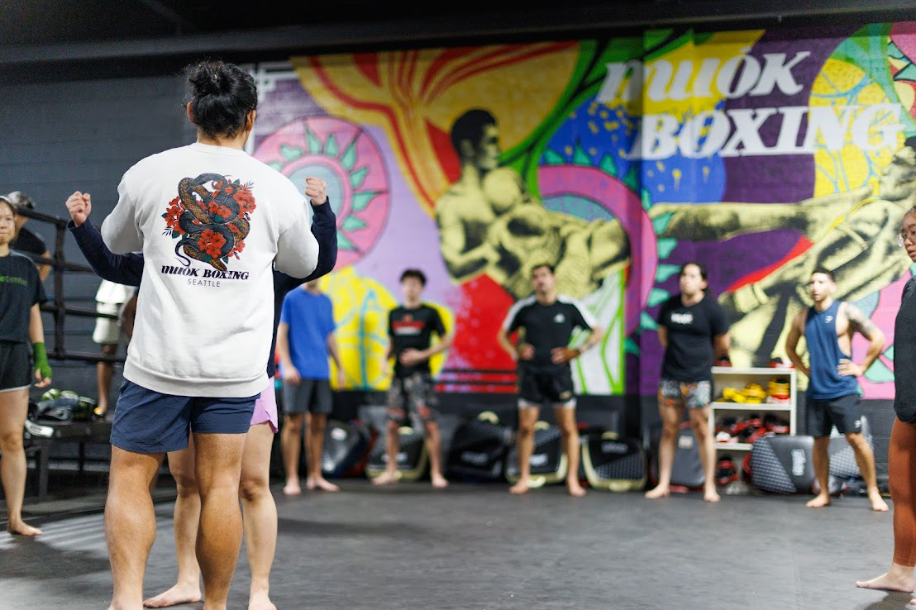
Here's what happens when an out-of-shape beginner takes their first class at a gym with real beginner programming: they gas out during the warmup. Everyone does. Skipping rope for three minutes is humbling for people who run marathons, because Muay Thai conditioning is its own thing that nobody arrives with.
Then the technical work starts, and something surprising happens: the fitness gap stops mattering. Learning to throw a jab or check a kick is a coordination problem, not a conditioning problem. The person next to you who does CrossFit five days a week is just as confused by their hips as you are. For most of the class, you're learning, resting between rounds, drilling again. It's interval work by accident, scaled by nature to whatever pace you can hold.
Nobody is watching you struggle, either. This fear deserves a direct answer: everyone in that room is too busy managing their own left kick to audit yours, and the experienced people remember their own first month too well to judge anyone else's.
You don't get in shape to train. You train, and shape follows.
What the First Two Months Look Like
WK 1–2
You're sore in muscles you didn't know existed, mostly hips, calves, and shoulders. You take breaks during class. Taking breaks is normal and expected; pushing to keep up with people who've trained for a year is how beginners get hurt, and a good coach will tell you to slow down before you think to.
WK 3–4
The soreness fades from "everything" to "whatever we drilled hardest." You make it through warmups without bargaining with yourself. Combinations start to feel like movements instead of instructions.
WK 5–8
This is where it flips. Rounds that wrecked you in week one are just work now. Clothes fit differently. And somewhere in here, you stop thinking of class as exercise, because you're too focused on finally landing that switch kick. That's the trick of the whole sport: the conditioning happens while your attention is elsewhere.
The Actual Prerequisites
There are only two, and neither is fitness. Show up consistently — twice a week is enough to progress, and our schedule has seventeen classes a week so "no time that works" is hard to claim. And leave your ego at the door, which for beginners mostly means resting when you need to and letting the technique be bad for a while. Everyone's was.
If you're deciding between gym types more broadly, we wrote an honest comparison of every kind of beginner gym in Seattle — but if the reason you haven't started anywhere is the fitness question, that answer doesn't change by gym type. Waiting doesn't work at any of them.
Common Worries, Answered Straight
Should I lose weight before I start?
No. This is the same trap as "get fit first" with a scale attached. Muay Thai is one of the most effective training styles there is for body composition, and it comes with coaching, structure, and people who notice when you skip. Whatever your weight does, it'll do faster with training than while preparing to train.
Am I too old for this?
Our beginner classes regularly have people in their 40s and 50s starting from zero. You'll pace yourself differently than the 25-year-olds and be sore in different places. That's roughly the whole difference. The technique doesn't care how old you are.
What if I have an old injury?
Tell your coach before class and they'll modify around it. This is also a place where our gym is unusual: our coaching staff includes multiple Doctors of Physical Therapy, and Root Physical Therapy operates in our building. If an old knee or shoulder is the thing between you and starting, there's an entire clinical team a few steps from the mats whose job is exactly that problem.
How out of shape is too out of shape?
If you can walk into the building, you can take a beginner class, because everything in it scales: pace, rest, intensity, all adjustable to the person doing it. If you have a medical condition that makes you unsure, check with your doctor first — that's the only real gate.
Will the first class hurt?
During? Not really — beginner classes are drilling and padwork, not getting hit. After? You'll be sore for a few days, the ordinary kind that comes with any new training. We covered the full first-three-months picture, gear included, in our complete beginner's guide.
Start Before You're Ready
Your first class at Muók Boxing is free. Come as you are — the shape you're in today is the shape every single person on our floor started in.
Book Your Free Trial Class6332 6th Ave S Unit A · Georgetown, Seattle · muokboxing.com
What Is a Physical Therapy Gym? (And Why Seattle Athletes Are Switching)
Recovery · Georgetown, Seattle
What Is a Physical Therapy Gym?
Why Seattle athletes are skipping the clinic-then-nothing routine for PT and strength training under one roof.
Here's how physical therapy usually ends: your pain is mostly gone, your visits run out, and you leave with a printout of exercises you'll do for about nine days. Then the printout goes in a drawer, and a year later the same injury is back.
That's not a failure of physical therapy. It's a gap in how it's delivered. Traditional PT gets you out of pain, but pain-free and strong are different finish lines, and most clinics discharge you at the first one. The space between "cleared" and "actually resilient" is where re-injury lives.
A physical therapy gym exists to close that gap. It's exactly what it sounds like: a PT clinic and a real training gym in the same building, run as one continuous system instead of two disconnected stops. You start on the treatment table and finish under a barbell, without ever changing addresses or starting over with someone who's never seen your chart.
Seattle has one in Georgetown: Root Physical Therapy, operating inside the same building as Root Strength and Muók Boxing. Here's how the model works and who it's built for.
The Problem With the Usual PT Experience
Most physical therapy follows insurance logic, not athletic logic. Coverage typically ends when symptoms do, so care stops at "you can walk without pain" rather than "your knee can absorb force again." For someone whose goal is getting back to lifting, running, climbing, or fighting, that leaves the hardest part of recovery — rebuilding real strength and confidence in the injured tissue — entirely on you, in a commercial gym, with no plan.
Research on return-to-sport backs up what most people learn the hard way: coming back too early, without rebuilding strength, is one of the biggest predictors of getting hurt again. The rehab didn't fail. It just stopped early.
How the Root PT Model Works: Three Phases
01
One-on-One Physical Therapy
Phase One · The Treatment Table
Care starts with a Doctor of Physical Therapy, one-on-one. Evaluation, hands-on treatment, and early loading — the clinical work of getting tissue healing and pain under control. Because your PT also works steps from a full training floor, your rehab is planned from day one with the end goal in sight: not just less pain, but a return to the thing you actually do.
02
The PT-to-Performance Bridge
Phase Two · Earned, Not Automatic
This is the phase most clinics don't have. When your PT clears you, you move to coordinated care between a Rehabilitation Strength Specialist and your physical therapist — structured strength training built on top of your rehab, not instead of it. The two work from the same plan in the same building, so nothing gets lost in a handoff.
Entry to the Bridge is earned. Your PT decides when you're ready, because loading tissue before it's prepared is how setbacks happen.
03
The Continuation Period
Phase Three · Graduation
When you graduate from care, you receive two complimentary weeks of access to Root Strength — the training gym downstairs from the treatment room. Instead of a printout and a handshake, you get a runway: real programming, real equipment, and time to make training a habit before deciding what comes next.
The treatment table got you ready. The gym floor makes you stronger.
Who a Physical Therapy Gym Is For
The model was built for people whose goal is more ambitious than "stop hurting":
Athletes coming back from injury — lifters, runners, climbers, and fighters who need a knee, shoulder, or back that can take force again, not just get through a workday. Post-surgical patients who want their recovery to end at full function instead of at the visit limit. People with chronic or recurring pain — the back that "goes out" every year usually isn't a flexibility problem, it's a strength problem wearing a disguise. And desk workers whose pain came from years of not loading their body at all, for whom the gym-floor phase is the entire point.
The clinical range is wide: the team's combined background covers orthopedics, sports medicine, pelvic health, and chronic pain management. Details on specific conditions are at rootptseattle.com.
The Team
Joe Rellora
PT, DPT
Lorrainne Dizon
PT, DPT
Andy Le
PT, DPT · Muay Thai Coach
Bobby Green
PTA · Muay Thai Coach
Two of the four also coach Muay Thai on the floor upstairs, which tells you something about how this clinic thinks: these are clinicians who train and teach the movements they rehab. When a fighter comes in with a cranky shoulder or a runner with a stubborn Achilles, the person treating it has likely thrown, caught, or run through the same problem themselves.
Insurance
Root Physical Therapy is in-network with major Washington plans, with a cash-pay option for everyone else:
Coverage details vary by plan, so verify your benefits when you book — the front desk can help you check.
Common Questions
Do I need a doctor's referral to start physical therapy?
Washington is a direct-access state, which means you can see a physical therapist without a physician referral. Some insurance plans still require one for coverage, so it's worth a quick check of your specific plan — but you don't need to wait weeks for a referral appointment just to get evaluated.
How is this different from a regular PT clinic?
The clinical care is the same standard — one-on-one evaluation and treatment with a Doctor of Physical Therapy. The difference is what happens after the table: instead of being discharged with a home exercise sheet, you have a defined path onto a real training floor, with your PT and a Rehabilitation Strength Specialist coordinating the transition when you're cleared for it.
How is the Bridge different from just hiring a personal trainer?
A trainer you find after discharge has never seen your evaluation, your surgical notes, or your movement history. In the Bridge, the strength specialist and your PT work from the same plan in the same building. Your training is built on your rehab instead of starting from a blank intake form.
Can I keep training while I'm in PT?
Often, yes — and it's usually encouraged. A good plan modifies around an injury rather than shutting everything down. If you train at Muók or Root Strength already, your PT can coordinate what to push and what to protect, since it's all happening under one roof.
Where is Root Physical Therapy located?
6332 6th Ave S, Unit A, in Georgetown — the same building as Root Strength and Muók Boxing, a few minutes from SoDo, Beacon Hill, and downtown Seattle. Parking is straightforward, which anyone who's done clinic visits on Capitol Hill will appreciate.
Finish Your Recovery Strong
Doctor of Physical Therapy care in Georgetown, with a real training floor waiting on the other side of it. Most major Washington insurance accepted.
Schedule at Root Physical Therapy6332 6th Ave S Unit A · Georgetown, Seattle · rootptseattle.com
The Best Gyms for Beginners in Seattle
Beginner's Guide · Seattle
The Best Gyms for Beginners in Seattle
An honest guide to every type of gym in this city — and which one you'll actually still be going to in six months.
Most people who join a gym in January have stopped going by March. Usually it's not laziness. They picked a gym built for people who already know what they're doing, then blamed themselves when it didn't stick.
If you're searching for a beginner-friendly gym in Seattle, you've probably noticed that every gym claims to be one. Big-box chains, boutique studios, CrossFit boxes, climbing gyms, martial arts schools — all of them say "all levels welcome." Most of them mean it. But "welcome" and "built for you" are two different things.
We run a Muay Thai gym in Georgetown, so yes, we have a horse in this race. But we've also met a lot of people who walked in here after two or three failed gym memberships, convinced the problem was them. It wasn't. So here's the guide we wish someone had handed them: every type of gym in Seattle, who each one actually serves, and what to check before you hand over a card number.
What Beginners Actually Need (It's Not Motivation)
Four things keep beginners training past the honeymoon phase: structure (you walk in and someone tells you what to do), coaching (someone watches you and fixes things, so you improve instead of guessing), community (people learn your name and notice when you disappear for two weeks), and progression (you can feel yourself getting better at something, not just more tired).
Every gym below gets measured against those four.
Every Type of Gym in Seattle, Ranked for Beginners
Big-Box Gyms
Best for: self-directed people with an existing plan
Cheap, everywhere, open long hours. If you already know how to train, a $30/month membership with rows of equipment is real value. The problem is that nothing in the building tells you what to do. You walk past forty machines, use the treadmill and the two you recognize, and leave feeling vaguely like you did it wrong. Do that three times a week with nobody noticing whether you show up, and March arrives fast.
The honest verdict: a fine second gym. A hard place to be a beginner.
Boutique Fitness Studios
Best for: people who want a hard workout with no learning curve
Seattle is full of these — interval studios, spin, bootcamps, hot yoga. They solve the structure problem completely: show up, follow the class, sweat, leave. Instructors are energetic and the rooms are nice. The trade-off is that most of these are workouts, not skills. There's no curriculum that builds week over week, so the thing keeping you coming back is the workout itself. For some people that's plenty. For a lot of beginners, exercise for its own sake stops being enough right around the time the novelty does. And at Seattle boutique prices, a half-used class pack stings.
The honest verdict: great structure, weak progression. Fun for months, rarely years.
CrossFit
Best for: people motivated by intensity and measurable numbers
Credit where it's due: CrossFit figured out community better than almost anyone in fitness. People know your name, celebrate your PRs, and text you when you disappear. A good box with patient coaches is a legitimately great place to learn to lift. The caution is that the format puts intensity first: complex barbell lifts, performed fast, under fatigue. At a great gym, coaches scale everything down for new people. At an average one, beginners end up in workouts their technique isn't ready for, and their lower back finds out first.
The honest verdict: strong community and progression — if you vet the coaching hard.
Climbing Gyms
Best for: puzzle-brained people who hate feeling like they're exercising
Seattle might be the best climbing-gym city in the country, and we're not going to pretend otherwise: climbing is an excellent way to start. It's a skill, so there's real progression. The community is famously welcoming. And because you're busy solving a problem on the wall, the workout sneaks up on you. The gaps: coaching costs extra, there's not much cardio in it, and finger injuries are common in year one, when enthusiasm outruns tendon strength.
The honest verdict: one of the two best beginner options in Seattle. (You can guess the other.)
Structured Martial Arts — Muay Thai & Boxing
Best for: people who want fitness to be a side effect of learning something
This is our world, so read this card knowing that. Martial arts is the only option on this list that covers all four things at once. Classes are fully structured. A coach corrects you every session. You train with the same people every week. And there's a skill ladder you can keep climbing for years. The conditioning shows up as a byproduct of practicing, which is exactly why it sticks.
The catch is the intimidation factor, and it's the one thing you have to vet. A gym that throws beginners into all-levels classes with experienced fighters on day one is not a beginner gym, no matter what the website says. Look for a dedicated beginner curriculum — a program explicitly built for people with zero experience, with a defined path out of it.
The honest verdict: the strongest retention formula in fitness — if the gym has real beginner programming.
Nobody drills a left kick for the calories. When training is about learning, the fitness takes care of itself.
The Question That Actually Decides It
Don't ask which gym is best. Ask: what would get me through the door on a rainy Tuesday in February when I'm tired?
If the answer is a class that starts at 6:30 whether you feel like it or not, a coach who notices you're there, and a technique you almost had last week, you want a skill-based gym. If the answer is doing your own thing quietly with headphones on, then a big-box membership is the right call for you, and don't let anyone talk you out of it.
If You Land on Muay Thai, Here's What to Look For
We wrote a full breakdown of what beginners should expect from Muay Thai in Seattle — gear, soreness, class structure, the first three months. The short version for gym-shopping: demand a real beginner program, coaches who explain mechanics instead of just yelling "harder," and a trial class before any commitment. If a gym can't tell you exactly how they teach someone with zero experience, keep looking.
Why Beginners Choose Muók Boxing
Muók Boxing sits in Georgetown, minutes from SoDo, Beacon Hill, and Columbia City, and beginners are the center of how we built the gym — not an afterthought bolted onto a fighters' program.
That looks like: a structured beginner curriculum with a clear graduation path, 17 classes a week across beginner and experienced levels so you're never the new person drowning in an advanced room, a coaching staff that includes multiple Doctors of Physical Therapy who care as much about how you move as how hard you hit, and a 9,000+ square foot facility with open gym hours seven days a week. And if you want strength training alongside your striking, Root Strength operates under the same roof. Same address, same front door.
Month-to-month membership. No enrollment fees. No contracts. Your first class is free — come stand in the room and see whether it feels like somewhere you'd show up on that rainy Tuesday.
Beginner Questions, Answered Straight
Do I need to be in shape before I join a gym?
No — and this belief keeps more people out of gyms than anything else. Getting in shape is what the gym is for. Any beginner program worth joining meets you exactly where you are, whether that's "ran a half marathon last year" or "haven't exercised since high school."
Am I too old to start something like Muay Thai or climbing?
Our beginner classes regularly have people in their 40s and 50s starting from zero. Skill-based training scales to the person doing it: you'll go at your pace, and you'll be sore in different places than the 25-year-olds. That's about the extent of the difference.
How much should a beginner expect to spend on a gym in Seattle?
Roughly: big-box runs $10–50/month, climbing gyms $90–120, boutique studios $150–250+ depending on class packs, and CrossFit or martial arts typically $150–220. The better math is cost per month you actually attend — a cheap membership you quit in March is the most expensive kind.
What if I try a gym and hate it?
Then it cost you nothing, which is the whole point of trial classes. Don't sign a contract at a gym you haven't stood in. Every good gym in Seattle will let you try a class first, and you should be suspicious of any that won't.
Can I combine two of these?
Yes, and plenty of people do. A lot of our members pair Muay Thai with strength training, which is exactly why Root Strength shares our building. Just start with one and make it a habit first. Two new routines at once is how you end up with zero.
Start Where You'll Actually Stay
Try your first class free at Muók Boxing in Georgetown. A structured beginner program, coaches who explain the why, and a room where being new is normal.
Book Your Free Trial Class6332 6th Ave S Unit A · Georgetown, Seattle · muokboxing.com
What We Took From Thai Camps — and What We Deliberately Changed
What We Took From Thai Camps — and What We Deliberately Changed
Thai camps and American gyms train differently for real reasons. Here's the honest accounting of what we imported whole, what we adapted, and why each choice was made.

Anyone who's trained in Thailand comes home changed — and slightly confused about why Western gyms do things so differently. Anyone who's only trained in the West eventually wonders whether the Thai way is "more authentic" and the class format is a compromise. Both questions deserve a straight answer, because this gym is deliberately built from both traditions.
How a Thai Camp Actually Runs
A traditional camp isn't a class business; it's a fighter factory that doubles as a home. Fighters — many of them kids from the provinces, fighting to support their families — live at the gym. Training runs twice a day, six days a week: the long morning run, then hours of bagwork, pads with trainers, clinch, and sparring, repeated again in the afternoon.
There's no curriculum and no lesson plan. You learn by doing your rounds, by one-on-one time on the pads, by clinching with seniors daily, and — as we covered in the Open Training piece — by watching, endlessly, from the ring apron. Knowledge flows senior to junior by osmosis. The trainer fixes you when you need fixing. Otherwise, you train.
It works spectacularly — for its purpose: producing professional fighters from people who train forty hours a week and have watched Muay Thai since birth.
Why Copying It Wholesale Would Fail Here
Our members are software engineers, nurses, students, and parents who train four hours a week, started as adults, and mostly don't plan to fight. Drop them into a pure camp model and predictable things happen: beginners flounder without structure — they don't have the childhood of ringside watching that makes "just train" workable in Thailand — progress stalls without a path, and the time-crunched get inefficient sessions.
The camp model assumes volume: enough hours that learning happens by immersion. Western hobbyist schedules don't have that volume, so structure has to do what volume would. That's not a downgrade. It's engineering for a different input.
What We Imported Whole
Daily clinch. Thai camps clinch every day; most Western gyms barely clinch at all. We sided with Thailand completely — here's the full argument — because the clinch is half the art, and it only develops through frequency.
Light, playful sparring as the default. Thai fighters spar light and smile doing it, saving the wars for fight night. We imported that culture wholesale: technical sparring is the default, hard rounds happen by coach approval only, and sparring is always optional.
Unstructured training time. Open Training — Tuesday and Thursday afternoons — is the camp's afternoon session transplanted to Georgetown: arrive anytime, run your own work, coaches on the floor, watching counts, knowledge moving sideways.
The culture of respect. The wai. Care for training partners. Humility toward the art and its history. Seniors responsible for juniors. "Zero ego" isn't our slogan by accident — it's the Thai camp's social contract, translated.
What We Deliberately Built Differently
A structured beginner path. Instead of "jump in and survive," beginners get their own group with their own coach in every evening class, a rotating curriculum, and a clear graduation point — around 30 classes — into the experienced group. Structure substitutes for the immersion volume a hobbyist can't give. It's the fastest route to the point where camp-style training starts working for you. And once you're there, the training deliberately loosens. That's by design too.
Recovery as a system. Thai camps run on youth: teenagers recover from double sessions because they're teenagers. Our members are adults with jobs, so we built what a camp never needed — a cedar sauna on-site, physical therapists in the building, and strength programming next door. Same goal as the camp masseur oiling fighters at dawn. Modernized for people who are 38 and have a meeting at nine.
Fighting as an option, not the point. In Thailand, the fight is the economic engine — everything serves it. Here, most members train for the art, the fitness, and the community, and the program treats that as fully legitimate rather than as failed fighter development.
The Filter Every Choice Runs Through
Keep what makes Muay Thai Muay Thai — the techniques, the clinch, the sparring culture, the respect — and adapt only the delivery system to the people actually in the room.
And it means being honest about what has to change when the students, the schedule, and the century are different. That's the gym we built.
Camp soul, Seattle engineering. Want to feel the blend? Your first class is free.
Training Muay Thai in Your 30s, 40s, and Beyond
Training Muay Thai in Your 30s, 40s, and Beyond
"Am I too old to start?" is the question people type into Google before they find the courage to walk in. Short answer: no. Longer answer below — without the pep-talk fluff.
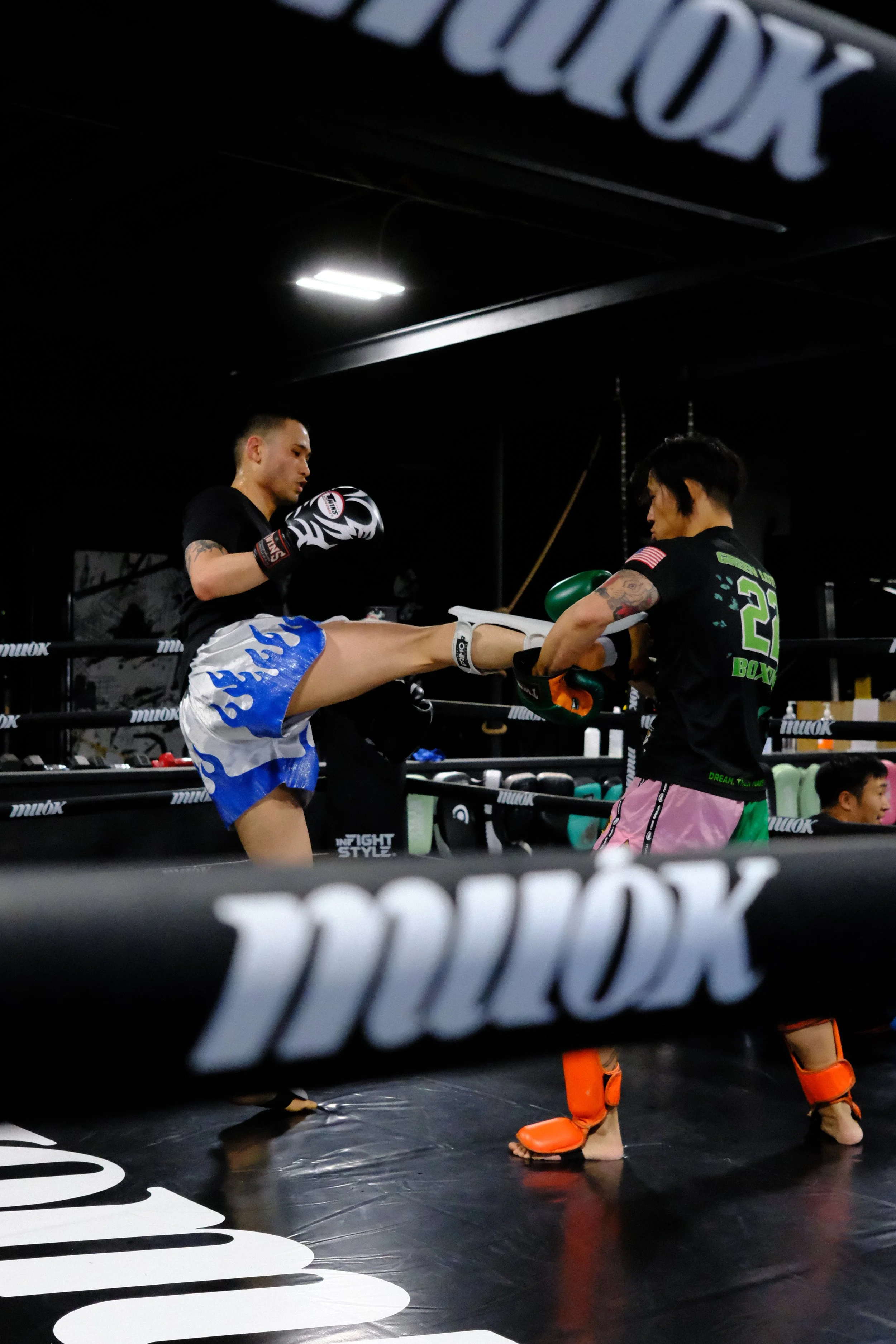
Not only are you not too old — adults who start in their 30s, 40s, and 50s are consistently some of our best students. And the way this gym is built has a lot to do with why. Here's the honest version.
Yes, Some Things Are Different at 40
You recover slower. Old desk-job stiffness shows up in your hips the first time you throw a kick. And you can't train recklessly and get away with it, because your body now invoices you for mistakes instead of letting them slide.
Here's what people miss: none of those are obstacles to Muay Thai. They're obstacles to training Muay Thai badly — and training badly is optional. The gym-war, no-days-off, push-through-everything model breaks 25-year-olds too; it just breaks them slower, so they mistake durability for a system. Adults don't have that luxury, which forces them to train intelligently from day one. That turns out to be an advantage.
Why Older Beginners Often Progress Faster
You listen. Twenty-two-year-olds want to hit hard — we wrote a whole article about why that backfires. Adults actually follow the instruction, drill the boring fundamentals, and build correct mechanics the first time. As that article explains, that's the fast path.
You're patient with process. You've learned hard things before — careers, instruments, parenting. You know the plateau is part of the curve, not the end of it, and you don't quit at month five because progress got quiet.
And Muay Thai is on your side. Speed peaks young; timing, distance, and composure keep improving for decades. Watch the legends who stayed great deep into their careers — they weren't outrunning anyone. They were reading everyone. Those are exactly the skills our technical sparring culture develops, which is why light, controlled training doesn't just protect older bodies. It plays to older strengths.
How This Gym Is Specifically Built for You
A real on-ramp. Every evening class splits into a beginner group with its own coach. You will never be thrown into the deep end with 24-year-old athletes as your measuring stick. Everything scales; nobody sits out.
No gym wars. Sparring is always optional, technical is the default, and hard rounds happen only with coach approval. Nobody here is allowed to shorten your training career for fun — which is precisely how you get to train this art for decades.
Recovery in the building. A 12-person cedar sauna comes with membership, and — this part genuinely doesn't exist at other gyms — Root Physical Therapy is on-site: Doctors of Physical Therapy who also coach here, with most major insurance accepted. The tweak you'd normally ignore for six months gets handled by someone who has watched you train and knows exactly what your body's being asked to do.
Strength next door. Muscle and bone density become the long game after 35, and Root Strength runs evidence-based strength programming in the same building. The combined membership exists largely because of members like you.
Consistency over intensity. Three moderate sessions a week beats one heroic one followed by four days of ibuprofen. Frequency is what your body adapts to.
Warm up like it matters — because it now does. Arrive a few minutes early. Your hips will thank you at month three.
Say things early. A tight calf mentioned to a coach — or a physical therapist twenty feet away — this week is a footnote. Ignored for two months, it's a layoff.
Use the sauna. It's not a luxury; it's part of the program.
Measure against yourself only. Your rival is you-from-last-month, not the college kid on the next bag. Give it a year and he'll be asking you about timing.
Your first class is free. Come see how many people your age are already on the mats. It's more than you think.