The Best Gyms for Beginners in Seattle
Beginner's Guide · Seattle
The Best Gyms for Beginners in Seattle
An honest guide to every type of gym in this city — and which one you'll actually still be going to in six months.
Most people who join a gym in January have stopped going by March. Usually it's not laziness. They picked a gym built for people who already know what they're doing, then blamed themselves when it didn't stick.
If you're searching for a beginner-friendly gym in Seattle, you've probably noticed that every gym claims to be one. Big-box chains, boutique studios, CrossFit boxes, climbing gyms, martial arts schools — all of them say "all levels welcome." Most of them mean it. But "welcome" and "built for you" are two different things.
We run a Muay Thai gym in Georgetown, so yes, we have a horse in this race. But we've also met a lot of people who walked in here after two or three failed gym memberships, convinced the problem was them. It wasn't. So here's the guide we wish someone had handed them: every type of gym in Seattle, who each one actually serves, and what to check before you hand over a card number.
What Beginners Actually Need (It's Not Motivation)
Four things keep beginners training past the honeymoon phase: structure (you walk in and someone tells you what to do), coaching (someone watches you and fixes things, so you improve instead of guessing), community (people learn your name and notice when you disappear for two weeks), and progression (you can feel yourself getting better at something, not just more tired).
Every gym below gets measured against those four.
Every Type of Gym in Seattle, Ranked for Beginners
Big-Box Gyms
Best for: self-directed people with an existing plan
Cheap, everywhere, open long hours. If you already know how to train, a $30/month membership with rows of equipment is real value. The problem is that nothing in the building tells you what to do. You walk past forty machines, use the treadmill and the two you recognize, and leave feeling vaguely like you did it wrong. Do that three times a week with nobody noticing whether you show up, and March arrives fast.
The honest verdict: a fine second gym. A hard place to be a beginner.
Boutique Fitness Studios
Best for: people who want a hard workout with no learning curve
Seattle is full of these — interval studios, spin, bootcamps, hot yoga. They solve the structure problem completely: show up, follow the class, sweat, leave. Instructors are energetic and the rooms are nice. The trade-off is that most of these are workouts, not skills. There's no curriculum that builds week over week, so the thing keeping you coming back is the workout itself. For some people that's plenty. For a lot of beginners, exercise for its own sake stops being enough right around the time the novelty does. And at Seattle boutique prices, a half-used class pack stings.
The honest verdict: great structure, weak progression. Fun for months, rarely years.
CrossFit
Best for: people motivated by intensity and measurable numbers
Credit where it's due: CrossFit figured out community better than almost anyone in fitness. People know your name, celebrate your PRs, and text you when you disappear. A good box with patient coaches is a legitimately great place to learn to lift. The caution is that the format puts intensity first: complex barbell lifts, performed fast, under fatigue. At a great gym, coaches scale everything down for new people. At an average one, beginners end up in workouts their technique isn't ready for, and their lower back finds out first.
The honest verdict: strong community and progression — if you vet the coaching hard.
Climbing Gyms
Best for: puzzle-brained people who hate feeling like they're exercising
Seattle might be the best climbing-gym city in the country, and we're not going to pretend otherwise: climbing is an excellent way to start. It's a skill, so there's real progression. The community is famously welcoming. And because you're busy solving a problem on the wall, the workout sneaks up on you. The gaps: coaching costs extra, there's not much cardio in it, and finger injuries are common in year one, when enthusiasm outruns tendon strength.
The honest verdict: one of the two best beginner options in Seattle. (You can guess the other.)
Structured Martial Arts — Muay Thai & Boxing
Best for: people who want fitness to be a side effect of learning something
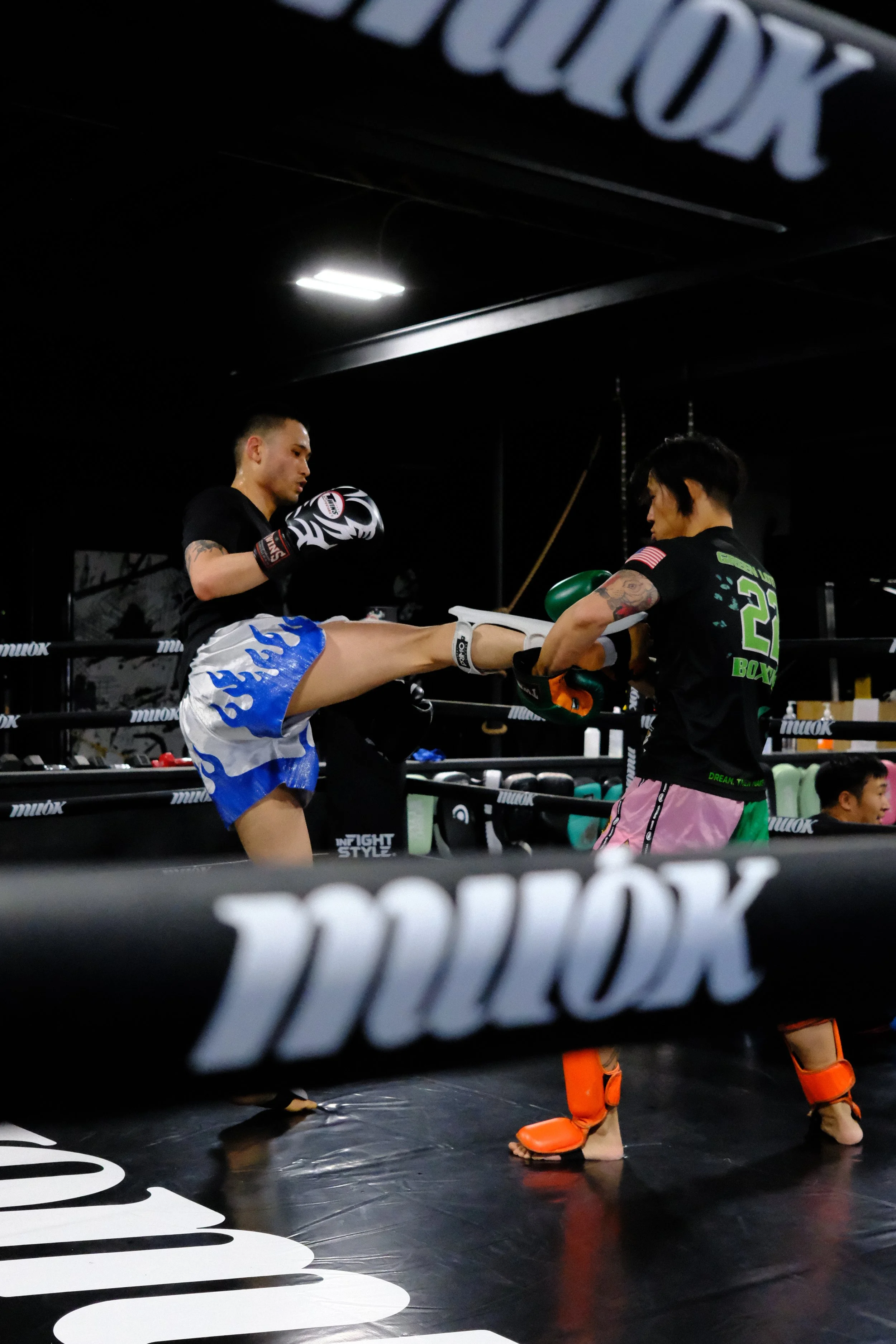
This is our world, so read this card knowing that. Martial arts is the only option on this list that covers all four things at once. Classes are fully structured. A coach corrects you every session. You train with the same people every week. And there's a skill ladder you can keep climbing for years. The conditioning shows up as a byproduct of practicing, which is exactly why it sticks.
The catch is the intimidation factor, and it's the one thing you have to vet. A gym that throws beginners into all-levels classes with experienced fighters on day one is not a beginner gym, no matter what the website says. Look for a dedicated beginner curriculum — a program explicitly built for people with zero experience, with a defined path out of it.
The honest verdict: the strongest retention formula in fitness — if the gym has real beginner programming.
Nobody drills a left kick for the calories. When training is about learning, the fitness takes care of itself.
The Question That Actually Decides It
Don't ask which gym is best. Ask: what would get me through the door on a rainy Tuesday in February when I'm tired?
If the answer is a class that starts at 6:30 whether you feel like it or not, a coach who notices you're there, and a technique you almost had last week, you want a skill-based gym. If the answer is doing your own thing quietly with headphones on, then a big-box membership is the right call for you, and don't let anyone talk you out of it.
If You Land on Muay Thai, Here's What to Look For
We wrote a full breakdown of what beginners should expect from Muay Thai in Seattle — gear, soreness, class structure, the first three months. The short version for gym-shopping: demand a real beginner program, coaches who explain mechanics instead of just yelling "harder," and a trial class before any commitment. If a gym can't tell you exactly how they teach someone with zero experience, keep looking.
Why Beginners Choose Muók Boxing
Muók Boxing sits in Georgetown, minutes from SoDo, Beacon Hill, and Columbia City, and beginners are the center of how we built the gym — not an afterthought bolted onto a fighters' program.
That looks like: a structured beginner curriculum with a clear graduation path, 17 classes a week across beginner and experienced levels so you're never the new person drowning in an advanced room, a coaching staff that includes multiple Doctors of Physical Therapy who care as much about how you move as how hard you hit, and a 9,000+ square foot facility with open gym hours seven days a week. And if you want strength training alongside your striking, Root Strength operates under the same roof. Same address, same front door.
Month-to-month membership. No enrollment fees. No contracts. Your first class is free — come stand in the room and see whether it feels like somewhere you'd show up on that rainy Tuesday.
Beginner Questions, Answered Straight
Do I need to be in shape before I join a gym?
No — and this belief keeps more people out of gyms than anything else. Getting in shape is what the gym is for. Any beginner program worth joining meets you exactly where you are, whether that's "ran a half marathon last year" or "haven't exercised since high school."
Am I too old to start something like Muay Thai or climbing?
Our beginner classes regularly have people in their 40s and 50s starting from zero. Skill-based training scales to the person doing it: you'll go at your pace, and you'll be sore in different places than the 25-year-olds. That's about the extent of the difference.
How much should a beginner expect to spend on a gym in Seattle?
Roughly: big-box runs $10–50/month, climbing gyms $90–120, boutique studios $150–250+ depending on class packs, and CrossFit or martial arts typically $150–220. The better math is cost per month you actually attend — a cheap membership you quit in March is the most expensive kind.
What if I try a gym and hate it?
Then it cost you nothing, which is the whole point of trial classes. Don't sign a contract at a gym you haven't stood in. Every good gym in Seattle will let you try a class first, and you should be suspicious of any that won't.
Can I combine two of these?
Yes, and plenty of people do. A lot of our members pair Muay Thai with strength training, which is exactly why Root Strength shares our building. Just start with one and make it a habit first. Two new routines at once is how you end up with zero.
Start Where You'll Actually Stay
Try your first class free at Muók Boxing in Georgetown. A structured beginner program, coaches who explain the why, and a room where being new is normal.
Book Your Free Trial Class6332 6th Ave S Unit A · Georgetown, Seattle · muokboxing.com