Why We Added Open Training (And Why Watching Might Be the Most Underrated Part)
Why We Added Open Training (And Why Watching Might Be the Most Underrated Part)
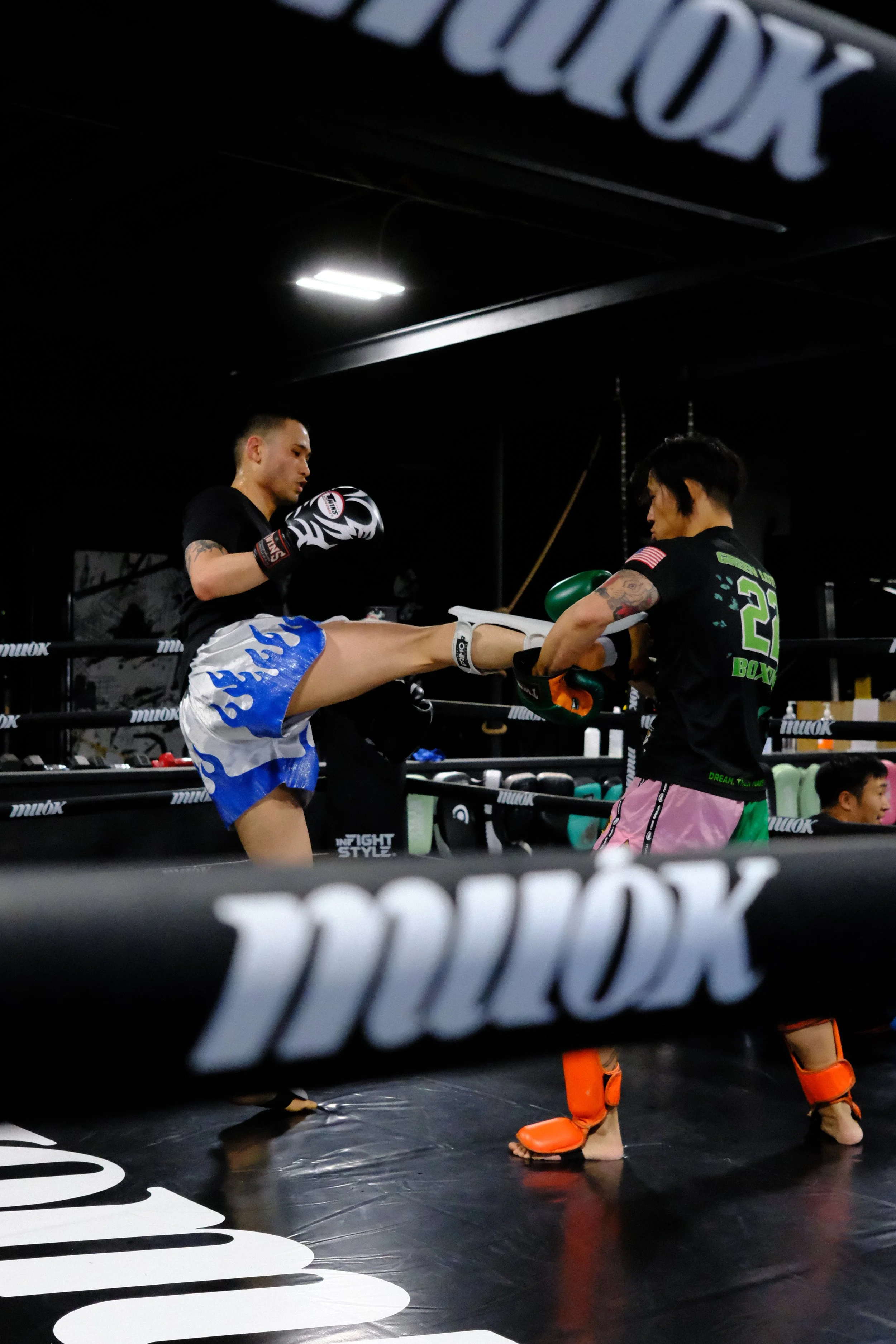
We just added something new to the schedule — and it's deliberately not a class.
Open Training runs Tuesdays and Thursdays, 3:30–5:00 PM. There's no led warm-up, no lesson plan, and minimal instruction. You arrive anytime within the window and get your work in: sparring rounds, bagwork, clinch, pads. Coaches are on the floor supervising, working with individuals, and getting their own training in. It's open to every member — the only requirement is being comfortable with a self-directed format.
If that sounds unusual for an American gym, it shouldn't. This is how Muay Thai camps in Thailand have run their afternoons forever. And there are real reasons that model produces such good fighters — reasons that have less to do with toughness and more to do with how people actually learn.
The Thing Class Time Can't Give You: Watching
A structured class is built around doing. You drill, you hit pads, you work with a partner — and that's exactly what a class should be. Repetition is how technique gets into your body.
But there's a second way humans learn movement, and it's badly underrated: observation. Motor learning research has shown for decades that watching skilled practitioners perform isn't passive — your brain rehearses what it sees, engaging many of the same neural pathways you'd use to perform the movement yourself. It's why fighters in Thailand grow up ringside before they ever grow up in the ring.
Watching does something drilling can't. Timing, setups, the way one person feels the other's balance shift, when to attack and when to wait — rhythm, distance, and decision-making are almost impossible to teach in isolation. They have to be absorbed, and absorbing takes watching.
Here's the honest gap in a normal class: you're doing so much that there's very little time to observe. Between your own rounds, your own reps, your own conditioning, you rarely get to just sit on the apron and study how the senior members put it all together. Open Training closes that gap. Come in, get your rounds — and then spend ten minutes watching two experienced people spar. Both halves count as training. In a real camp, they always have.
Learning Works Better When You're Not Exhausted
There's a second problem with trying to learn everything inside class time: by the time the interesting question occurs to you, you're usually too gassed to ask it — and too gassed to remember the answer.
That's not a character flaw; it's how the brain works. Processing new information takes attention and energy, and hard physical effort competes for both. In a 75-minute class, the priority is rightly the work itself. But it means the thinking part of your development — why that counter works, what you keep getting caught with, how to fix the hitch in your kick — gets squeezed.
Open Training flips the ratio. You dictate the pace. Work a hard round, then rest and actually think about what happened. Watch someone solve the exact problem you've been having. Walk over to a coach with the specific question you've been sitting on for two weeks — the one there's never time for mid-class — and get a real answer while your mind is fresh enough to keep it. Then go apply it, immediately, on a bag or with a partner.
No Lesson Plan Means You Have to Think — and That's a Skill
Here's the part of the camp-style format that's easiest to miss: when nobody structures the session for you, the responsibility to figure it out becomes the training.
In a class, most decisions are made before you walk in — what you'll work on, for how long, with whom, and why. That's not a flaw; it's exactly what structure is for. When you're building your foundation, having those decisions made for you frees up all your attention for learning the movements themselves. It's why our beginner program is as structured as it is, and why it should be.
But at some point, fighting stops being a movement problem and becomes a thinking problem. Solving an opponent — reading what they're doing, forming a plan, adjusting when the plan fails — is a skill of its own. And like any skill, it only develops when you're the one making the decisions. Skill-acquisition research points the same direction: practice where the learner chooses what to work on and evaluates their own performance tends to produce better long-term retention and adaptability than practice that's fully prescribed. A session that's planned for you, top to bottom, quietly does that thinking on your behalf — which is perfect early on, and limiting later.
Open Training hands the decisions back to you on purpose. Nobody tells you what today is for, so you have to ask the questions a coach normally answers: What's weak right now? What did I keep getting caught with on Tuesday? What am I building toward? Then you design the work, run it, and judge whether it worked. That's critical thinking with a heart rate — the same faculty you'll need when someone across from you refuses to cooperate with your game plan.
The Exchange Is the Point
Something else happens when you put members of every level in one room with no lesson plan: knowledge starts moving sideways.
A newer member asks a senior member how they enter the clinch, and gets a five-minute answer no curriculum could schedule. Two experienced people compare notes after a round. A coach spots something in someone's bagwork and quietly fixes a hip rotation. None of it is on a whiteboard, and all of it is training.
This is the part of camp culture we most wanted to bring into the gym. The knowledge in this room doesn't just live with the coaches — it lives across the whole community, and it transfers best in unstructured time, between rounds, when nobody's watching a clock.
And Honestly — It's Also Just Time Together
Not everything needs a performance justification. Part of what makes a gym a gym is the time between the work: hanging out, talking shop, watching your teammates get better, being around the thing you love without a timer running. Open Training is that too. Come in with no plan. Watch the room. Catch up with people before your evening class. That's not slacking off — that's what belonging to a fight gym has always looked like.