
The Plateau Is the Point
The Plateau Is the Point
Somewhere around month four to eight, progress goes quiet for almost everyone. It hasn't stopped — it's changed shape. Here's what's actually happening, and how to train through it.
Every coach here has had the same conversation a hundred times. A member pulls us aside — usually somewhere around month five or six — and says, almost like a confession: "I feel like I'm not getting better anymore."
The beginner phase, where every single class taught you something new and the progress was almost intoxicating, has quietly ended. You're still showing up. You're working just as hard. And it feels like nothing is moving. Before you do what most people do — decide you've "peaked," lose steam, and drift away — let us tell you what's actually going on. Because the plateau isn't where progress stops. It's where the real progress happens.
Early Progress Is Loud. Real Progress Is Quiet.
Beginner gains are loud because you're going from zero to something: first proper stance, first real kick, first combination that actually flows. Each one is a visible, feel-able milestone, and they arrive weekly.
Then the milestones run out — not because you stopped improving, but because improvement changed shape. What develops next is invisible from the inside: your kick gets a little sharper, your reactions shave a beat, your balance recovers faster, your defense starts happening without you deciding. Skill research calls this the shift from rapid early acquisition to consolidation — the phase where movements migrate from conscious effort to automatic execution. Nothing new appears; everything you have gets quietly rebuilt at a deeper level. It doesn't feel like learning. It is learning — the durable kind.
Here's a test you can run on yourself right now. Think about what confused you at week two — the check you couldn't time, the combination that tangled your feet. It's automatic now, isn't it? You didn't notice it becoming automatic. That's what this phase does. It works behind your back.
The Plateau Is Where Most People Quit
Every skill worth having has a plateau, and the plateau is where most people leave — in Muay Thai, in music, in languages, in everything. Which means simply continuing to show up through this phase moves you into increasingly rare company. The members you look up to here — the smooth ones, the ones who make it look easy — every one of them spent months on the same flat ground you're standing on. The difference between them and everyone who quit isn't talent. It's that they kept attending through the boring middle.
How to Train Through It
Change what you measure. Class count, not felt progress. Your feelings are a terrible progress meter right now; attendance never lies. This is exactly why our beginner program runs on a class-count milestone instead of a vibe check.
Shrink your focus. "Get better at Muay Thai" is unmeasurable and demoralizing on a plateau. "Improve my left kick this month" is winnable. Pick one thing per month. Let the rest ride.
Use the tools built for this phase. The plateau is where film study starts paying compound interest — you finally know enough to see what the legends are doing (here's how to watch). It's where Open Training earns its keep: self-directed time to drill the specific thing, ask the specific question, watch a senior member solve the exact problem you're stuck on. And it's where technical sparring volume quietly converts everything you've consolidated into timing.
Ask a coach what they see. Here's a plateau secret: we can see your progress when you can't. Ask "what's improved in my game since summer?" and prepare to be surprised. External eyes don't share your blind spot.
Progress Comes Back as a Jump, Not a Slope
Plateaus in skill learning famously end the same way: not gradually, but all at once. Weeks of flat, then one day the sweep works, the counter fires itself, sparring feels slower — because everything consolidating underneath finally surfaced together. Everyone who's trained past a plateau knows this moment, and most of us can tell you exactly where we were standing when it happened.
It's coming for you too. The only way to miss it is to leave before it arrives.
Stuck on the flat part right now? Tell a coach — genuinely, we like this conversation. And if you're reading this before you've even started: your first class is free, and the loud, fun months are waiting.
Why We Clinch Every Day
Why We Clinch Every Day
Most gyms treat the clinch as a seminar topic. We treat it as daily bread. New members ask why we're so insistent about it — here's the honest answer.

If you look at our schedule, you'll notice something unusual for an American gym: clinch isn't a once-a-month special here. Partner drill and clinch classes run every week, and clinch work is woven into daily training. New members ask about it all the time — usually somewhere around week three, usually while catching their breath. Fair question. Here's the honest answer.
The Clinch Is Half the Art — and Most Gyms Skip It
Watch any stadium fight in Bangkok and count how much of it happens with the fighters attached to each other. The clinch isn't a stall or a break in the action, the way boxing referees treat it. In Muay Thai it's a full battlefield — knees, elbows, sweeps, off-balancing, control — with its own techniques, its own scoring weight, and its own specialists. Our Muay Khao breakdown covers the fighters who built entire legendary careers there.
Now walk into most Western gyms and watch a class. Padwork, bagwork, some sparring — and the clinch, if it shows up at all, shows up as a novelty. There are practical reasons: clinch is hard to teach in big groups, it's tiring, it can't be learned from a distance, and honestly, a lot of coaches never learned it deeply themselves. The result is a generation of Western fighters who look complete until someone grabs them.
What Daily Clinch Actually Does for You
Comfort in chaos. The clinch is the most claustrophobic place in fighting — someone controlling your posture, your balance under attack, no room to see what's coming. The only cure for that panic is exposure. Clinch a little every day and the chaos stops being chaos. It becomes a place where you can think. That composure follows you into everything else — including things that have nothing to do with fighting.
Balance you can't build any other way. Clinch work is a constant negotiation with someone who's actively trying to take your balance away. Months of it quietly rewires your base — your stance gets stronger, your kicks recover faster, you stop getting bumped off posture in exchanges. It's strength and conditioning disguised as technique.
Sensitivity. In the clinch you fight by feel — reading weight shifts, sensing when a knee is loading, feeling a sweep coming before you see it. That skill has a long learning curve, which is exactly why it has to be trained often instead of crammed. There's no shortcut. There's only time spent attached to another person.
And the conditioning is real. Ask anyone after five honest clinch rounds — nothing else in the gym gasses you quite the same way. Daily clinch is the quiet engine behind the cardio our long-term members are known for.
Little and Often Beats Rare and Heroic
Skills built on feel decay fast and compound slowly. A monthly clinch seminar teaches your brain the moves; only frequent exposure teaches your body the timing. Twenty focused minutes of clinch, several times a week, beats a three-hour workshop every time — the same logic as everything else we've written about learning this sport: reps under supervision, spaced over time, are how skills become permanent.
There's a cultural reason too. In Thai camps, clinch is daily bread — often the longest, most social part of the afternoon, seniors and juniors locked up together, laughing between rounds while quietly wrecking each other's balance. It's where technique gets passed down by touch. When we built Open Training, that tradition was part of what we wanted in the room: clinch rounds happening because people want them, not because a lesson plan said so.
"Isn't Clinch Advanced?"
The opposite, actually. Clinch is one of the safest ways to train Muay Thai live: no strikes flying at your head, intensity that naturally scales to both partners, instant feedback. Beginners here start with posture, frames, and balance — the foundations everything else in the clinch is built on — and go from there.
And you'll be surprised how fast it becomes your favorite part of class. It's the part of Muay Thai that feels most like a puzzle and least like getting hit.
Your first class is free. Come find out what the other half of Muay Thai feels like.
Five Legends Worth Copying — and What Each One Teaches
Five Legends Worth Copying — and What Each One Teaches
We told you to pick one fighter and copy everything. The obvious next question: who? Here are five, with honest notes on which kind of student each one fits.
In our beginner's guide, we gave you an unusual assignment: find one fighter you love and copy everything — techniques, rhythm, body language, down to the mannerisms. The follow-up question started coming almost immediately, in class and in our DMs: "Okay — who?"
Fair. Here are five, all from the golden era of the 1980s and '90s. Muay Thai Scholar has breakdowns of every one of them, and each teaches something different. If you've read our Styles series, you'll recognize the archetypes underneath.
Samart Payakaroon
If Muay Thai has a Mona Lisa, it's Samart: four-time Lumpinee champion across four weight classes and a boxing world champion, all of it delivered with an elegance that made beating people look like a stroll. The Muay Femur ideal — vision, timing, the teep as a steering wheel, and defense so good he always seemed to be fighting a round ahead of everyone else.
That composure is the highest skill. Copy the posture, the unhurried rhythm, the way nothing rattles him.
You value brains over brawn and want the most complete gold standard there is. Fair warning: you're copying the hardest thing in the art. Worth knowing — our own Coach Bobby learned under Samart, so around here, questions about him get answered with particular joy.
Karuhat Sor. Supawan
Ask serious students of the game to name the most skilled fighter of the golden era and Karuhat's name comes up constantly. His signature: constant stance-switching and angular movement — sliding a half-step off your centerline so his kick arrives from a direction you weren't defending. Over and over, like a man who's found a door in the ring you can't see.
That position beats power. Footwork, angles, and the switch — the geometry of the sport.
You're the puzzle-solver type, you like footwork more than trading, and you're patient enough to build movement skills that pay off later and forever.
Dieselnoi Chor. Thanasukarn
The most terrifying line on any résumé in Muay Thai: Dieselnoi retired as Lumpinee champion because nobody would fight him anymore. The ultimate Muay Khao — endless forward pressure, a strangling clinch, and knees thrown from his towering frame until opponents wilted. Relentlessness as an art form.
Pressure, conditioning, clinch dominance, and the psychological weight of someone who keeps coming. Since we clinch every day, his tape doubles as homework.
You're long, you love the clinch, or your natural gift is a gas tank rather than raw speed. Tall students especially — this is your blueprint.
Sangtiennoi Sor. Rungroj
The other half of Coach Bobby's lineage — Bobby learned under Sangtiennoi too, so this pick is personal. "The Deadly Kisser" was the fighter nobody enjoyed sharing a ring with: durable, composed under fire, brutal in the clinch and with his knees, and famous for walking through the golden era's killers with his poise intact.
Toughness as a skill — not recklessness, but the trained ability to stay technical, keep posture, and keep scoring while under real pressure.
You're the steady type. Not the flashiest in the room, but the one who never breaks. Every gym's backbone is built from students like this.
Somrak Khamsing
The trickster of the era: a southpaw stylist so evasive that opponents spent whole fights hitting air, and versatile enough to win Olympic gold in boxing for Thailand in 1996 while being an elite nak muay. Somrak barely seemed interested in hurting people — he just made hitting him impossible, then scored at will. Often with a grin.
That defense is an offense. Reading opponents, controlling distance, and the confidence that comes from being unhittable.
You're naturally slippery, you'd rather make someone miss than make them hurt, and you want the style that keeps you healthiest the longest. Also — the most fun to watch of the five. It's not close.
One thing before you dive in: don't study all five. That's a survey course, and the assignment was immersion. Watch a breakdown of each, notice which one makes you sit forward, and commit to that one for a long while. Copy everything. And mention your fighter to a coach — it changes how we coach you, and honestly, it's our favorite conversation in the gym.
Years from now, you'll borrow from the others. That's how a style gets made. For now: pick your legend.
New here? Your first class is free — come tell us which of the five you picked.
Technical Sparring: Why Going Light Makes You Dangerous
Technical Sparring: Why Going Light Makes You Dangerous
How sparring works at Muók, why we do it this way, and why the people who go light for years end up being the ones nobody can touch.
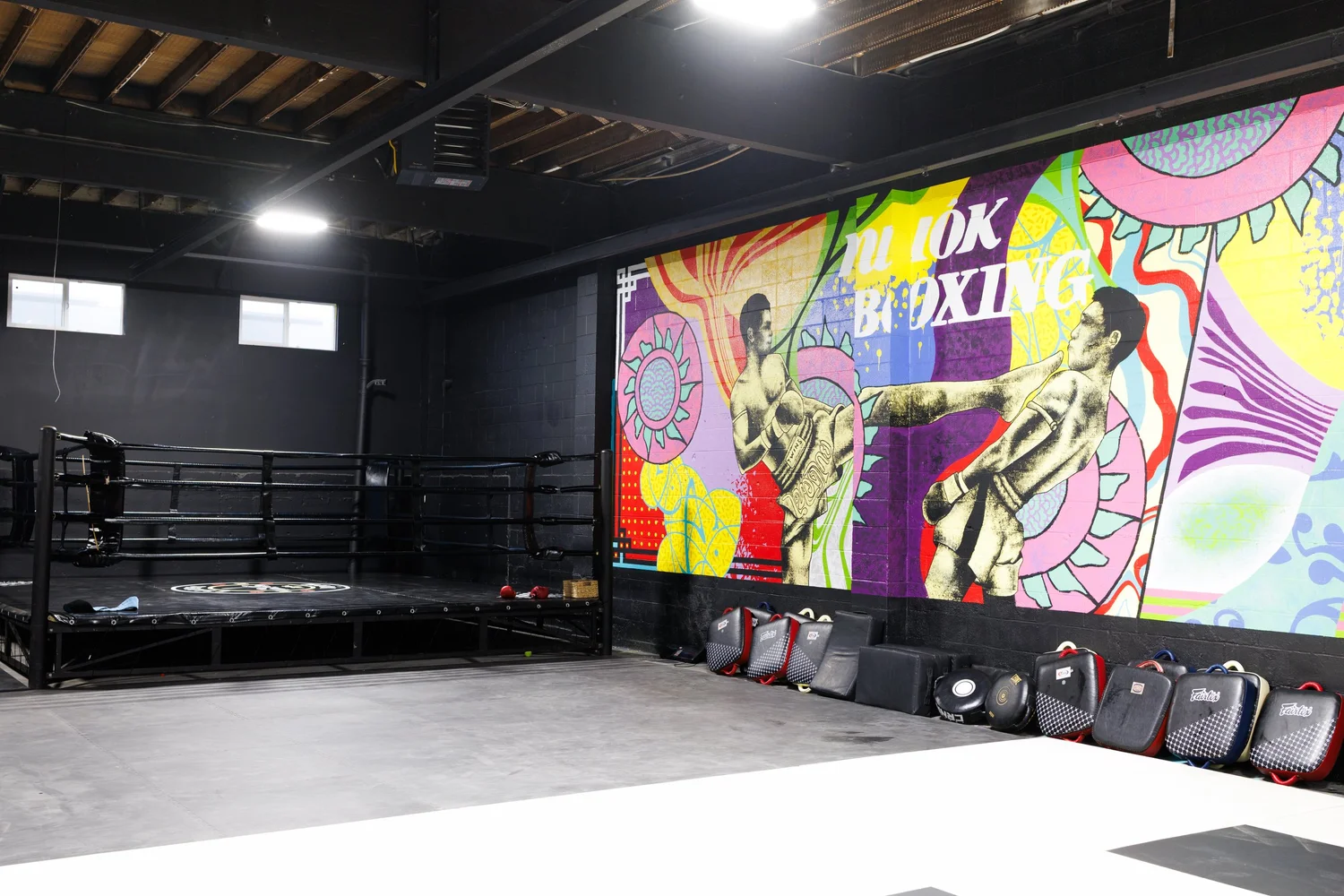
Two things surprise people about sparring here. First: sparring is optional. Plenty of our members train for years, get genuinely skilled, and never spar — and that's a completely valid way to do this. Second: when we do spar, the default is technical — controlled, playful, light contact — and hard rounds only happen with coach approval, matched pairs, and full gear.
If you came up in gym-war culture, that probably sounds soft. Here's why it's the opposite.
What Technical Sparring Actually Is
Technical sparring is live, unscripted fighting at reduced power. Real timing, real reactions, real problems — your partner is genuinely trying to touch you, and you're genuinely trying to touch them — but the contact is light enough that nobody's flinching, covering up, or protecting their week at work. Think of it as playing the game of Muay Thai at a speed where your brain can keep up.
In Thailand, this is just how sparring is done. Thai fighters — people who fight for a living, sometimes hundreds of times — spar light, smiling, almost daily. They save the wars for fight night, when they're getting paid for them. The Western gym-war tradition has it backwards: amateurs with day jobs beating each other up for free, then wondering why they're always hurt and never improving.
Why Light Builds Skill Faster Than Hard
Volume is everything, and hard sparring caps your volume. Skill grows out of live repetitions — thousands of them. If sparring hurts, you can do it maybe once a week and spend the rest of the week recovering. If sparring is light, you can do it constantly, for years. The person going light racks up ten times the live experience of the gym warrior. The math isn't close.
Fear makes you worse, and hard rounds run on fear. When getting hit really costs something, your brain stops experimenting. You retreat to your two safest techniques, tense up, and stop seeing openings — the same tension we broke down in Slow Is Smooth, now with adrenaline on top. Take the fear away and you'll actually try the sweep. You'll test the question-mark kick. You'll stay in the pocket a beat longer than feels safe and find out what actually lives there. Every skill you own, you learned relaxed first.
Your defense gets honest. This one's counterintuitive: light sparring produces better defense than hard sparring. When shots are light, partners throw more of them, with more variety — so you see far more incoming strikes per round, and you learn to deal with them by reading and moving instead of hunkering behind your gloves and eating them. Blocking everything isn't defense. It's billing the pain to your future self.
And you keep your brain. We'll say the quiet part plainly: repeated head impact adds up, and no hobbyist's progress is worth trading cognitive health for. A gym that lets members bang heads every week isn't tough. It's careless with the people it's supposed to be developing.
Watch two of our senior members do technical rounds during Open Training sometime. They're relaxed, they're smiling, it looks almost casual — and neither one can touch the other. That's what years of high-volume light work produces: speed, vision, composure, timing. The better two people get, the lighter and more creative their rounds tend to look. Right up until you're inside one and realize you can't land anything.
"But Don't Fighters Need Hard Sparring?"
The small group actually preparing to compete? Yes — controlled hard rounds have a place in a fight camp, which is exactly why they exist here by coach approval: right pairing, right timing, full protection, and a coach owning the intensity. What competitors don't need is unsupervised weekly wars. And what everyone else doesn't need is any of it.
Curious what a room full of relaxed, skilled, zero-ego sparring looks like? Come watch a class — or come take one. Nobody's going to hurt you here. That's the system working.
Slow Is Smooth: Stop Trying to Hit Hard
Slow Is Smooth: Stop Trying to Hit Hard
Every beginner makes the same mistake in their first month. Here's what it costs you, and what to do instead.
There's one mistake so common among beginners that we can predict it before your first class starts: you're going to try to hit hard.
We see it every week in the beginner group — someone brand new, shoulders up around their ears, trying to put a hole in the pad. And honestly, it makes sense. You came to a fight gym. Hitting hard feels like the point, and that loud thwack off the pads feels like progress. But trying to hit hard is exactly what's keeping you from hitting hard. Every experienced fighter learned this eventually. Most of us learned it the slow way.
What Real Power Actually Looks Like
Watch the hardest kickers in the world — the Muay Tae archetype from our Styles series — and notice something strange: they don't look like they're trying. The kick looks almost lazy right up until it lands like a car crash. That's not talent hiding effort. That's what real power actually looks like, because power comes from mechanics, and mechanics come from relaxation.
When a beginner "tries hard," what they're actually doing is flexing everything at once — shoulders up, arms rigid, breath held — which slows the whip, kills the snap, and burns triple the energy producing less force. You're pressing the gas and the brake at the same time and wondering why the car is loud but slow.
This is why the tense beginner gasses out in one round while the relaxed veteran floats through five. It's not cardio. It's braking losses.
Slow Is Smooth, Smooth Is Fast
The fix is an old training saying — you'll hear versions of it from marksmen, musicians, surgeons: slow is smooth, and smooth is fast. Practice the movement slowly enough to do it correctly — relaxed, in sequence, on balance — and speed shows up on its own, because speed is just correct mechanics with the brakes off. Practice fast and tense, and you're practicing the brakes.
A thousand tense power-punches make you permanently tense. A thousand relaxed, technical ones build the base that real power grows out of — same logic as our beginner's guide. So when a coach tells you to slow down and go lighter, we're not holding you back from the real training. That is the real training. It's the shortcut, even though it doesn't feel like one.
How to Actually Do It
Drop your shoulders and breathe out on every strike. That tss sound you hear all over the gym isn't a style thing. The exhale forces you to relax at the moment of impact, and it keeps you from holding your breath until you're gassed. If your pad holder tells you to relax twice in the same round, that's not small talk — that's the correction.
Finish the technique, not the pad. Beginners abandon their mechanics reaching for impact — leaning in, over-swinging, hands dropping. Let the pad be something your technique passes through, not something you strain toward.
Use the film to recalibrate. Next time you're studying tape, watch specifically for how relaxed the legends are — the loose shoulders, the easy rhythm, the sudden violence out of calm. That's your gold standard: not the impact, the looseness that produces it.
Muay Thai Scholar — Any Samart Breakdown
Save the power tests. There's a time to sit down on strikes and let it fly — on the heavy bag, in specific pad rounds, when a coach calls for it. Power has a place in training. It just can't be the default setting while you're still building the machine that generates it.
The Day It Sounds Different
Nobody believes this part until it happens to them. A few months into training relaxed, you'll throw a kick without trying and it'll sound different. Sharper. Heavier. Usually your partner notices before you do. That's the whip finally moving without the brakes on — and that kind of power keeps growing for years, because it's built on mechanics, not muscle.
The beginners who chase power from day one plateau at whatever their arm strength allows. The ones who chase smooth end up hitting harder than all of them.
Your first class is free — and don't worry about impressing anyone with power. We'll be more impressed by your patience.