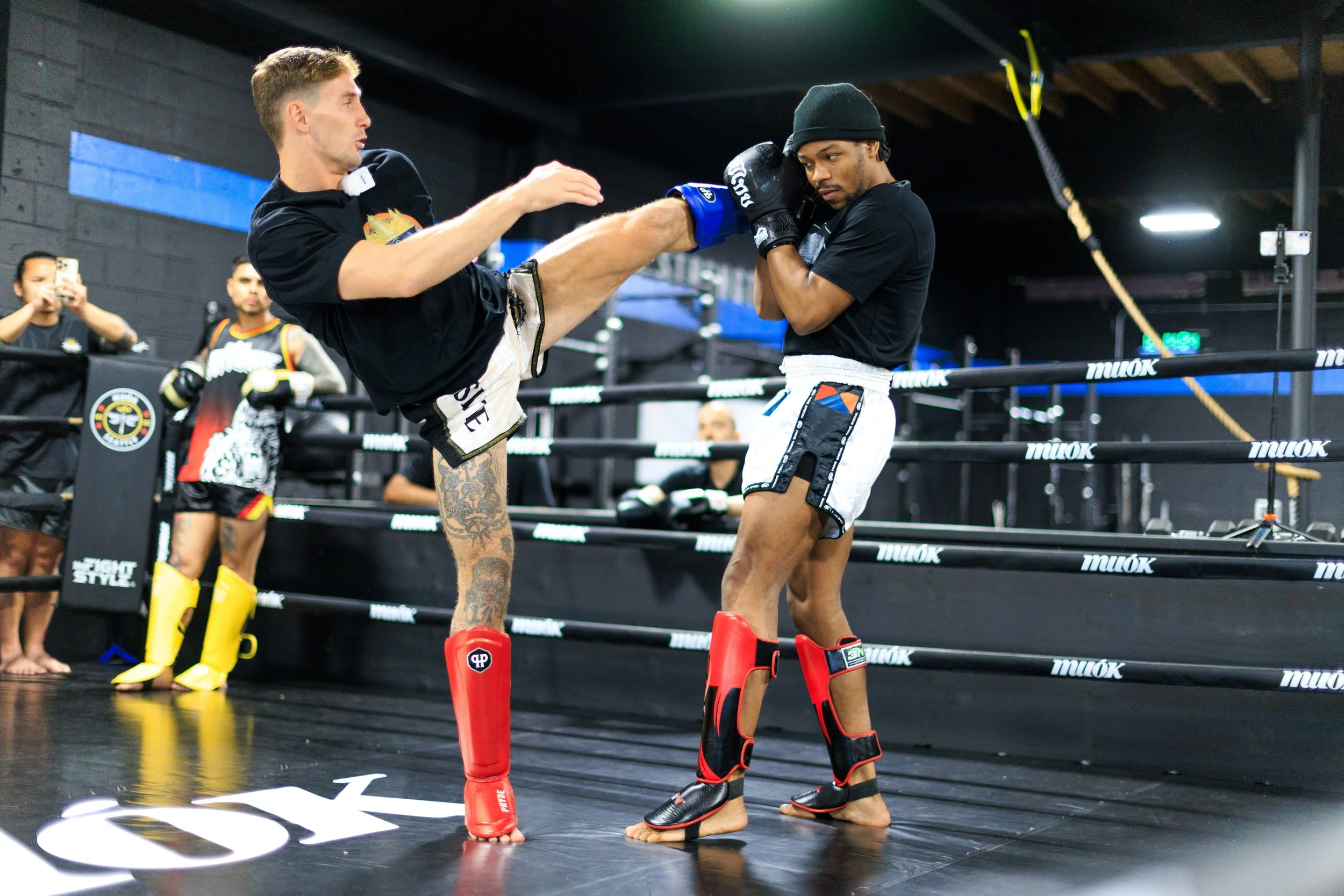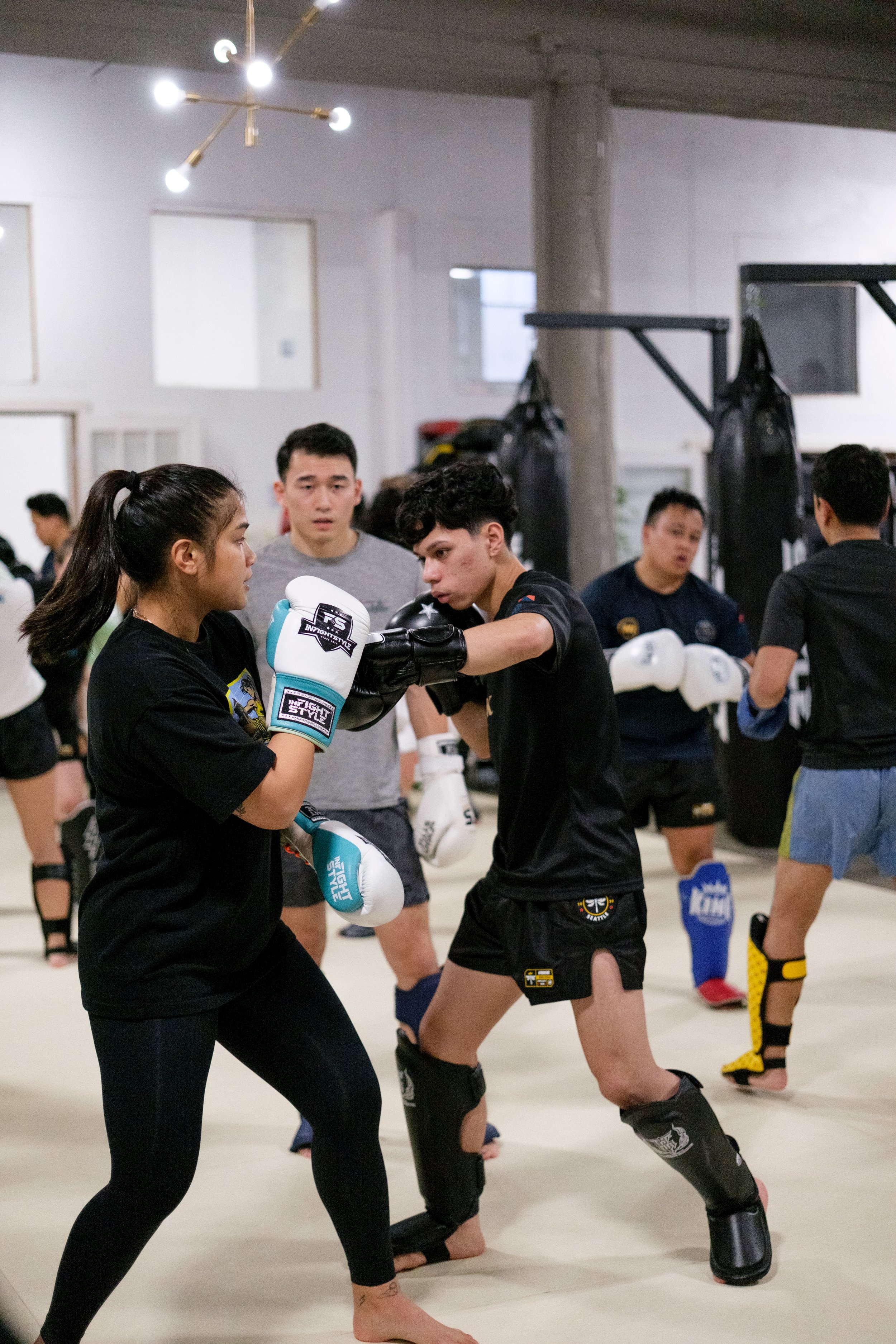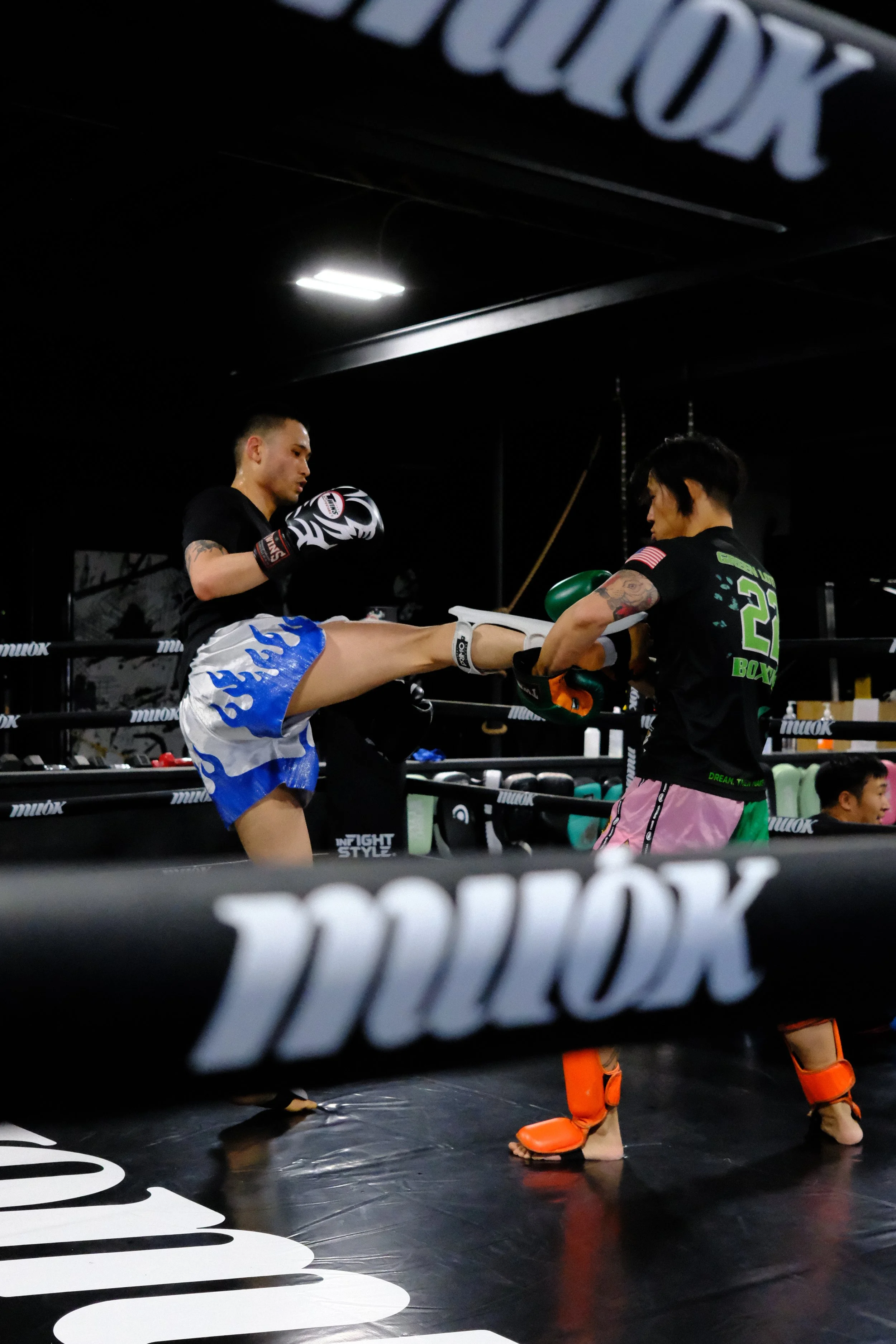
How Long Does It Take to Get Good at Muay Thai?
This is one of the questions we get asked most often. Sometimes by people who haven't started yet and are wondering whether it's worth committing to. Sometimes by members three months in who are frustrated that they don't feel "good" yet. Sometimes by people six months deep who suddenly notice they've improved and want to know what comes next.
The honest answer requires defining what "good" means — because the timeline depends entirely on that. "Good enough to enjoy training" is a very different milestone from "good enough to spar an experienced training partner" which is very different from "good enough to compete." Each one has its own timeline, and the gap between them is usually bigger than people expect.
Here's the version we tell people who actually want a real answer.
-
01What "good" actually means — and why it mattersThe single biggest reason people get the timeline wrong is they don't define what they're aiming for.
-
02The realistic timeline by milestoneClass 1 to "I feel competent" to "experienced practitioner" — what each one actually takes.
-
03What changes the timeline (and what doesn't)Athletic background, prior martial arts experience, age, and what they actually mean for your progress.
-
04The plateau every member hits — and what to do about itAround the 6-month mark, most people stall. Here's why, and how the people who break through it actually do.
-
05The thing nobody tells you about getting goodWhy the people who actually get good aren't the ones with the most talent.
First — Define What You Mean by "Good"
"Good at Muay Thai" can mean five completely different things, and the timeline depends on which one you're after. Here's what most beginners actually mean when they ask the question, ranked roughly in difficulty:
You know the basic techniques, you can follow along, you don't feel lost. You enjoy training. This is what most people actually want when they ask the question.
Your jab, cross, kick, and teep have real power and reasonable form. You can hold pads. You can do most drills cleanly. People at the gym recognize you've put in time.
You can spar a similarly-experienced partner without falling apart. You can throw what you want, defend what you see coming, and stay composed under pressure.
You can train with anyone in the gym, including more advanced members, and hold your own. You're starting to develop your own style. New members come to you with questions.
You can fight an amateur match safely and competitively. This is a different commitment level entirely — most members never aim for this, and that's fine.
Even fighters with 100+ professional fights still have things they're working on. Mastery in Muay Thai is a moving target — and that's part of why people stay.
The Realistic Timeline by Stage
This is what we actually observe at Muók for someone who trains consistently — meaning 2 to 3 classes per week, with reasonable focus during class. Less than that and the timeline stretches considerably. More than that — 4+ classes per week — and the timeline compresses, but only up to a point. Recovery and skill consolidation also take time, and they don't happen any faster just because you train more.
Within your first month, you'll start to feel like you belong. You'll know the basic stance, the jab-cross combination, the front kick (teep), and the roundhouse. You won't feel proficient yet — but you won't feel completely lost either. The discomfort of week 1 fades fast. By week 6 to 8, most members tell us they look forward to class instead of dreading the unfamiliarity.
Six months to a year of consistent training is what it takes for the basic techniques — jab, cross, hook, lead and rear roundhouse, teep, knees, basic clinch — to feel like yours rather than something you're consciously remembering. You'll be able to hold pads for a partner reasonably well. You'll throw combinations without thinking through each strike individually. This is the stage where most people start to genuinely feel like they're "doing Muay Thai" rather than just learning it.
Sparring well is its own skill, separate from technique. It requires reading your partner, managing distance, controlling your own composure, and applying technique under pressure — none of which can be learned through bag work. Most members who come to spar productively need 12 to 24 months of consistent training and gradually accumulated sparring rounds. Note that sparring is always optional at Muók — many members train long-term and never spar, and that's a completely valid path.
Three to five years of consistent training is what it takes to be the kind of training partner that makes everyone in the gym better. You'll have a developed personal style, you'll be able to coach newer members through problems they're working on, and you'll have built durability — your body adapted to the demands of the sport rather than fighting them. This is also where Muay Thai stops feeling like something you're learning and starts feeling like something you do.
Amateur competition readiness depends heavily on athletic background. Someone from a wrestling or boxing background can be ready for an amateur fight in 1–2 years. Someone starting from no athletic base typically needs 3–4 years. Either way, this stage requires a different commitment level — most members aren't aiming for this, and that's perfectly fine. Muay Thai is far more often a long-term practice than a competitive pursuit.
Most people overestimate what they can do in 3 months and dramatically underestimate what they can do in 3 years. Muay Thai is one of the clearest examples of this we see.
What Changes the Timeline (And What Doesn't)
People often ask whether their athletic background, age, or previous experience will speed things up or slow them down. The honest answer is — some things matter a lot, and some things matter much less than people think.
What actually speeds things up
Frequency, more than intensity. Three 90-minute sessions per week beats two hard 2-hour sessions. Your nervous system needs reps, not just hours, to internalize technique. The members who progress fastest at Muók are not the hardest trainers — they're the most consistent ones.
Coaching attention and pad work. One round of focused pad work with a coach who's correcting you in real time is worth several rounds on the bag. Choose gyms where you actually get coaching, not just classes you attend.
Drilling outside class. Members who shadow box at home for 5 minutes a day, who think about footwork while walking around, who watch fights with intention — they progress measurably faster. Skill is built between classes as much as in them.
Prior martial arts or combat sports experience. Boxing experience helps the most (your hands are already built). Other striking arts (TKD, karate) help with kicking but sometimes require unlearning bad habits. Wrestling or BJJ experience gives you body awareness and doesn't conflict with anything in Muay Thai.
What matters less than you think
Athletic baseline. Being in shape helps, but Muay Thai will get you in shape if you're not. Members who started genuinely out of shape and stayed consistent for 6 months end up at a comparable skill level to athletic newcomers. The fitness comes from the training itself.
Age. We have members in their 50s and 60s who are technically excellent. Age affects what you can do at the highest competitive levels, and recovery becomes more important to manage. But for the goal most people actually have — being good enough to enjoy training and develop real skill — age is much less of a barrier than people assume.
Body type. Muay Thai is built around leverage and technique, not strength or size. Smaller, less athletic members can develop into excellent practitioners. Larger members do too. The myth that you need a specific body type is part of what keeps people from starting.
What slows things down
Inconsistency. The biggest single factor by far. Three months of training twice a week beats six months of training once a week. Skill accumulates only when sessions are close enough together that you don't reset every time you walk in.
Training only on the bag. Solo bag work has value, but it's not enough. The skills that actually matter — distance management, timing, reading partners, pressure response — only develop with another human being involved.
Untreated injury. Members who train through shoulder problems, shin splints, or other accumulating injuries lose far more time than members who address things early. The PT team at Root Strength next door is a meaningful part of why our members stay healthy and continue progressing.
The 6-Month Plateau — And How to Break Through It
This one happens to almost everyone, and most beginner content doesn't talk about it. Around 4 to 6 months in, most members hit a stretch where progress stalls. The first few months had visible week-over-week improvement. Then suddenly nothing seems to be getting better. Some members drop out here. Most don't, but they get frustrated.
Here's what's actually happening: the early phase of any skill is steep gains because everything is new. Once you've covered the fundamentals, progress moves from "learning new techniques" to "refining the techniques you already know" — which is much harder to see week-over-week, but is where real skill gets built. The plateau is real, but it's not actually a plateau in growth. It's a plateau in visible growth.
If you're 4–6 months in and feel like you've stopped progressing, here's what we tell members who come to us with that exact frustration: ask a coach to film you doing a combination you knew at week 4, and compare it to now. The difference is almost always significant — your stance is more stable, your weight transfer is cleaner, your timing is better. You stopped seeing the gains because you've internalized them.
What to do during the plateau
The members who break through this stretch and end up with real skill long-term tend to do a few specific things:
They add a small amount of variety — a private session, a focused drill series, a different class time with different partners. Variety reawakens the nervous system to specific corrections.
They focus on weak techniques deliberately instead of just throwing the ones they like. The hook you avoid is usually the technique that, when developed, unlocks the rest of your boxing.
They start watching fights with intention — not just for entertainment but to study how technique applies under pressure. This is one of the highest-leverage things you can do for skill development outside of training itself.
They accept the plateau and keep showing up. Not glamorous, but it's the difference between members who eventually become genuinely skilled and members who quit at this exact stage.
The Thing Nobody Tells You About Getting Good
The members who actually get good at Muay Thai — the ones we look at five years in and recognize as developed practitioners — are not the most athletic ones, not the strongest ones, and usually not the ones who came in with the most natural coordination.
They're the ones who showed up consistently for years, paid attention during class, took feedback well, addressed injuries early, and kept training when it stopped being novel. That's it. Talent matters less than people think. Consistency matters more than people want to believe.
This is good news for anyone wondering whether they have "what it takes" before signing up. You don't need a particular athletic background, body type, or natural ability. You need a willingness to show up regularly for an extended period of time. Everything else gets built along the way.
So — Is It Worth Starting If It's Going to Take That Long?
That's the real question hiding underneath the timeline question. And the answer is yes — but not for the reason most beginner guides give you.
It's not because the destination is worth the wait. The actual reason is that the experience of training is good throughout. Class is enjoyable from week 2 onward. The community is genuine. The fitness improvements are real and noticeable. The mental clarity that comes with consistent training is something most members talk about more than the technical progress. You're not waiting until year 3 to enjoy this. You're enjoying it the whole time.
The skill is the side effect of showing up to something you actually enjoy. That's what makes this sustainable, and it's why members who train at Muók for five years describe it as one of the best decisions they've made — not because they became fighters, but because they found a practice they kept coming back to.
Start Where You Are
You don't need to commit to a 5-year journey. You need to commit to your first class. Come try a free trial at Muók — bring workout clothes and a water bottle, and we'll handle the rest. The timeline starts when you walk in the door.
Book a Free Class →Muay Thai Gear for Beginners — What You Actually Need (And What You Don't)
One of the most common questions we get from people thinking about starting Muay Thai is some version of: "Do I need to buy gear before my first class?"
The answer is no. You really don't. We have everything you need at the gym, and your first few weeks are the wrong time to be buying anything anyway — because you don't know yet what you actually like, what fits your hands, or what kind of training you'll end up doing.
That said, if you stick with it (and most people who try a few classes do), you're going to want your own stuff at some point. This guide walks through what's actually worth owning, in roughly the order most members buy it. We'll be direct about what's worth spending money on, what's not, and where the gear industry is happy to take your money for things you don't really need.
-
01What you need for your first classThe honest answer: clothes you can move in and a water bottle. We provide the rest.
-
02Your first real purchase — hand wrapsThe first thing every member ends up owning. Cheap, important, and there's almost no wrong choice.
-
03Gloves — what weight, what brand, when to buyThe piece of gear people overthink the most. Here's what actually matters.
-
04Shin guards — only when you need themWhen you actually need shin guards (later than you think), and what to look for.
-
05Mouthguard, shorts, and the restThe accessories — what's worth getting, what's optional, and what's a waste of money.
What You Actually Need for Your First Class
Almost nothing. Seriously. Here's the full list:
Athletic shorts or leggings, a t-shirt or tank top. Nothing with zippers, buttons, or hard fasteners. Avoid anything baggy that could get in the way.
You're going to sweat. A lot. More than you think. Bring more water than you think you need.
For your face, the back of your neck, and wiping down. Not required, but you'll be glad you brought one.
Gloves and hand wraps are loaned for your first class. We have plenty. We'll show you how to use them. Don't buy anything before you walk in — you'll buy the wrong stuff.
One important note: we train barefoot. No shoes on the mats. Trim your toenails before class so you don't dig into a partner during footwork. Trim your fingernails too — you'll be in close contact with people during clinch work and drilling.
The single most common mistake we see new members make is buying $300 of gear before their first class — based on what someone on YouTube recommended for advanced training. Don't do this. Take a few classes first. Figure out what you actually like and what fits your hands. Then buy. Your future self will thank you for not having a closet full of stuff you don't use.
Your First Real Purchase — Hand Wraps
After a few classes, the first thing most members buy is their own hand wraps. This is the right call, and it's also one of the cheapest pieces of gear you'll ever own.
Why your own wraps? Hygiene mostly. Hand wraps absorb a lot of sweat and need to be washed after every session. Using gym-loaner wraps day after day is fine for the first week or two, but having your own pair you can wash and rotate is genuinely better.
Get 180-inch (4.5m) Mexican-style wraps. They have a small thumb loop on one end and Velcro on the other. Buy two pairs so you have one to wear while the other is in the wash. Brands don't matter much here — Sanabul, Hayabusa, Fairtex, RDX, anything from a real fight gear brand will be fine. Avoid the super short 108-inch wraps; they don't give you enough wrist support.
Don't know how to wrap your hands yet? It's a skill — and yes, it takes a few tries to get right. Ask any coach at Muók to show you, or watch a video on a brand site like Fairtex or Hayabusa. After about a week of doing it yourself, it'll take you 90 seconds without thinking.
Gloves — The Piece People Overthink the Most
Eventually you'll want your own gloves. This is the gear decision people agonize over the most, and it's genuinely not that complicated. Here's what matters:
Weight — what oz to buy
Muay Thai gloves come in weights from 8 oz to 16 oz. The weight is about the padding, not your strength.
Good general-purpose option for smaller adults under about 145 lbs. Faster on the bag, slightly less protection. Not ideal for sparring partners larger than you.
The most common weight bought by adult beginners. Works for bag, pads, and most sparring. If you're not sure what to buy and you want a single pair that does everything, get 14 oz.
More padding, more protection for both you and your partner. If you're over about 175 lbs or you know you want to spar regularly, this is the right call. Most experienced members eventually own a pair of 16 oz alongside their training pair.
You don't need to own multiple pairs at first. One good pair that fits well will get you through your entire first year. Buy a second pair down the line when you have a clearer sense of what you need.
Brands — what's actually worth buying
The Muay Thai glove market is full of options. Here's the honest version:
Strong middle ground (most members): Fairtex, Twins, Top King, Yokkao. These are the Thai-made brands that have been making gear for decades. Quality is consistent, durability is excellent, and a pair of these will last you years if you take care of them. Expect to pay $90–$160 for a quality pair. This is where most members land.
Budget options that are still legitimate: Sanabul, RDX, Hayabusa entry-level. You can get a workable pair for $50–$80. They won't last as long as a Thai brand, and the leather quality and fit are noticeably less premium, but they'll absolutely get you through your first six months without issue.
Premium brands: Yokkao Matrix, Hayabusa T3, Fairtex BGV1. The $180–$250 tier. These are excellent gloves. They're also overkill for someone in their first year. Get a mid-tier pair, train hard for a year, and then upgrade to a premium pair when you actually know what you like in a glove.
Generic gloves from Amazon at the $20–$30 price point — the kind that show up with no brand recognition. The padding compresses fast, the wrist support is poor, and you'll be replacing them within a couple of months. The $30 you "saved" gets eaten by buying twice. Stick with a known brand even if you're going budget.
Fit — the only thing that really matters
A glove that fits well is more important than the brand or weight. Try gloves on in person if you can. Your hand should fit snugly with your hand wraps on — not crammed, not loose. Your knuckles should sit on the padded part, your thumb shouldn't feel like it's bent at a weird angle, and the wrist closure should feel supportive without cutting off circulation.
Before you buy, come ask one of the coaches at Muók. We have most of the major brands floating around the gym, and you can try them on for fit before committing. We'll tell you honestly what works — and what doesn't.
Shin Guards — Only When You Actually Need Them
Here's something most beginner gear lists get wrong: you do not need shin guards immediately. You don't need them on day one, and you don't need them in week three.
Shin guards are required when you start doing partner kicking drills with contact, and definitely for sparring. For the first weeks (sometimes months) of training, you'll mostly be doing bag work, pad work, and shadow boxing — none of which require shin guards.
When the time comes that your training is moving into clinch sparring or technical sparring, you'll know — your coach will mention it, and that's the trigger to buy.
Top sits just below the kneecap, bottom covers the ankle and instep. Same brands as gloves work well — Fairtex SP5, Twins, Top King, Yokkao. For a first pair, mid-range synthetic leather is fine ($50–$80). True leather guards last longer and feel more premium but cost more. Do not buy slip-on "sock" style guards — they're underprotective and useless once you actually need shin guards for what they're for.
Why this matters specifically for Muay Thai
Muay Thai is different from kickboxing or karate in that we throw — and check — kicks shin to shin. Cheap shin guards or undersized guards leave gaps that cause real injuries. Shin splints and bone bruising are already common in Muay Thai from the impact volume; bad shin guards make it worse. Spend the money once on a good pair rather than three times on cheap ones.
Mouthguard — Cheap, Required, Don't Skip
The first time someone hands you a mouthguard at sparring, you want to already own one. Mouthguards are cheap, required for any contact training, and there's no real downside to having one even before you need it.
A standard boil-and-bite mouthguard from Shock Doctor, Venum, or SISU is fine. You boil it, bite into it, and it molds to your teeth. Don't bother with the $5 "stock" mouthguards that don't mold to your bite — they're uncomfortable and don't seal properly. If you have braces or significant dental work, get a custom-fitted guard from your dentist instead.
Shorts — Optional But Most People Eventually Buy a Pair
Muay Thai shorts are short, wide-cut, and made specifically to allow full hip range for kicking. You don't need them — athletic shorts work fine — but they look cool, they let you kick more freely, and they'll last forever. Most members get a pair within their first six months, often after they've been training for a while and finally feel like they belong in the gym.
Fairtex, Twins, and Top King all make solid shorts. Sizing runs small in Thai brands — usually one size up from your usual. Avoid super-short shorts as a beginner; you'll feel exposed and self-conscious. Standard length is fine. The Muók team can show you how Thai sizing works at the gym.
What Most Beginner Gear Lists Try to Sell You That You Don't Need
The Muay Thai gear industry is happy to upsell beginners on stuff they don't need. Here's the honest version:
Headgear — skip it. Headgear is for advanced sparring at heavier intensity, and even then it's optional. As a beginner, you won't be doing the kind of sparring that requires it. If and when you eventually need headgear, your coaches will tell you, and you can buy it then.
Elbow pads — skip. Elbow pads are for full-contact elbow sparring, which is rare in most gym environments and almost never something a beginner is doing. Don't waste money here.
Custom hand wraps with gel inserts — skip. Standard cotton wraps are what every coach and every fighter uses. The gel-insert wraps and cushioned "speed wraps" are gimmicks. Stick with traditional wraps.
Boxing shoes — skip entirely. We train barefoot. There is literally no use for boxing shoes in a Muay Thai gym.
Pre-workout, BCAAs, recovery powders — that's a different conversation. Save your money. Eat well, hydrate, sleep enough. The supplement industry would love your $80/month. You don't need any of it to start training.
The members who train longest aren't the ones with the most expensive gear. They're the ones who buy the right things at the right time, take care of what they have, and spend the difference on more class time.
The Order in Which to Buy Things — A Quick Recap
If you want a simple sequence to follow as you progress through your first year of training:
-
01Day 1 — Workout clothes, water, towelDon't buy anything else. Use the gym's loaner gear. Figure out if you like it first.
-
02Week 2–3 — Hand wrapsTwo pairs, 180 inches. Cheapest piece of gear, biggest hygiene improvement. Easy first step.
-
03Week 3–6 — Gloves and mouthguardOnce you know you're sticking with it, get your own gloves (14 oz for most people) and a boil-and-bite mouthguard.
-
04Month 2–4 — Shin guards (when contact starts)When your training moves into partner kicking drills with contact, that's the trigger. A solid mid-range pair is fine.
-
05Whenever — ShortsOptional. When you feel like it. They're a milestone purchase more than a necessity.
One More Thing — Take Care of Your Gear
Quality gear, taken care of, lasts for years. Cheap gear or neglected gear gets replaced often.
Air it out after every session. Don't leave gloves in a closed gym bag. Pull them out, leave them in a ventilated spot, and let them dry. The single biggest reason gear fails early is moisture damage from being stuffed in a wet gym bag for days.
Wash your wraps. Every session. Mesh laundry bag in a washing machine. Air dry. Sounds obvious, isn't always done.
Wipe your gloves. Anti-bacterial wipes or a dilute vinegar spray inside the gloves once a week kills the bacteria that cause that distinctive Muay Thai gym smell. Your training partners will appreciate it.
Replace your mouthguard. Every 6–12 months. They wear down and lose their fit.
Where to Actually Buy
For Seattle members, the easiest path is online. We don't run a gym pro shop, but we can recommend what to buy and where. The major retailers worth knowing:
Direct from brand sites (Fairtex.com, Yokkao.com, Topkingboxingusa.com) — best for authentic Thai gear. FightStorePro and Combat Sports — solid US retailers carrying multiple brands. Amazon — fine for known brands, sketchy for the cheap stuff.
If you're not sure what to get, just ask. We'll walk you through what we recommend specifically for what you're training, and we'll tell you honestly when something isn't worth the price.
Just Starting Out?
You don't need any gear to take your first class. We have everything you need on day one. Come try a free class — bring workout clothes and a water bottle, leave the gear questions for after.
Book a Free Class →Training Through Pregnancy and Back — What Nobody Told You About Your Pelvic Floor
If you've been training at Muók Boxing while pregnant, or you're thinking about coming back after having a baby, you're dealing with a set of questions that most gyms aren't equipped to answer. Can I still train? What's off-limits? Why does it feel weird down there? Is it normal to leak when I skip rope? Am I supposed to just wait six weeks and then jump back in?
The short answer on that last one: no. The six-week OB clearance is real, but it's not a green light to go straight back to full training. And the stuff that feels "normal" — leaking, pelvic pressure, not being able to do a sit-up without something doming out of your stomach — isn't something you just have to accept as part of having had a baby.
Here's what's actually happening with your pelvic floor, what the research says about managing it before and after delivery, and what getting back to Muay Thai training actually looks like when you do it right.
-
01What your pelvic floor is and why it matters for trainingIt's not just about Kegels. Your pelvic floor is a performance structure — and it takes a significant hit during pregnancy and delivery.
-
02What's actually happening during pregnancyWhy things change as early as the first trimester, and what that means for how you should be training.
-
03The signs you shouldn't ignoreCommon symptoms that are normalized but are not normal — and what they're telling you.
-
04What the research actually says about training through pregnancyThe evidence on pelvic floor training before and after delivery has moved significantly in the last few years. Here's what it says.
-
05The real return-to-training timelineNot a date — a set of criteria. What you should actually be able to do before you come back to sparring, bag rounds, and heavy lifting.
What Your Pelvic Floor Actually Does
Your pelvic floor is a hammock of muscle and connective tissue across the base of your pelvis. It supports your bladder, uterus, and bowel. It's responsible for keeping you continent — meaning you don't leak urine when you cough, jump, or get kneed in the stomach. It coordinates with your diaphragm and deep abdominal muscles to manage pressure when you lift, kick, or take impact. And it needs to both contract and fully relax to do its job — which is why "do more Kegels" is not always the right advice. This is exactly why our team at Root Physical Therapy always begins with a proper assessment before writing any exercise program.
For Muay Thai specifically, your pelvic floor is under a specific kind of load that most sports don't create: impact absorption from checked kicks, repeated abdominal bracing during clinch, explosive hip extension during teeps and roundhouses, and the body rotation involved in every technique. A pelvic floor that isn't coordinating properly will affect performance long before it causes obvious symptoms.
What Happens During Pregnancy
Pregnancy changes your pelvic floor starting in the first trimester — well before there's any visible belly. A hormone called relaxin, which peaks early in pregnancy, increases laxity in your connective tissue and ligaments throughout the pelvis. This is necessary for labor — it allows the pelvis to open during delivery — but it also means the support structures around your pelvic floor are working differently from very early on.
As your pregnancy progresses, the increasing weight of your uterus adds sustained downward load on your pelvic floor. Your posture shifts — most women develop increased lower back arch and rib flare, both of which change how pressure moves through your trunk during movement. By the third trimester, your pelvic floor is doing significantly more work than it was before you got pregnant, under different mechanical conditions, often without any specific preparation.
The thing most people miss — it's not always weakness
The cultural narrative about pelvic floor problems during and after pregnancy is that the pelvic floor is "weak" and needs Kegels. That's sometimes true. But it's also fairly common — especially in athletes — for the pelvic floor to develop elevated resting tension, what clinicians call hypertonicity. A hypertonic pelvic floor can't fully relax and coordinate properly. It can cause pelvic pain, painful intercourse, difficulty with certain movements, and — paradoxically — leaking, because poor coordination causes dysfunction even when the muscles aren't weak. Doing Kegels on a hypertonic pelvic floor makes things worse, not better. This is one of the reasons a proper assessment by a Doctor of Physical Therapy at Root Strength matters — an assessment tells you which direction the dysfunction is actually running. Just as our team approaches shoulder injuries from pad work or head impacts in sparring with a proper clinical assessment before recommending any intervention, the same applies here.
Signs That Are Common But Not Normal
This is important: common means a lot of women experience it. Normal means it's acceptable and expected with no need for intervention. These are not the same thing.
Any leaking of urine when you cough, jump, skip rope, or get hit. A feeling of pressure, heaviness, or bulging in the vagina. Pelvic pain that affects your training, daily life, or sex life. Pain around the pubic bone or tailbone during or after training. An inability to do a sit-up or crunch without something doming or coning visibly out of your abdomen (this is diastasis recti). Ongoing perineal or C-section scar pain past 8 weeks postpartum. Any of these, at any point during pregnancy or postpartum, is a reason to get assessed at Root Physical Therapy — not something to wait out.
Leaking when you train is not a badge of effort. It's a signal. The pelvic floor is telling you something isn't coordinating the way it should — and that signal responds well to treatment.
What the Research Actually Says
The evidence on pelvic floor health during pregnancy and postpartum has improved significantly. Here's what it actually shows, without the usual oversimplification.
Training your pelvic floor during pregnancy helps — and the earlier the better
A 2024 systematic review published in a major obstetrics journal found that structured pelvic floor muscle training during pregnancy — started in the first or second trimester — reduces the likelihood of urinary incontinence in late pregnancy. Women who started earlier consistently saw better outcomes than those who started in the third trimester or waited until after delivery. A separate 2024 analysis found that the same training reduced the duration of the second stage of labor — a pelvic floor that has been specifically trained to contract and relax is mechanically better prepared for delivery.
Postpartum pelvic floor training has strong evidence behind it
A 2025 meta-analysis in the British Journal of Sports Medicine, analyzing data from seven randomized controlled trials involving nearly 2,000 women, found that structured pelvic floor muscle training reduced the odds of postpartum urinary incontinence by 37% and also reduced pelvic organ prolapse. This isn't soft evidence — it's the kind of consistent finding across large trials that supports clinical recommendation. Pelvic floor PT is the first-line treatment for postpartum incontinence. Not a supplement to treatment — the treatment itself. For the full clinical breakdown of the evidence, including the specific trial data and assessment tools, see our detailed PT guide at Root Strength.
Complete rest postpartum is not the recommendation
The evidence here mirrors what we've seen in concussion management: extended complete rest is not better than thoughtful progressive activity. Just as the Amsterdam Consensus Statement on concussion moved away from "dark room until symptoms resolve," the postpartum evidence supports early pelvic floor reconnection and light activity within the first week or two after delivery. The goal is graduated, symptom-guided return — not waiting for everything to feel perfect before doing anything. The same principles that govern return to training after any injury apply here.
Diastasis Recti — What It Is and What It Means for Training
Diastasis recti abdominis (DRA) is a separation of the two sides of the rectus abdominis — the "six pack" muscle — at the midline. It occurs in the majority of pregnancies to some degree, because the growing uterus simply creates the space. A diastasis that leaves the connective tissue at the midline unable to transfer load properly is the clinically relevant version, and it affects how you should approach abdominal loading when you return to training.
The visible sign of a poorly managed diastasis during exercise is coning or doming — a ridge or peak that appears at the midline of the abdomen when you do a sit-up or crunch. That's not a core activation you want. It's a sign that the tissue isn't managing the load appropriately, and exercises that cause it consistently should be avoided until the system is more functional. The good news: diastasis responds well to physical therapy at Root Strength, and most women who receive proper rehab and appropriate loading progression recover full function. The measure of a well-managed diastasis is not the width of the gap — it's whether you can generate tension and transfer load through the midline without coning.
The Real Return-to-Training Timeline
This is not six weeks and you're cleared. The six-week OB appointment is important — but it does not include a pelvic floor assessment, and "cleared for activity" does not mean "cleared for Muay Thai." The return to sparring, bag rounds, clinch, and skipping is a graduated process with specific criteria at each stage. Here's how our PT team at Root Strength Georgetown frames it. You can also read the full clinical version of this framework in our Root Strength pelvic health guide.
-
01Weeks 0–2: Reconnect, don't loadGentle pelvic floor awareness and breathing coordination — not strengthening. The goal is neuromotor reconnection. The pelvic floor can be temporarily impaired after delivery, especially if you had an epidural or significant perineal trauma. Light walking as tolerated. No abdominal loading, no impact, no weights.
-
02Weeks 2–6: Build the foundationStructured pelvic floor training — endurance holds and quick contractions. Hip and glute activation. Basic stability work coordinated with breathing. Walking progression. C-section scar mobilization begins around 6–8 weeks if your scar has closed. Get your PT assessment during this phase — don't wait for symptoms to develop.
-
03Weeks 6–12: Progressive loadingResistance training returns — squats, deadlifts, pressing — at reduced load from your pre-pregnancy baseline. Core work progresses from stability to anti-rotation and anti-extension. Hip strength is critical here: your glutes and hip abductors are load-transfer partners for your pelvic floor. No running, no impact, no bag work with full body rotation until you can pass the impact criteria below.
-
04Week 12+: Return to impact — when criteria are metReturn to skipping, running, and bag work begins when: you can single-leg hop without leaking or feeling pelvic heaviness; you can do 10 rapid pelvic floor contractions; your hip stability is solid under single-leg loading; and you have no prolapse symptoms with exertion. These are criteria, not a date. Some women meet them at 12 weeks. Some take longer. The timeline varies.
-
05Return to sparringSparring is the final stage. It requires all of the above, plus the physical readiness to absorb and deliver contact without your pelvic floor failing under load. At Muók, return to sparring after postpartum is something we approach collaboratively — with our coaching staff and the PT team at Root Strength — not something you just jump back into when you feel ready. The goal is a return that holds up, not one that creates a setback three weeks in.
The athletes who manage this well are the ones who take the return seriously. Not because they're being overly cautious — but because they understand that a solid eight-week foundation is what lets you train hard for the next eight years without issue.
Training During Pregnancy — What to Modify and When
Continuing to train through pregnancy is generally safe and beneficial, with modifications. The research supports exercise during uncomplicated pregnancies, and maintaining conditioning through pregnancy significantly reduces the recovery timeline postpartum. But the modifications matter, and they change as your pregnancy progresses.
First trimester
Most of your normal training is appropriate, with attention to hydration, overheating, and fatigue — which tends to be significant. If you're feeling any pelvic pressure, pubic bone pain, or lower back pain, that's a signal to reduce load and get assessed at Root Physical Therapy. These symptoms are not something to push through; they're the pelvic floor and lumbopelvic system telling you the load isn't being managed well.
Second trimester
As the belly becomes visible, supine exercises (lying flat on your back for extended periods) may need modification due to vena cava compression. Begin reducing lumbar flexion loading — sit-ups, crunches, heavy deadlifts with spinal flexion — and replace with stability-based alternatives. Clinch work and sparring are typically discontinued as the pregnancy progresses — the risk of contact to the abdomen and the mechanical changes to your base make these inappropriate.
Third trimester
Focus shifts to maintaining conditioning without provoking symptoms. Coning during any abdominal exercise means the exercise should be modified or stopped. Impact and rotational loading should be reduced. Pelvic floor coordination, breathing mechanics, and hip mobility become the training priority. Talk to your coach and get a PT assessment at Root Strength if you haven't already — this is the window where preparation for delivery has direct value. Our team works with members of Muók Boxing's classes specifically to build trimester-appropriate training plans.
We've had pregnant members train with us through their second trimester and beyond, safely, with appropriate modifications. We've also had members who needed to step back from contact work at week 12 because of pelvic girdle pain that wasn't being managed. Every pregnancy is different. We work with what you're actually dealing with — not a generic template. And when it comes to the pelvic floor piece, Dr. Lorrainne is right next door at Root Strength. She's a Doctor of Physical Therapy, she specializes in exactly this kind of care, and she works directly with our coaching team on return-to-training plans. Come talk to us, then go see Lorrainne — or do it the other way around. Either works.
A Note on "Bouncing Back"
There's a cultural pressure on postpartum women — especially athletic ones — to return to training quickly, to look like they never had a baby, to "bounce back." We're going to be direct about this: that pressure is not coming from the evidence, and acting on it is how you end up with injuries, persistent incontinence, or prolapse symptoms that follow you into your forties. The athletes who return to Muay Thai training successfully after pregnancy are almost universally the ones who slowed down enough to do the foundational work — the breathing, the pelvic floor rehab, the graduated loading — before jumping back into bag rounds and sparring.
That's not weakness. That's how you train for the long game.
Pregnant or Recently Postpartum?
Dr. Lorrainne sees patients on-site at Root Strength Georgetown — same building as Muók. She's a Doctor of Physical Therapy with extensive experience in pelvic health and postpartum rehabilitation for active women. No referral required. Most major insurance accepted.
Book with Lorrainne →- Beamish NF, Davenport MH, Ali MU, et al. Impact of postpartum exercise on pelvic floor disorders and diastasis recti abdominis: a systematic review and meta-analysis. British Journal of Sports Medicine. 2025;59(8):562–575.
- Zhang R, et al. Influence of pelvic floor muscle training alone or as part of a general physical activity program during pregnancy on urinary incontinence, episiotomy and perineal tear. Acta Obstetricia et Gynecologica Scandinavica. 2024;103:1015–1027.
- Woodley S, Dumoulin C. Pelvic floor muscle training for preventing and treating urinary incontinence during pregnancy and after childbirth: A Cochrane Review. Cochrane Database of Systematic Reviews. 2024;(1):CD012279.
- Maximizing recovery in the postpartum period: a timeline for rehabilitation from pregnancy through return to sport. International Journal of Sports Physical Therapy. 2022.
- Return to running for postpartum elite and subelite athletes. PMC. 2025 May–Jun.
- Donnelly GM, Moore IS, Brockwell E, et al. Reframing return-to-sport postpartum: the 6 Rs framework. British Journal of Sports Medicine. 2022;56(5):244–245.
- APTA Pelvic Health Division. Pregnancy & Postpartum Physical Therapy — Evidence Highlight. 2025. aptapelvichealth.org
- Santos AC, et al. Effectiveness of group aerobic and/or resistance exercise programs associated with pelvic floor muscle training during prenatal care for the prevention and treatment of urinary incontinence. Neurourology and Urodynamics. 2024;43(1):205–218.
Concussion in Muay Thai — What Every Athlete Needs to Know
Muay Thai is a contact sport. Head strikes are legal, sparring involves real impact, and even technical drilling carries some risk. Every serious Muay Thai athlete is going to take shots to the head — and the question isn't whether you'll experience head impact, it's whether you know what to do when it's significant enough to matter.
The culture around concussions in combat sports has historically been bad. Push through it. You're fine. Don't be soft. That culture has cost athletes months of training, caused unnecessary long-term damage, and in some cases ended careers. It doesn't have to be that way — and at Muók, it isn't.
Here's what concussion actually is, how to recognize it, and what the current evidence says about managing it correctly so you can get back to training as fast as safely possible.
-
01What a concussion actually is — and what it isn'tThe science has evolved. Concussion isn't just "getting your bell rung" — and you don't have to lose consciousness for it to be real.
-
02How to recognize one in yourself or a training partnerThe signs that mean you stop — right now — and the ones that mean get to an emergency room immediately.
-
03What the current guidelines actually say about recoveryThe science changed. Complete rest is no longer the recommendation. Here's what the 2023 Amsterdam Consensus Statement actually says.
-
04The 6-step return to sparring protocolThe evidence-based framework for returning to full Muay Thai training — and why skipping steps is how you turn a 2-week problem into a 3-month one.
-
05What we do at Muók when a member takes a significant hitOur protocol, our expectations, and why we take this seriously even when athletes want to keep going.
What a Concussion Actually Is
A concussion is a traumatic brain injury caused by a direct or indirect blow to the head, neck, or body that transmits force to the brain. The 6th International Consensus Conference on Concussion in Sport, held in Amsterdam in 2022 and published in the British Journal of Sports Medicine in 2023, defines it as a brain injury that causes a range of clinical symptoms which may or may not involve loss of consciousness — and importantly, cannot be seen on standard MRI or CT scans.
That last point matters. A "clear" brain scan doesn't mean there's no concussion. The injury is neurometabolic — it disrupts the brain's energy systems and neurotransmitter function at a cellular level in ways that imaging doesn't capture. The symptoms are real even when the scans look normal.
Two things most Muay Thai athletes get wrong about concussion:
You don't have to lose consciousness. Loss of consciousness occurs in fewer than 10% of concussions. The vast majority involve no blackout at all — just a range of symptoms that may appear immediately or evolve over hours.
"Getting your bell rung" is a concussion. The cultural phrase exists to minimize what's actually happening. That brief period of dizziness, confusion, or visual disturbance after a hard shot to the head is a concussion until proven otherwise.
How to Recognize a Concussion — In Yourself and in a Training Partner
Recognition is the hardest part in a training environment. Athletes don't want to stop. Coaches don't want to pull someone who seems okay. And the symptoms aren't always dramatic. Here's what to look for.
Symptoms that appear immediately or within minutes
Headache or pressure in the head. Dizziness or balance problems. Visual disturbance — blurred vision, double vision, or "seeing stars." Confusion or a feeling of "fogginess." Slowed response time or difficulty following instructions. Nausea. These don't all have to be present. Any one of them following a significant head impact is enough to stop training.
Symptoms that develop over hours
Concussion symptoms can evolve. An athlete who seems fine immediately after a hit may develop a worsening headache, increasing sensitivity to light or noise, or cognitive difficulty over the following hours. This is normal — and it's why the rule at Muók is that any significant head impact ends training for the day, regardless of how the athlete feels in the moment.
Signs that mean go to an emergency room immediately
One or more of these requires immediate emergency medical attention: loss of consciousness (any duration), seizure or convulsing, repeated vomiting, worsening headache that doesn't improve, weakness or numbness in the arms or legs, slurred speech, confusion that is getting worse rather than better, or any visible deformity of the skull. Stop training and call 911.
The hardest part of concussion recognition in Muay Thai isn't the knowledge — it's the culture. We're working on that. At Muók, pulling someone after a significant hit is a sign of good coaching, not weakness on their part.
What the Current Science Actually Says About Recovery
This is where the guidance has changed most significantly in recent years — and where a lot of well-meaning advice from older sources is now incorrect.
The Amsterdam 2022 Consensus Statement — the most current international gold standard for concussion management, published in 2023 — explicitly states that strict complete rest until all symptoms resolve is no longer recommended. Earlier guidelines told athletes to stay in a dark room and do nothing. The evidence has moved on.
What the current guidelines actually say
A period of 24–48 hours of relative rest is still recommended immediately after injury — meaning reduced physical and cognitive demands, but not complete isolation. After that window, the evidence supports a gradual, symptom-guided return to light physical activity. Research published in JAMA Pediatrics found that early sub-threshold aerobic exercise — activity below the level that triggers symptoms — safely accelerated recovery and reduced the incidence of persistent symptoms compared to strict rest.
The key phrase is sub-threshold. The goal is to find the level of activity that doesn't make symptoms worse and stay there, then gradually increase. This isn't "push through it." It's a carefully managed progressive return that respects what the brain needs while avoiding the deconditioning and psychological effects of prolonged total rest.
Why this matters for Muay Thai athletes
For our members, this means that after the initial 24–48 hour rest period, there is likely activity you can do. Lower body conditioning, light walking, non-contact technique work with no head impact risk — these can often be part of recovery rather than waiting for full symptom resolution before doing anything. But this has to be assessed and guided properly, not self-managed by an athlete who wants to train.
We have coaches on staff with clinical training in concussion assessment. If you've taken a significant hit and aren't sure what you should be doing, come talk to us before you make that call yourself. The worst thing that happens is we confirm you're fine to train. The second worst thing that happens is you train through a concussion and turn a 10-day recovery into 6 weeks.
The 6-Step Return to Sparring Protocol
The following is adapted from the 6th International Consensus Statement on Concussion in Sport (Amsterdam 2023) and the CDC HEADS UP return-to-play protocol, tailored to the demands of Muay Thai training. Each step requires a minimum of 24 hours. If symptoms return at any step, drop back to the previous step and hold there until symptom-free.
-
01Relative rest — 24 to 48 hoursReduce physical and cognitive demands. No training, no sparring, reduced screen time. This is not complete isolation — normal daily activities like light walking are fine. This phase ends after 24–48 hours, not after symptoms resolve.
-
02Light aerobic activity — no head impact riskWalking, light stationary cycling, or easy swimming. Heart rate elevation is the goal, not intensity. No bag work, no pads, no anything that could result in head impact. If symptoms worsen, you're not ready for this step yet. Return to step 1 for another 24 hours.
-
03Sport-specific exercise — still no contactRunning, skipping, shadow boxing, footwork drills, kicking the heavy bag at controlled intensity. Increased heart rate and body movement are fine here. No drills involving head impact risk. This step is symptom-free at step 2 for 24 hours minimum.
-
04Non-contact technical workPad work, bag rounds, clinch drilling with a cooperative partner where head impact is controlled and unlikely. Full training intensity on all techniques that don't involve sparring or the risk of an uncontrolled hit. This step requires clinical clearance — symptom-free at rest AND with exertion before proceeding to step 5.
-
05Full contact practice — light technical sparringReturn to sparring begins here, at controlled light intensity. Communicative sparring with trusted partners. This step requires written clearance from a healthcare provider familiar with concussion management — not a self-assessment that you feel fine.
-
06Return to full training and competitionFull sparring, full intensity, competition readiness. Only reached after two consecutive symptom-free weeks through steps 4 and 5. At Muók, this final clearance involves a conversation with our coaching and PT team, not just a personal decision.
What We Do at Muók When a Member Takes a Significant Hit
Our protocol is simple: if there's any question, the answer is stop. No coach at Muók will pressure an athlete to continue training after a significant head impact. No athlete will be penalized socially or in their training for being pulled. We've built a culture where stopping is respected — because it's the right call.
Immediate removal
Any athlete who takes a head impact with symptoms — confusion, dizziness, headache, visual disturbance — is removed from training immediately. This is non-negotiable. An athlete who continues training after a suspected concussion is at significantly elevated risk of a more severe second impact, and the consequences of second-impact syndrome are serious.
No same-day return
Regardless of how an athlete feels 30 minutes later, they do not return to training the same day. The research is consistent on this. Symptoms can be suppressed by adrenaline and competitive drive and re-emerge hours later. Same-day return is not permitted.
Assessment before return
Before an athlete returns to sparring after a suspected concussion, we want them assessed. Our coaching staff includes clinicians, and we have Root Physical Therapy on-site at Root Strength Georgetown — same building. Get assessed. Know what you're actually dealing with before you get back in.
The athletes who manage this well are the ones who take two weeks off properly rather than train through it and take three months off involuntarily. This is a management problem, not a toughness problem.
The Long-Term Picture — What the Research Says About Repeated Head Trauma
We're not going to pretend this isn't a real concern in combat sports. Research on repeated head trauma in athletes is growing, and some of it is serious. The relationship between repeated head impacts and long-term cognitive health — including conditions like chronic traumatic encephalopathy (CTE) — is an area of active research.
What the current evidence actually supports: a causal relationship between repeated head trauma and long-term neurological outcomes has not been definitively established for Muay Thai athletes at the training levels most of our members operate at. The Amsterdam 2022 Statement acknowledges that current data is insufficient to confirm a direct causal link. What is established is that managing concussions properly — removing athletes immediately, following return-to-play protocols, and not allowing repeated concussions within short windows — significantly reduces the cumulative risk.
The practical takeaway: the way you manage each individual concussion matters enormously for your long-term health. A well-managed concussion followed by proper return-to-play is a fundamentally different exposure than training through it and taking more impacts while still symptomatic. We take this seriously because our members' long-term wellbeing matters more to us than any single training session.
Took a Hard Hit and Not Sure?
Don't guess. Book an assessment with Root Physical Therapy — on-site at Root Strength Georgetown, same building as Muók. Our clinicians can assess your symptoms, give you a clear picture of where you are, and build a return-to-training timeline around you.
Book an Assessment →- Patricios JS, Schneider KJ, Dvorak J, et al. Consensus statement on concussion in sport: the 6th International Conference on Concussion in Sport–Amsterdam, October 2022. British Journal of Sports Medicine. 2023;57(11):695–711.
- Hallaçeli H, Davut S, Özbek A, et al. Epidemiological analysis of athlete injuries in Muay Thai in-ring matches. Injury Epidemiology. 2025;12:28.
- Doherty CS, Barley OR, Fortington LV. Incidence of health problems in Australian MMA and Muay Thai competitors: a 14-month study of 26 combat sports events. Sports Medicine – Open. 2025;11:60.
- Leddy JJ, Mannix R, Willer B, et al. Early subthreshold aerobic exercise for sport-related concussion: a randomized clinical trial. JAMA Pediatrics. 2019;173(4):319–325.
- Broglio SP, Harezlak J, Rowson S, et al. Bridge statement: management of sport-related concussion. Journal of Athletic Training. 2024;59(3):225–242.
- CDC HEADS UP. Returning to sports. Updated September 15, 2025. Centers for Disease Control and Prevention.
- Eliason PH, Galarneau JM, Kolstad AT, et al. Prevention strategies and modifiable risk factors for sport-related concussions and head impacts: a systematic review and meta-analysis. British Journal of Sports Medicine. 2023;57(12):749–761.
- Kaguturu N, et al. Advancing sports-related concussion management: evidence-based protocols and emerging diagnostics. Journal of Integrated Primary Care. 2025;2(1):Art.3.
Shoulder Injuries From Pad Work and Clinching — What's Going On and How to Fix It
The shoulder is the most mobile joint in the body. It can move in more directions than any other joint you have — which is exactly what makes it so useful in Muay Thai, and exactly what makes it so vulnerable.
Think about what your shoulder does in a single training session. It throws punches, hundreds of times, against resistance. It absorbs pad impact through your guard when you hold. It gets pulled, pushed, and cranked in clinch work. It holds your arms up for three-minute rounds when everything in your body wants to drop them. And then you do it again the next session, and the one after that.
Shoulder problems are one of the most common things we see at Muók — not from one specific incident, but from volume accumulating over time without the right maintenance to back it up. Here's how it develops, what the warning signs are, and what the approach looks like when you handle it correctly.
-
01How pad work and clinching specifically load the shoulderThe mechanics of punching, holding pads, and clinch work — and why each one stresses the shoulder in a different way.
-
02The most common injuries we see and what they feel likeRotator cuff impingement, AC joint irritation, and biceps tendon issues — how to tell them apart and which ones you can train around.
-
03What actually fixes itThe exercises, load management approach, and technique adjustments that resolve most Muay Thai shoulder problems — without months off the mat.
-
04How to protect your shoulders long-termThe maintenance work that the athletes with the longest training careers all do consistently — and most newer members skip entirely.
Why Muay Thai Is So Hard on Shoulders
Most people think of shoulder injuries as something that happens in one moment — a bad fall, a hyperextension, something acute. In Muay Thai, that's rarely how it goes. Most shoulder problems build up quietly over weeks or months, and then something relatively minor tips them over the edge and suddenly you can't raise your arm above your head without pain.
Punching volume
Throwing punches correctly requires your rotator cuff — four small muscles that hold the ball of your shoulder in the socket — to fire and stabilize on every single rep. Do that for multiple rounds of bag work, pad work, and shadow boxing and you're asking those muscles to work a lot. When they get fatigued and you keep going, form breaks down, mechanics change, and the joint starts absorbing load in ways it wasn't designed to handle.
Holding pads
Pad holders take a beating that doesn't get talked about enough. Every kick or punch your partner throws transfers impact through the pad and into your shoulder — especially if your positioning is off or you're holding heavy for multiple rounds. Over time, that impact accumulates in the joint structures in a way that's very similar to overuse from throwing.
Clinch work
The clinch puts the shoulder in positions it doesn't often get tested in other aspects of training — loaded external rotation, sustained isometric holds, sudden jerks and pulls in unpredictable directions. The muscles around the shoulder joint that stabilize in these positions often aren't trained specifically for this kind of demand. They get strong from punching, but clinch-specific strength is different. That gap is where injuries develop.
Fatigue and guard position
When you're tired, your guard drops. When your guard drops, your shoulder mechanics on punches change. The rotator cuff has to work harder to compensate for the change in positioning, and it's already fatigued. This is the window where most Muay Thai shoulder issues actually start — not in the first round, but in the last one when form is compromised and volume is still high.
Most shoulder injuries in Muay Thai don't happen in a single moment. They build slowly over weeks of training volume without the maintenance to back it up — and then one session tips the balance.
The Most Common Shoulder Problems We See at Muók
Rotator cuff impingement
The most common one by far. It shows up as pain or pinching on the outside or front of the shoulder when you raise your arm — especially when you throw a cross or hold your guard up for extended periods. It often feels fine at rest but catches or aches during training. If you ignore it and keep training at full volume, it progresses. If you catch it early and address the mechanics and strength, it resolves relatively quickly.
AC joint irritation
The acromioclavicular joint sits at the top of your shoulder where your collarbone meets your shoulder blade. It gets irritated in Muay Thai from repeated compression — especially in clinch work where your partner posts or pushes directly down on your shoulder. It's tender right at the top of the joint when you press on it, and it aches during and after sessions. Often confused with a rotator cuff issue because the location is similar.
Biceps tendon pain
The long head of your biceps tendon runs through a groove at the front of your shoulder. In Muay Thai it gets loaded heavily during clinch work — particularly when you're pulling your partner, resisting being thrown, or catching kicks with your lead arm. It shows up as a deep aching pain at the front of the shoulder that gets worse with any pulling motion or when you supinate your forearm against resistance.
The honest answer is that most of our athletes can tell something is off in their shoulder long before they say anything about it. They start favouring one side on the bag, pulling punches slightly, shifting how they hold in clinch. If that's you right now — don't wait for it to get worse. These things are much easier to fix early than after months of compensation patterns have layered on top.
What Actually Fixes It
The answer isn't just rest. Rest reduces the pain but doesn't address why it developed — and when you go back to full training, the same mechanics and the same weakness are still there. The athletes who resolve shoulder issues properly are the ones who use the reduced-load period to build what was missing in the first place.
-
01Reduce what's loading it — don't stop everythingPull back on heavy bag rounds and pad holding. Avoid sparring with hard punching until pain settles. But stay active — kicks, footwork, conditioning, and lower body strength work can all continue. You don't need to disappear from training. You need to reduce what's specifically stressing the joint.
-
02Build rotator cuff and scapular strengthExternal rotation with a band, prone Y-T-W raises, side-lying external rotation — these aren't glamorous exercises but they're the ones that directly strengthen the muscles responsible for keeping your shoulder joint stable under the loads Muay Thai puts on it. Most athletes have never done them consistently. Most athletes also deal with recurring shoulder issues. That's not a coincidence.
-
03Fix the technique issues that drove itA lot of Muay Thai shoulder problems have a technique component. Overextending on the cross, holding your guard too wide, muscling in clinch instead of using your hips and posture — these change the loading pattern on the shoulder. Your coaches can identify what's contributing from a technique standpoint. That conversation is worth having before you just return to full training and repeat the cycle.
-
04Return to full training graduallyStart with light shadow boxing and technique work before returning to the heavy bag. Return to pad work before sparring. Return to light clinch drilling before hard clinch sparring. Each step should be pain-free before you move to the next one. The worst thing you can do is feel better and immediately jump back to the volume that caused the problem in the first place.
How to Protect Your Shoulders Long-Term
The athletes at Muók who don't deal with recurring shoulder issues have a few things in common. They warm up their shoulders before every session — not just the general class warm-up, but specific rotation and activation work before they start throwing. They do rotator cuff and scapular strengthening as a permanent part of their routine, not just when something hurts. And they pay attention to technique under fatigue — when their form starts to break down, they dial back the intensity instead of pushing through with bad mechanics.
The athletes with the longest training careers aren't the ones who never get hurt. They're the ones who catch things early, address them properly, and build the maintenance habits that keep them from repeating.
When to Get It Properly Assessed
If your shoulder has been bothering you for more than two weeks, if it's affecting how you train in ways you're trying to hide, or if it wakes you up at night — that's the signal to get eyes on it. Night pain in particular is a sign that something more significant is going on and needs a proper assessment before you continue loading it.
Our coaches at Root Physical Therapy — on-site at Root Strength Georgetown, same building as Muók — can assess what's driving it, differentiate between the different shoulder conditions, and build a return-to-training plan around your actual schedule and goals. Most major insurance plans are accepted and most members pay little to nothing out of pocket. No referral needed.
Shoulder Holding You Back?
Book a session with Root Physical Therapy — on-site at Root Strength Georgetown, same building as Muók Boxing. We'll assess what's going on and get you back to training without losing more time than necessary.
Book a PT Session →