
Concussion in Muay Thai — What Every Athlete Needs to Know

Muay Thai is a contact sport. Head strikes are legal, sparring involves real impact, and even technical drilling carries some risk. Every serious Muay Thai athlete is going to take shots to the head — and the question isn't whether you'll experience head impact, it's whether you know what to do when it's significant enough to matter.
The culture around concussions in combat sports has historically been bad. Push through it. You're fine. Don't be soft. That culture has cost athletes months of training, caused unnecessary long-term damage, and in some cases ended careers. It doesn't have to be that way — and at Muók, it isn't.
Here's what concussion actually is, how to recognize it, and what the current evidence says about managing it correctly so you can get back to training as fast as safely possible.
-
01What a concussion actually is — and what it isn'tThe science has evolved. Concussion isn't just "getting your bell rung" — and you don't have to lose consciousness for it to be real.
-
02How to recognize one in yourself or a training partnerThe signs that mean you stop — right now — and the ones that mean get to an emergency room immediately.
-
03What the current guidelines actually say about recoveryThe science changed. Complete rest is no longer the recommendation. Here's what the 2023 Amsterdam Consensus Statement actually says.
-
04The 6-step return to sparring protocolThe evidence-based framework for returning to full Muay Thai training — and why skipping steps is how you turn a 2-week problem into a 3-month one.
-
05What we do at Muók when a member takes a significant hitOur protocol, our expectations, and why we take this seriously even when athletes want to keep going.
What a Concussion Actually Is
A concussion is a traumatic brain injury caused by a direct or indirect blow to the head, neck, or body that transmits force to the brain. The 6th International Consensus Conference on Concussion in Sport, held in Amsterdam in 2022 and published in the British Journal of Sports Medicine in 2023, defines it as a brain injury that causes a range of clinical symptoms which may or may not involve loss of consciousness — and importantly, cannot be seen on standard MRI or CT scans.
That last point matters. A "clear" brain scan doesn't mean there's no concussion. The injury is neurometabolic — it disrupts the brain's energy systems and neurotransmitter function at a cellular level in ways that imaging doesn't capture. The symptoms are real even when the scans look normal.
Two things most Muay Thai athletes get wrong about concussion:
You don't have to lose consciousness. Loss of consciousness occurs in fewer than 10% of concussions. The vast majority involve no blackout at all — just a range of symptoms that may appear immediately or evolve over hours.
"Getting your bell rung" is a concussion. The cultural phrase exists to minimize what's actually happening. That brief period of dizziness, confusion, or visual disturbance after a hard shot to the head is a concussion until proven otherwise.
How to Recognize a Concussion — In Yourself and in a Training Partner
Recognition is the hardest part in a training environment. Athletes don't want to stop. Coaches don't want to pull someone who seems okay. And the symptoms aren't always dramatic. Here's what to look for.
Symptoms that appear immediately or within minutes
Headache or pressure in the head. Dizziness or balance problems. Visual disturbance — blurred vision, double vision, or "seeing stars." Confusion or a feeling of "fogginess." Slowed response time or difficulty following instructions. Nausea. These don't all have to be present. Any one of them following a significant head impact is enough to stop training.
Symptoms that develop over hours
Concussion symptoms can evolve. An athlete who seems fine immediately after a hit may develop a worsening headache, increasing sensitivity to light or noise, or cognitive difficulty over the following hours. This is normal — and it's why the rule at Muók is that any significant head impact ends training for the day, regardless of how the athlete feels in the moment.
Signs that mean go to an emergency room immediately
One or more of these requires immediate emergency medical attention: loss of consciousness (any duration), seizure or convulsing, repeated vomiting, worsening headache that doesn't improve, weakness or numbness in the arms or legs, slurred speech, confusion that is getting worse rather than better, or any visible deformity of the skull. Stop training and call 911.
The hardest part of concussion recognition in Muay Thai isn't the knowledge — it's the culture. We're working on that. At Muók, pulling someone after a significant hit is a sign of good coaching, not weakness on their part.
What the Current Science Actually Says About Recovery
This is where the guidance has changed most significantly in recent years — and where a lot of well-meaning advice from older sources is now incorrect.
The Amsterdam 2022 Consensus Statement — the most current international gold standard for concussion management, published in 2023 — explicitly states that strict complete rest until all symptoms resolve is no longer recommended. Earlier guidelines told athletes to stay in a dark room and do nothing. The evidence has moved on.
What the current guidelines actually say
A period of 24–48 hours of relative rest is still recommended immediately after injury — meaning reduced physical and cognitive demands, but not complete isolation. After that window, the evidence supports a gradual, symptom-guided return to light physical activity. Research published in JAMA Pediatrics found that early sub-threshold aerobic exercise — activity below the level that triggers symptoms — safely accelerated recovery and reduced the incidence of persistent symptoms compared to strict rest.
The key phrase is sub-threshold. The goal is to find the level of activity that doesn't make symptoms worse and stay there, then gradually increase. This isn't "push through it." It's a carefully managed progressive return that respects what the brain needs while avoiding the deconditioning and psychological effects of prolonged total rest.
Why this matters for Muay Thai athletes
For our members, this means that after the initial 24–48 hour rest period, there is likely activity you can do. Lower body conditioning, light walking, non-contact technique work with no head impact risk — these can often be part of recovery rather than waiting for full symptom resolution before doing anything. But this has to be assessed and guided properly, not self-managed by an athlete who wants to train.
We have coaches on staff with clinical training in concussion assessment. If you've taken a significant hit and aren't sure what you should be doing, come talk to us before you make that call yourself. The worst thing that happens is we confirm you're fine to train. The second worst thing that happens is you train through a concussion and turn a 10-day recovery into 6 weeks.
The 6-Step Return to Sparring Protocol
The following is adapted from the 6th International Consensus Statement on Concussion in Sport (Amsterdam 2023) and the CDC HEADS UP return-to-play protocol, tailored to the demands of Muay Thai training. Each step requires a minimum of 24 hours. If symptoms return at any step, drop back to the previous step and hold there until symptom-free.
-
01Relative rest — 24 to 48 hoursReduce physical and cognitive demands. No training, no sparring, reduced screen time. This is not complete isolation — normal daily activities like light walking are fine. This phase ends after 24–48 hours, not after symptoms resolve.
-
02Light aerobic activity — no head impact riskWalking, light stationary cycling, or easy swimming. Heart rate elevation is the goal, not intensity. No bag work, no pads, no anything that could result in head impact. If symptoms worsen, you're not ready for this step yet. Return to step 1 for another 24 hours.
-
03Sport-specific exercise — still no contactRunning, skipping, shadow boxing, footwork drills, kicking the heavy bag at controlled intensity. Increased heart rate and body movement are fine here. No drills involving head impact risk. This step is symptom-free at step 2 for 24 hours minimum.
-
04Non-contact technical workPad work, bag rounds, clinch drilling with a cooperative partner where head impact is controlled and unlikely. Full training intensity on all techniques that don't involve sparring or the risk of an uncontrolled hit. This step requires clinical clearance — symptom-free at rest AND with exertion before proceeding to step 5.
-
05Full contact practice — light technical sparringReturn to sparring begins here, at controlled light intensity. Communicative sparring with trusted partners. This step requires written clearance from a healthcare provider familiar with concussion management — not a self-assessment that you feel fine.
-
06Return to full training and competitionFull sparring, full intensity, competition readiness. Only reached after two consecutive symptom-free weeks through steps 4 and 5. At Muók, this final clearance involves a conversation with our coaching and PT team, not just a personal decision.
What We Do at Muók When a Member Takes a Significant Hit
Our protocol is simple: if there's any question, the answer is stop. No coach at Muók will pressure an athlete to continue training after a significant head impact. No athlete will be penalized socially or in their training for being pulled. We've built a culture where stopping is respected — because it's the right call.
Immediate removal
Any athlete who takes a head impact with symptoms — confusion, dizziness, headache, visual disturbance — is removed from training immediately. This is non-negotiable. An athlete who continues training after a suspected concussion is at significantly elevated risk of a more severe second impact, and the consequences of second-impact syndrome are serious.
No same-day return
Regardless of how an athlete feels 30 minutes later, they do not return to training the same day. The research is consistent on this. Symptoms can be suppressed by adrenaline and competitive drive and re-emerge hours later. Same-day return is not permitted.
Assessment before return
Before an athlete returns to sparring after a suspected concussion, we want them assessed. Our coaching staff includes clinicians, and we have Root Physical Therapy on-site at Root Strength Georgetown — same building. Get assessed. Know what you're actually dealing with before you get back in.
The athletes who manage this well are the ones who take two weeks off properly rather than train through it and take three months off involuntarily. This is a management problem, not a toughness problem.
The Long-Term Picture — What the Research Says About Repeated Head Trauma
We're not going to pretend this isn't a real concern in combat sports. Research on repeated head trauma in athletes is growing, and some of it is serious. The relationship between repeated head impacts and long-term cognitive health — including conditions like chronic traumatic encephalopathy (CTE) — is an area of active research.
What the current evidence actually supports: a causal relationship between repeated head trauma and long-term neurological outcomes has not been definitively established for Muay Thai athletes at the training levels most of our members operate at. The Amsterdam 2022 Statement acknowledges that current data is insufficient to confirm a direct causal link. What is established is that managing concussions properly — removing athletes immediately, following return-to-play protocols, and not allowing repeated concussions within short windows — significantly reduces the cumulative risk.
The practical takeaway: the way you manage each individual concussion matters enormously for your long-term health. A well-managed concussion followed by proper return-to-play is a fundamentally different exposure than training through it and taking more impacts while still symptomatic. We take this seriously because our members' long-term wellbeing matters more to us than any single training session.
Took a Hard Hit and Not Sure?
Don't guess. Book an assessment with Root Physical Therapy — on-site at Root Strength Georgetown, same building as Muók. Our clinicians can assess your symptoms, give you a clear picture of where you are, and build a return-to-training timeline around you.
Book an Assessment →- Patricios JS, Schneider KJ, Dvorak J, et al. Consensus statement on concussion in sport: the 6th International Conference on Concussion in Sport–Amsterdam, October 2022. British Journal of Sports Medicine. 2023;57(11):695–711.
- Hallaçeli H, Davut S, Özbek A, et al. Epidemiological analysis of athlete injuries in Muay Thai in-ring matches. Injury Epidemiology. 2025;12:28.
- Doherty CS, Barley OR, Fortington LV. Incidence of health problems in Australian MMA and Muay Thai competitors: a 14-month study of 26 combat sports events. Sports Medicine – Open. 2025;11:60.
- Leddy JJ, Mannix R, Willer B, et al. Early subthreshold aerobic exercise for sport-related concussion: a randomized clinical trial. JAMA Pediatrics. 2019;173(4):319–325.
- Broglio SP, Harezlak J, Rowson S, et al. Bridge statement: management of sport-related concussion. Journal of Athletic Training. 2024;59(3):225–242.
- CDC HEADS UP. Returning to sports. Updated September 15, 2025. Centers for Disease Control and Prevention.
- Eliason PH, Galarneau JM, Kolstad AT, et al. Prevention strategies and modifiable risk factors for sport-related concussions and head impacts: a systematic review and meta-analysis. British Journal of Sports Medicine. 2023;57(12):749–761.
- Kaguturu N, et al. Advancing sports-related concussion management: evidence-based protocols and emerging diagnostics. Journal of Integrated Primary Care. 2025;2(1):Art.3.
Shoulder Injuries From Pad Work and Clinching — What's Going On and How to Fix It
The shoulder is the most mobile joint in the body. It can move in more directions than any other joint you have — which is exactly what makes it so useful in Muay Thai, and exactly what makes it so vulnerable.
Think about what your shoulder does in a single training session. It throws punches, hundreds of times, against resistance. It absorbs pad impact through your guard when you hold. It gets pulled, pushed, and cranked in clinch work. It holds your arms up for three-minute rounds when everything in your body wants to drop them. And then you do it again the next session, and the one after that.
Shoulder problems are one of the most common things we see at Muók — not from one specific incident, but from volume accumulating over time without the right maintenance to back it up. Here's how it develops, what the warning signs are, and what the approach looks like when you handle it correctly.
-
01How pad work and clinching specifically load the shoulderThe mechanics of punching, holding pads, and clinch work — and why each one stresses the shoulder in a different way.
-
02The most common injuries we see and what they feel likeRotator cuff impingement, AC joint irritation, and biceps tendon issues — how to tell them apart and which ones you can train around.
-
03What actually fixes itThe exercises, load management approach, and technique adjustments that resolve most Muay Thai shoulder problems — without months off the mat.
-
04How to protect your shoulders long-termThe maintenance work that the athletes with the longest training careers all do consistently — and most newer members skip entirely.
Why Muay Thai Is So Hard on Shoulders
Most people think of shoulder injuries as something that happens in one moment — a bad fall, a hyperextension, something acute. In Muay Thai, that's rarely how it goes. Most shoulder problems build up quietly over weeks or months, and then something relatively minor tips them over the edge and suddenly you can't raise your arm above your head without pain.
Punching volume
Throwing punches correctly requires your rotator cuff — four small muscles that hold the ball of your shoulder in the socket — to fire and stabilize on every single rep. Do that for multiple rounds of bag work, pad work, and shadow boxing and you're asking those muscles to work a lot. When they get fatigued and you keep going, form breaks down, mechanics change, and the joint starts absorbing load in ways it wasn't designed to handle.
Holding pads
Pad holders take a beating that doesn't get talked about enough. Every kick or punch your partner throws transfers impact through the pad and into your shoulder — especially if your positioning is off or you're holding heavy for multiple rounds. Over time, that impact accumulates in the joint structures in a way that's very similar to overuse from throwing.
Clinch work
The clinch puts the shoulder in positions it doesn't often get tested in other aspects of training — loaded external rotation, sustained isometric holds, sudden jerks and pulls in unpredictable directions. The muscles around the shoulder joint that stabilize in these positions often aren't trained specifically for this kind of demand. They get strong from punching, but clinch-specific strength is different. That gap is where injuries develop.
Fatigue and guard position
When you're tired, your guard drops. When your guard drops, your shoulder mechanics on punches change. The rotator cuff has to work harder to compensate for the change in positioning, and it's already fatigued. This is the window where most Muay Thai shoulder issues actually start — not in the first round, but in the last one when form is compromised and volume is still high.
Most shoulder injuries in Muay Thai don't happen in a single moment. They build slowly over weeks of training volume without the maintenance to back it up — and then one session tips the balance.
The Most Common Shoulder Problems We See at Muók
Rotator cuff impingement
The most common one by far. It shows up as pain or pinching on the outside or front of the shoulder when you raise your arm — especially when you throw a cross or hold your guard up for extended periods. It often feels fine at rest but catches or aches during training. If you ignore it and keep training at full volume, it progresses. If you catch it early and address the mechanics and strength, it resolves relatively quickly.
AC joint irritation
The acromioclavicular joint sits at the top of your shoulder where your collarbone meets your shoulder blade. It gets irritated in Muay Thai from repeated compression — especially in clinch work where your partner posts or pushes directly down on your shoulder. It's tender right at the top of the joint when you press on it, and it aches during and after sessions. Often confused with a rotator cuff issue because the location is similar.
Biceps tendon pain
The long head of your biceps tendon runs through a groove at the front of your shoulder. In Muay Thai it gets loaded heavily during clinch work — particularly when you're pulling your partner, resisting being thrown, or catching kicks with your lead arm. It shows up as a deep aching pain at the front of the shoulder that gets worse with any pulling motion or when you supinate your forearm against resistance.
The honest answer is that most of our athletes can tell something is off in their shoulder long before they say anything about it. They start favouring one side on the bag, pulling punches slightly, shifting how they hold in clinch. If that's you right now — don't wait for it to get worse. These things are much easier to fix early than after months of compensation patterns have layered on top.
What Actually Fixes It
The answer isn't just rest. Rest reduces the pain but doesn't address why it developed — and when you go back to full training, the same mechanics and the same weakness are still there. The athletes who resolve shoulder issues properly are the ones who use the reduced-load period to build what was missing in the first place.
-
01Reduce what's loading it — don't stop everythingPull back on heavy bag rounds and pad holding. Avoid sparring with hard punching until pain settles. But stay active — kicks, footwork, conditioning, and lower body strength work can all continue. You don't need to disappear from training. You need to reduce what's specifically stressing the joint.
-
02Build rotator cuff and scapular strengthExternal rotation with a band, prone Y-T-W raises, side-lying external rotation — these aren't glamorous exercises but they're the ones that directly strengthen the muscles responsible for keeping your shoulder joint stable under the loads Muay Thai puts on it. Most athletes have never done them consistently. Most athletes also deal with recurring shoulder issues. That's not a coincidence.
-
03Fix the technique issues that drove itA lot of Muay Thai shoulder problems have a technique component. Overextending on the cross, holding your guard too wide, muscling in clinch instead of using your hips and posture — these change the loading pattern on the shoulder. Your coaches can identify what's contributing from a technique standpoint. That conversation is worth having before you just return to full training and repeat the cycle.
-
04Return to full training graduallyStart with light shadow boxing and technique work before returning to the heavy bag. Return to pad work before sparring. Return to light clinch drilling before hard clinch sparring. Each step should be pain-free before you move to the next one. The worst thing you can do is feel better and immediately jump back to the volume that caused the problem in the first place.
How to Protect Your Shoulders Long-Term
The athletes at Muók who don't deal with recurring shoulder issues have a few things in common. They warm up their shoulders before every session — not just the general class warm-up, but specific rotation and activation work before they start throwing. They do rotator cuff and scapular strengthening as a permanent part of their routine, not just when something hurts. And they pay attention to technique under fatigue — when their form starts to break down, they dial back the intensity instead of pushing through with bad mechanics.
The athletes with the longest training careers aren't the ones who never get hurt. They're the ones who catch things early, address them properly, and build the maintenance habits that keep them from repeating.
When to Get It Properly Assessed
If your shoulder has been bothering you for more than two weeks, if it's affecting how you train in ways you're trying to hide, or if it wakes you up at night — that's the signal to get eyes on it. Night pain in particular is a sign that something more significant is going on and needs a proper assessment before you continue loading it.
Our coaches at Root Physical Therapy — on-site at Root Strength Georgetown, same building as Muók — can assess what's driving it, differentiate between the different shoulder conditions, and build a return-to-training plan around your actual schedule and goals. Most major insurance plans are accepted and most members pay little to nothing out of pocket. No referral needed.
Shoulder Holding You Back?
Book a session with Root Physical Therapy — on-site at Root Strength Georgetown, same building as Muók Boxing. We'll assess what's going on and get you back to training without losing more time than necessary.
Book a PT Session →
Shin Splints From Muay Thai Training — What's Actually Happening and What to Do
Every Muay Thai athlete has been here. You put in a big week — hard conditioning, a lot of bag rounds, maybe some sparring — and by Thursday evening your shins are letting you know about it. Not the bone bruise from a bad check. Something deeper. A long, dull ache along the inside of your lower leg that's still there when you wake up the next morning.
Most people train through it for a few weeks, hoping it goes away. Sometimes it does. Sometimes it gets worse. And occasionally — if you really push it — it turns into something that puts you out for months instead of weeks.
Shin splints, or medial tibial stress syndrome, is one of the most common overuse injuries in Muay Thai. It's also one of the most mismanaged. Here's what we see at Muók, why it happens specifically in our sport, and what the approach looks like when you handle it right.
-
01Why Muay Thai specifically causes thisRunning, kicking, and checked kicks each stack load onto your shins in different ways. Most sports only hit one or two of those. We hit all three.
-
02How to know how bad it isThe difference between shin splints you can manage and a stress fracture you absolutely cannot train through — and why it matters.
-
03What actually fixes itNot rest alone. A progressive return built around what you need to get back to — bag work, sparring, running, checked kicks and all.
-
04What most people do wrongThe mistakes we see over and over — and why the athletes who handle this well are the ones who stay in the gym longest.
Why Muay Thai Hits Your Shins So Hard
The reason shin splints are so common in Muay Thai is that we load the tibia in three completely different ways within a single training session — and most athletes don't think about the cumulative effect until something starts to hurt.
Kicking
Every roundhouse kick generates rotational force through your hip, through your knee, and into your tibia on the way to impact. Throw a few hundred of those in a week of training — bag rounds, pad work, technical drilling — and the bone and the muscles attached to it are absorbing a significant amount of cumulative stress. This is especially true when you ramp up volume quickly, like before a fight or after a break.
Blocked kicks — the one people don't think about
When your training partner checks your kick, shin meets shin. The impact travels straight into your tibia. Do that repeatedly over a week of sparring and technical work, and you're stacking bone stress on top of whatever you've already accumulated from bag work and running. Most athletes don't connect the dots here because the pain doesn't show up during sparring — it shows up two days later at rest.
Roadwork and conditioning
Running is part of Muay Thai. It's also where shin splints classically show up in every sport. The problem for our athletes is that we're often adding roadwork on top of already high training volume — or we spike it hard during fight prep — without building up to it gradually. Your shins are already loaded from training. Adding a sudden jump in running miles is the thing that pushes you over the edge.
The shin doesn't care whether the load came from kicking, being checked, or running. It's all the same stress on the same bone. Muay Thai stacks all three — which is why we see this more than most sports do.
Is It Shin Splints or Something You Can't Train Through?
Most shin pain in Muay Thai is shin splints — manageable, progressive, something you can work around with the right approach. But occasionally it's a stress fracture. And those two things look similar enough that athletes confuse them all the time.
Shin splints
The pain is spread across a wider area along the inner edge of your shin — not one sharp spot. It hurts more at the start of a session and sometimes eases as you warm up. It aches after training and the next morning. You can press along the inside of your shin and find a stretch of tenderness, not a single point that makes you want to pull your leg away.
Stress fracture
One specific spot on the bone that's acutely painful when you press on it. Doesn't ease up when you warm up — often gets worse as activity continues. If you hop on that leg, you feel it immediately. If there's any chance it's a stress fracture, stop training and get it looked at. Continuing to train through a stress fracture can turn a 6-week problem into surgery.
We've seen athletes push through what they thought was shin splints for months before finding out it was something more serious. If you're not sure, come in and get eyes on it. Our coaches at Root Physical Therapy can tell the difference quickly and get you on the right track — whether that's modified training or something that needs imaging.
What Actually Fixes It
Rest alone doesn't fix shin splints. It reduces the pain, which makes you feel like you've recovered, and then you go back to full training and it comes back within a few weeks. The athletes who actually resolve this are the ones who use the reduced load period to build the strength that protects them when they return.
-
01Back off the things that loaded itCut running volume significantly. Pull back on heavy bag kicking. No sparring with shin contact until you're pain-free at rest. You can still train — upper body work, clinch, technique at low intensity. Keep moving. Just reduce what's stressing the bone.
-
02Build the tissue that takes the loadCalf raises — especially single-leg eccentric work — are the most important thing you can do for shin splints. Your calf is what absorbs ground impact on every run and every kick landing. Weak calves put more stress on the bone. Hip strengthening matters too, because your hip stability directly controls how your shin angles under load when you kick and when you run.
-
03Bring running and kicking back graduallyOnce you're pain-free at rest and on brisk walks, start with short run-walk intervals and light bag work at reduced power. The key word is gradual — no more than a 10% increase in volume per week. If your shins speak up, that's feedback. Back down a notch and hold there longer before progressing.
-
04Return to sparring and checked kicks lastSparring involves unpredictable impact. Checked kicks are direct bone-to-bone load. These come back after everything else — after you're running pain-free, after bag work is back to full power, after two consecutive weeks of full training without symptoms. Don't rush this step. It's the one that resets the clock if you get it wrong.
The Mistakes We See Over and Over
Training through it because it "warms up fine"
Shin splints often ease up once you're moving. Athletes take this as a green light to keep training at full volume. It isn't. The tissue is still under stress. The fact that it stops hurting during activity just means the pain signal is being suppressed — not that the problem is resolved. The ache that comes back that evening is the honest signal.
Spiking roadwork before a fight
Fight prep almost always involves more running. If your shins have been borderline throughout camp and then you add a hard week of roadwork in the final month, you're gambling. The athletes who manage this best are the ones who build their running base consistently between camps — not in a rush at the end of one.
Skipping the strength work because it feels like a waste of time
The calf raises and hip work aren't optional extras. They're the reason the injury doesn't keep coming back. Every athlete who has gone through this properly and done the strength work reports that their training volume tolerance goes up significantly on the other side. The athletes who skip it are usually back dealing with the same thing six months later.
The athletes who last in this sport are the ones who learn to read their body early. Shin splints are one of the clearest signals your training load is outpacing your recovery. The sooner you respond, the less it costs you.
If It Keeps Coming Back
Some athletes deal with shin splints repeatedly — not because they're doing everything wrong, but because there's a mechanical reason underneath it. Overpronation when you run, weakness in a specific part of the hip chain, a gait pattern that puts extra rotational stress on your tibia with every kick. These things don't resolve on their own no matter how carefully you manage load.
This is where getting an actual assessment pays off. Our coaches at Root Physical Therapy — on-site at Root Strength Georgetown, same building as Muók — can watch you move, identify what's driving the pattern, and build a plan around it. Most major insurance plans are accepted. Most members end up paying very little out of pocket. And you don't need a referral.
If your shins have been a recurring problem, that's worth 45 minutes of someone's actual attention — not another round of hoping it resolves itself.
Shins Still Bothering You?
Book a session with Root Physical Therapy — on-site at Root Strength Georgetown, same building as Muók Boxing. Our coaches will assess what's driving it and build a return-to-training plan around your actual schedule.
Book a PT Session →
Root Physical Therapy Is Now Open at Muók Boxing
We've always believed the best training environments do more than push you — they take care of you. That belief just got a lot more concrete.
Root Physical Therapy is now fully operational at 6332 6th Ave S. The PT room is complete, our team of Doctors of Physical Therapy is on-site, and we're ready to take on Muók members as patients. Whether you're dealing with a nagging injury, recovering from something acute, or just want to move and feel better — we're here.
This isn't a clinic across town. It's in the same building where you train, staffed by people who know exactly what your body goes through in a Muay Thai class or a strength training session. That distinction matters more than it might sound.
The biggest gap in most athletic rehab isn't the quality of the PT — it's the disconnect between PT and coaching staff. At Muók, your PT and your coaches talk to each other. That changes everything.
Why This Is Different From a Standard PT Clinic
Most physical therapy clinics treat athletes without knowing anything about how they actually train. You describe your sport, they nod, and they give you a generic protocol built for someone vaguely athletic. If you train Muay Thai, that means your PT has probably never watched a roundhouse kick, doesn't know what pad work feels like on the shoulder, and has no idea what "clinch work" does to the neck and spine.
Our team does. Andy Le — one of our PTs — has been coaching Muay Thai at Muók for over 10 years. Bobby Green is a PTA and Muay Thai coach here simultaneously. Joe Rellora is both Lead PT and a strength coach. The clinical knowledge and the training knowledge exist in the same people, in the same building.
How Recovery Works When PT and Coaching Are Connected
The standard rehab experience goes like this: you get injured, you go to a PT clinic, you do your exercises, you get discharged, and then you try to figure out on your own when it's safe to go back to training. That gap — between PT discharge and full return to sport — is where most re-injuries happen.
At Muók, that gap doesn't exist. Here's how the process actually works:
-
01Assessment and team communicationYour PT evaluates the injury and communicates directly with your Muay Thai and strength coaches — what's safe, what isn't, and what modifications are possible. Everyone is on the same page from day one.
-
02Modified training continuesWhere possible, you keep training with smart modifications. Coaches adapt your sessions around your rehab so you stay active, maintain conditioning, and don't lose the progress you've built.
-
03Progressive return to full trainingPT and coaches work together to reintroduce full training progressively. A clear, coordinated plan — no guesswork, no "you should probably be okay" discharge notes.
-
04Back at full capacityYou return stronger and better informed, with a PT team that knows your history, understands your training demands, and can support you long-term — not just for this injury.
Insurance We Accept
We verify your benefits before your first appointment so there are no surprises. Most Muók members end up paying little to nothing out of pocket.
Don't see your insurance listed? Reach out — we may still be able to help, or arrange a cash-pay rate that works for you.
Meet the PT Team
Four providers, all on-site — each bringing a different clinical specialty, all with a deep understanding of combat sports and strength training.




Who Should Book an Appointment
You have a nagging injury you've been training through
Most training injuries don't stop people — they just make training less effective and more uncomfortable. If you've been managing something for weeks or months, a proper assessment can identify what's actually happening and build a plan that resolves it rather than just tolerating it.
You're recovering from something acute
A sprain, a strain, a collision in sparring — anything that took you off the mat recently. The faster you get into proper rehab, the faster you return to full Muay Thai training. And with our team, that return is coordinated with your coaches from day one.
You want to move and feel better long-term
You don't need to be injured to see a PT. Plenty of our members book sessions for movement screening, mobility work, and building the kind of physical resilience that keeps injuries from happening in the first place. If you train seriously, proactive PT is one of the smartest investments you can make in your long-term training capacity.
Muay Thai for Women in Seattle — What to Expect and Why It Works
If you've been thinking about trying Muay Thai in Seattle but assumed it wasn't really for you — too aggressive, too intimidating, built for people who already know how to fight — this post is worth reading before you decide.
The assumption is wrong. And the people who are most surprised by that, once they actually walk in, are usually women who spent months convinced it wasn't going to be their thing.
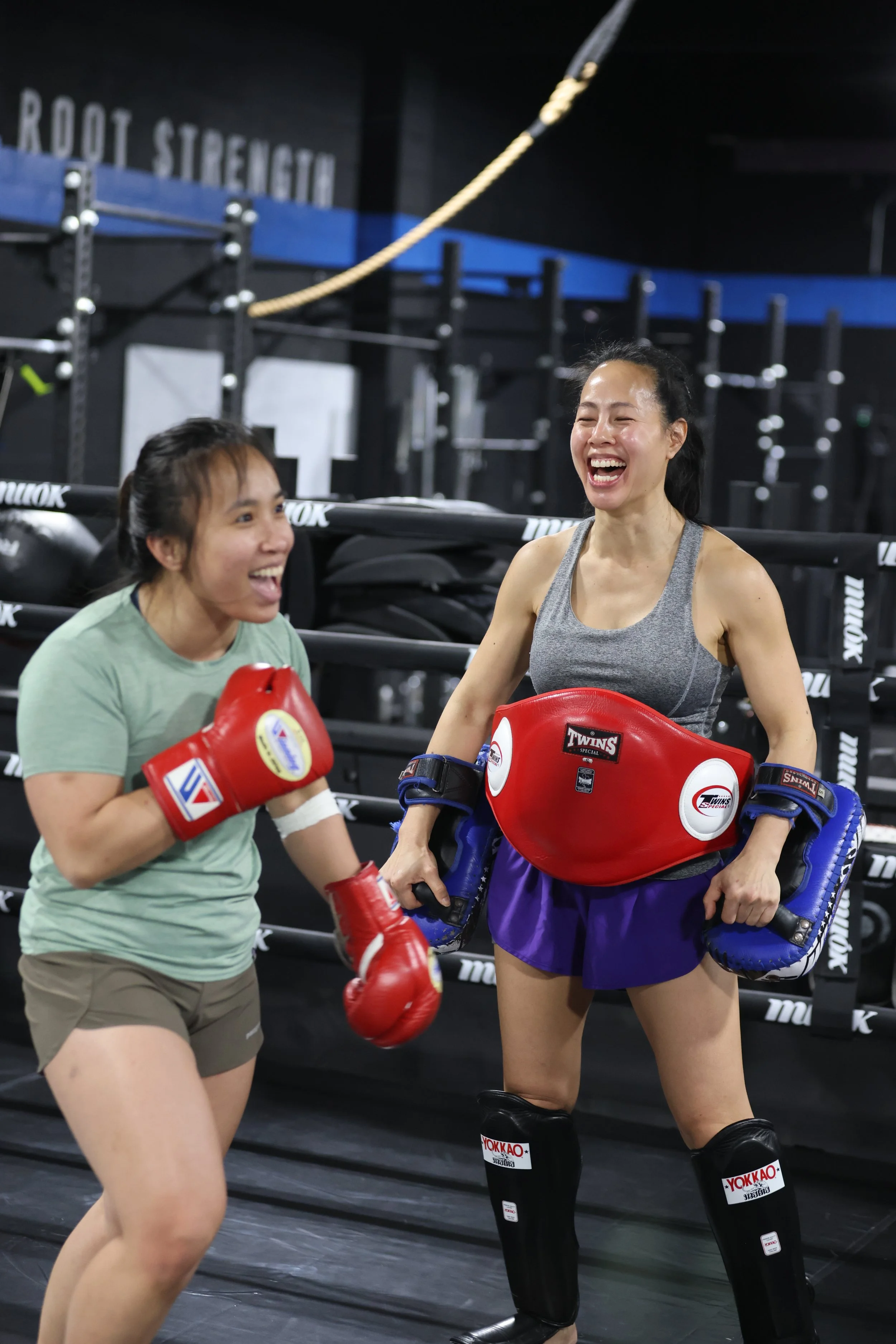
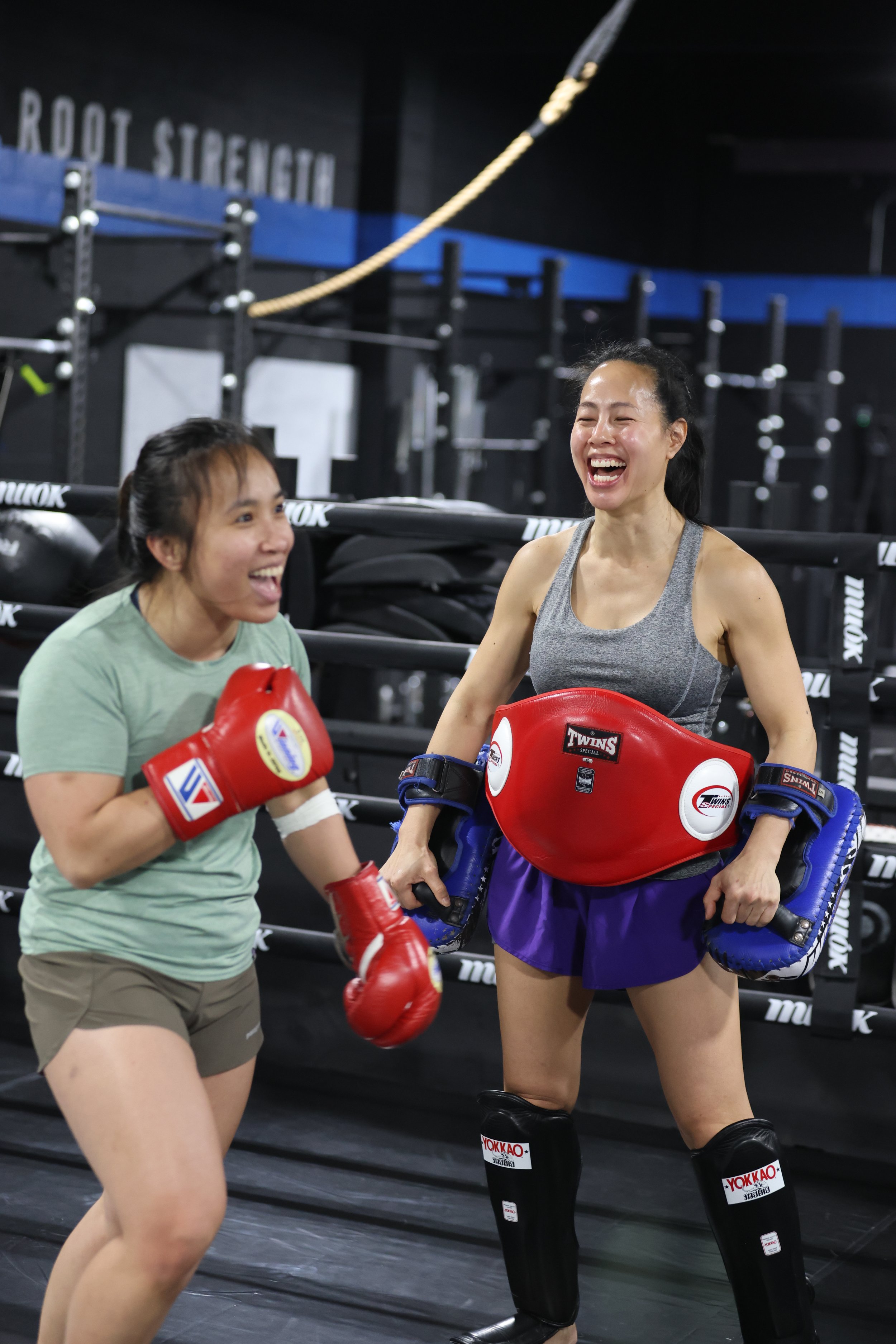
At Muók Boxing, women make up a significant portion of our membership at every level — beginners, intermediate practitioners, and people who've been training for years. That's not accidental. It reflects something real about what Muay Thai actually offers, and how we run our program.
Why Muay Thai Works Especially Well for Women
Most fitness programs ask you to work harder. Muay Thai asks you to work smarter. The techniques are built around leverage, timing, and technique — not brute strength. A well-executed teep doesn't require you to be strong. A well-timed elbow doesn't require you to be bigger than your opponent. This is a martial art designed to work for a smaller practitioner against a larger one — which is exactly why it's one of the most practical self-defense systems available regardless of size or strength.
-
01The fitness outcomes are exceptionalResearch published in Frontiers in Psychology in 2025 found that a 6-week Muay Thai program produced a 13% improvement in physical quality of life and a 22% improvement in mental quality of life. A separate study showed Muay Thai burns around 532 calories per session on average — more than most cardio formats — while building functional strength, coordination, and cardiovascular capacity simultaneously. It's one of the most complete fitness disciplines available. Read more in our post on Muay Thai for fitness in Seattle.
-
02It builds confidence that carries outside the gymLearning to hit with real technique — to throw a roundhouse that actually connects properly, to feel your teep stop someone's forward movement, to work through a sparring round without freezing — builds a kind of confidence that fitness classes don't produce. It's specific and earned. Members consistently describe it as one of the most meaningful things they've developed through training, not just the most physically demanding.
-
03The self-defense capability is real and practicalMuay Thai develops striking tools that work at every range — the teep to manage distance, punches and body kicks at mid range, elbows and knees in close range, and clinch control when someone grabs you. These aren't memorized techniques practiced against a cooperative partner. They're instinctive responses built through thousands of repetitions under gradually increasing pressure. That's the difference between a skill and a memory. For a full breakdown, see our guide to self defense classes in Seattle.
-
04Size and strength are not prerequisitesThis bears repeating because it's the assumption that keeps most women from trying: you don't need to be strong, fast, or athletic to start. You need to show up. Muay Thai technique is built on leverage and timing — qualities that develop through repetition, not natural physical gifts. Many of our most technically sharp members are women who started with zero athletic background and built their skills from scratch over months of consistent training.
-
05The community at most good Muay Thai gyms is genuinely welcomingThe culture of a gym matters as much as the quality of coaching. At Muók, the environment is intentionally ego-free — experienced members remember what it felt like to be a beginner and act accordingly. Women who train here consistently describe the community as one of the reasons they kept coming back after their first class. The technical challenge keeps you engaged; the community makes it a practice you build your week around.
The women who train at Muók aren't the exception to the rule — they are the rule. Muay Thai rewards technique, timing, and intelligence. Those qualities have nothing to do with gender.
What Your First Class Actually Looks Like
This is where the anxiety lives for most people — the not knowing. So here's exactly what happens when you come in for a free trial at Muók.
Before class
You'll be greeted when you walk in and introduced to a coach before the session starts. There's no expectation that you know anything — beginner orientation is built into how we run classes. You'll be placed in the beginner group, which trains alongside but separately from the experienced group, with its own dedicated coaching.
The warm-up
Every class starts with a shared warm-up — both groups together. This is where you start to feel the pace and get a sense of who's in the room. The warm-up is active and athletic but manageable at any fitness level.
Technique work
The beginner group moves into technique work — typically a combination of strikes broken down step by step by a coach. You'll drill it solo, then on pads with a partner. The focus is mechanics: stance, hip rotation, guard position. Nobody expects you to be smooth on day one. Coaches give individual corrections throughout.
Bag and pad rounds
You'll finish with bag work or partner pad rounds — putting the technique into practice at your own pace. This is usually where people realize they've been working harder than they noticed, because the focus on technique keeps the mind occupied.
After class
You'll be exhausted, probably more than you expected, and you'll want to come back. That's the standard first-class experience at a well-run Muay Thai gym.
What to Look for in a Muay Thai Gym as a Woman
Watch how the coaches interact with beginners
If you're evaluating gyms, our guide to Muay Thai classes near me in Seattle covers exactly what to look for. The quality of a gym's culture is visible in the first five minutes. Coaches who take time to explain why a technique works — not just how to do it — are the ones who build genuine capability. Coaches who ignore beginners or rush through corrections are building a gym that works for experienced practitioners and nobody else.
Check the gender breakdown of the membership
A gym where women make up a meaningful portion of the membership has already done something right culturally. If you walk in and every member is male, that tells you something about the environment regardless of what the website says.
Ask about sparring expectations
Sparring is an important part of Muay Thai development — but it should always be optional for beginners and introduced gradually at a pace that's appropriate for you. A gym that pressures new members into sparring before they're ready, or that runs sparring without proper supervision, is not the right environment for someone building their foundation.
Look for DPT credentials in the coaching staff
This is rare in Seattle gyms and genuinely matters — especially for women who may be coming to Muay Thai from a history of injury or physical therapy, or who want to train hard without accumulated damage. Coaches with Doctor of Physical Therapy backgrounds understand load management, injury prevention, and how to build long-term athletic sustainability into a training program.
Common Questions Women Ask Before Starting
-
Do I need to be fit before I start?No. Muay Thai will get you fit — it's not a prerequisite. Every class is scalable. Coaches adjust intensity and volume to where you are on day one, not where they wish you were. The fitness comes from the training itself, not from arriving already in shape.
-
Is sparring required?Never. Sparring is always optional at Muók and is only introduced when both you and your coach feel you're ready. Most members train for months before their first sparring session. Many train long-term and spar occasionally or not at all. Both approaches are completely valid.
-
Will I be the only woman in class?Unlikely. Women train across all class times at Muók. Evening classes in particular tend to have strong female attendance. But the honest answer is: even if you are the only woman in a given session, the environment is welcoming. Nobody is looking at you that way.
-
What do I wear?Athletic shorts or leggings and a fitted athletic top. Muay Thai is barefoot, so no shoes needed on the mat. Gloves and wraps are available to borrow for your first class — you don't need to buy anything before you try it.
-
I've never thrown a punch. Is that okay?That's the ideal starting point. You don't have habits to unlearn. Beginners with no prior experience often progress faster than people with backgrounds in other martial arts because they come in genuinely open to learning. Starting from zero is not a disadvantage here.
-
Is Muay Thai good for weight loss?It's one of the most effective formats available. A single session burns around 532 calories on average — more than most cardio classes — while building lean muscle and improving coordination simultaneously. Members who train 3x per week consistently describe significant body composition changes within the first 2–3 months alongside fitness improvements that go well beyond what the scale shows.
Muay Thai for Women at Muók Boxing — Georgetown, Seattle
Our coaching staff includes multiple Doctors of Physical Therapy — a combination that's genuinely rare in Seattle. It means you're learning technique from coaches who understand movement mechanics, injury prevention, and how to build a training practice that's sustainable for years rather than months.
We run 17 classes per week across morning, midday, and evening slots — specifically because we know your schedule doesn't always cooperate. Every class splits into beginner and experienced groups with dedicated coaching at each level, so your first class isn't you trying to keep up with people who've been training for three years.
The first class is free. No commitment, no pressure — just come in and see if it's the right fit. Most people who try it once find out within the first hour that the assumptions that kept them away were wrong.