Shoulder Injuries From Pad Work and Clinching — What's Going On and How to Fix It
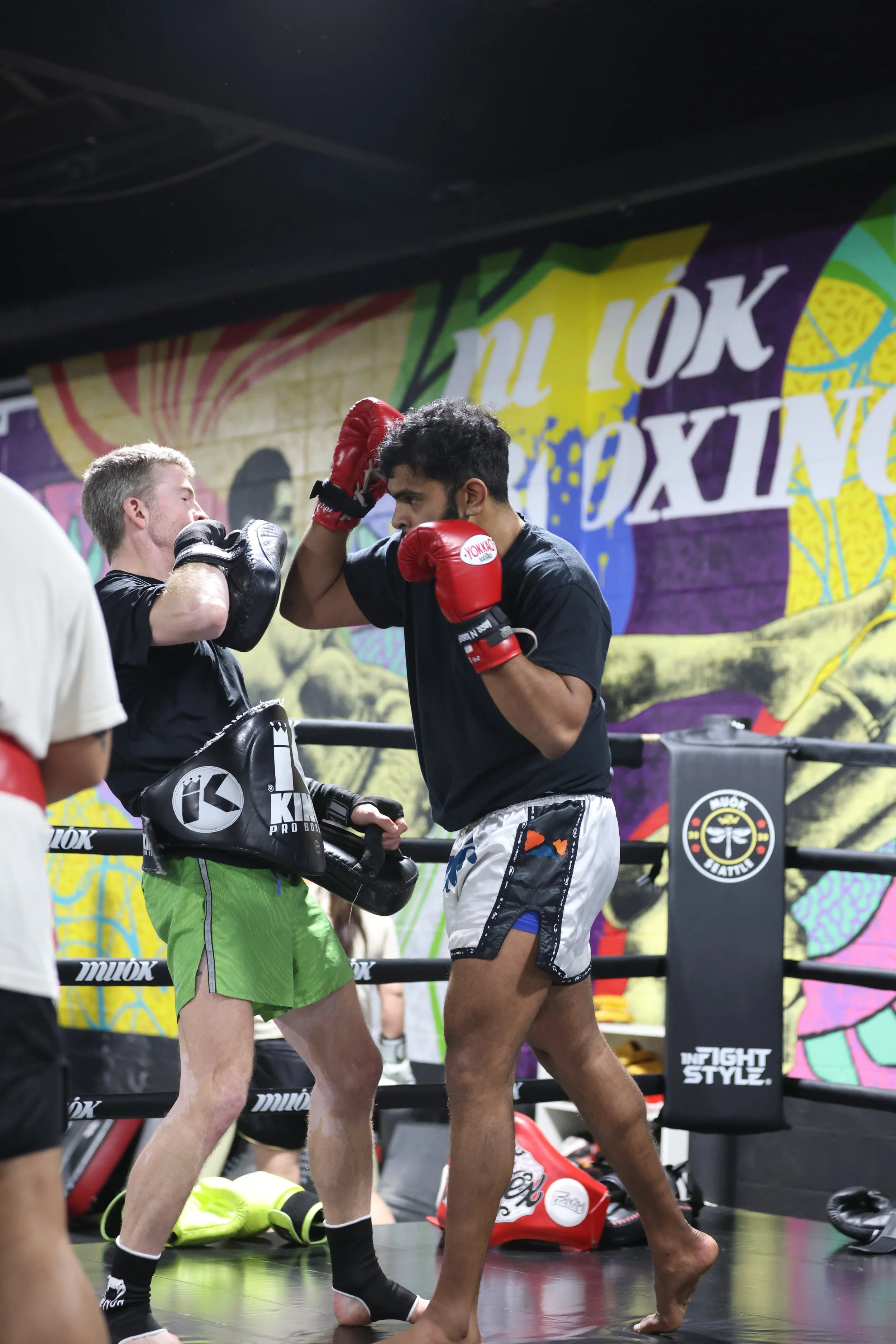
The shoulder is the most mobile joint in the body. It can move in more directions than any other joint you have — which is exactly what makes it so useful in Muay Thai, and exactly what makes it so vulnerable.
Think about what your shoulder does in a single training session. It throws punches, hundreds of times, against resistance. It absorbs pad impact through your guard when you hold. It gets pulled, pushed, and cranked in clinch work. It holds your arms up for three-minute rounds when everything in your body wants to drop them. And then you do it again the next session, and the one after that.
Shoulder problems are one of the most common things we see at Muók — not from one specific incident, but from volume accumulating over time without the right maintenance to back it up. Here's how it develops, what the warning signs are, and what the approach looks like when you handle it correctly.
-
01How pad work and clinching specifically load the shoulderThe mechanics of punching, holding pads, and clinch work — and why each one stresses the shoulder in a different way.
-
02The most common injuries we see and what they feel likeRotator cuff impingement, AC joint irritation, and biceps tendon issues — how to tell them apart and which ones you can train around.
-
03What actually fixes itThe exercises, load management approach, and technique adjustments that resolve most Muay Thai shoulder problems — without months off the mat.
-
04How to protect your shoulders long-termThe maintenance work that the athletes with the longest training careers all do consistently — and most newer members skip entirely.
Why Muay Thai Is So Hard on Shoulders
Most people think of shoulder injuries as something that happens in one moment — a bad fall, a hyperextension, something acute. In Muay Thai, that's rarely how it goes. Most shoulder problems build up quietly over weeks or months, and then something relatively minor tips them over the edge and suddenly you can't raise your arm above your head without pain.
Punching volume
Throwing punches correctly requires your rotator cuff — four small muscles that hold the ball of your shoulder in the socket — to fire and stabilize on every single rep. Do that for multiple rounds of bag work, pad work, and shadow boxing and you're asking those muscles to work a lot. When they get fatigued and you keep going, form breaks down, mechanics change, and the joint starts absorbing load in ways it wasn't designed to handle.
Holding pads
Pad holders take a beating that doesn't get talked about enough. Every kick or punch your partner throws transfers impact through the pad and into your shoulder — especially if your positioning is off or you're holding heavy for multiple rounds. Over time, that impact accumulates in the joint structures in a way that's very similar to overuse from throwing.
Clinch work
The clinch puts the shoulder in positions it doesn't often get tested in other aspects of training — loaded external rotation, sustained isometric holds, sudden jerks and pulls in unpredictable directions. The muscles around the shoulder joint that stabilize in these positions often aren't trained specifically for this kind of demand. They get strong from punching, but clinch-specific strength is different. That gap is where injuries develop.
Fatigue and guard position
When you're tired, your guard drops. When your guard drops, your shoulder mechanics on punches change. The rotator cuff has to work harder to compensate for the change in positioning, and it's already fatigued. This is the window where most Muay Thai shoulder issues actually start — not in the first round, but in the last one when form is compromised and volume is still high.
Most shoulder injuries in Muay Thai don't happen in a single moment. They build slowly over weeks of training volume without the maintenance to back it up — and then one session tips the balance.
The Most Common Shoulder Problems We See at Muók
Rotator cuff impingement
The most common one by far. It shows up as pain or pinching on the outside or front of the shoulder when you raise your arm — especially when you throw a cross or hold your guard up for extended periods. It often feels fine at rest but catches or aches during training. If you ignore it and keep training at full volume, it progresses. If you catch it early and address the mechanics and strength, it resolves relatively quickly.
AC joint irritation
The acromioclavicular joint sits at the top of your shoulder where your collarbone meets your shoulder blade. It gets irritated in Muay Thai from repeated compression — especially in clinch work where your partner posts or pushes directly down on your shoulder. It's tender right at the top of the joint when you press on it, and it aches during and after sessions. Often confused with a rotator cuff issue because the location is similar.
Biceps tendon pain
The long head of your biceps tendon runs through a groove at the front of your shoulder. In Muay Thai it gets loaded heavily during clinch work — particularly when you're pulling your partner, resisting being thrown, or catching kicks with your lead arm. It shows up as a deep aching pain at the front of the shoulder that gets worse with any pulling motion or when you supinate your forearm against resistance.
The honest answer is that most of our athletes can tell something is off in their shoulder long before they say anything about it. They start favouring one side on the bag, pulling punches slightly, shifting how they hold in clinch. If that's you right now — don't wait for it to get worse. These things are much easier to fix early than after months of compensation patterns have layered on top.
What Actually Fixes It
The answer isn't just rest. Rest reduces the pain but doesn't address why it developed — and when you go back to full training, the same mechanics and the same weakness are still there. The athletes who resolve shoulder issues properly are the ones who use the reduced-load period to build what was missing in the first place.
-
01Reduce what's loading it — don't stop everythingPull back on heavy bag rounds and pad holding. Avoid sparring with hard punching until pain settles. But stay active — kicks, footwork, conditioning, and lower body strength work can all continue. You don't need to disappear from training. You need to reduce what's specifically stressing the joint.
-
02Build rotator cuff and scapular strengthExternal rotation with a band, prone Y-T-W raises, side-lying external rotation — these aren't glamorous exercises but they're the ones that directly strengthen the muscles responsible for keeping your shoulder joint stable under the loads Muay Thai puts on it. Most athletes have never done them consistently. Most athletes also deal with recurring shoulder issues. That's not a coincidence.
-
03Fix the technique issues that drove itA lot of Muay Thai shoulder problems have a technique component. Overextending on the cross, holding your guard too wide, muscling in clinch instead of using your hips and posture — these change the loading pattern on the shoulder. Your coaches can identify what's contributing from a technique standpoint. That conversation is worth having before you just return to full training and repeat the cycle.
-
04Return to full training graduallyStart with light shadow boxing and technique work before returning to the heavy bag. Return to pad work before sparring. Return to light clinch drilling before hard clinch sparring. Each step should be pain-free before you move to the next one. The worst thing you can do is feel better and immediately jump back to the volume that caused the problem in the first place.
How to Protect Your Shoulders Long-Term
The athletes at Muók who don't deal with recurring shoulder issues have a few things in common. They warm up their shoulders before every session — not just the general class warm-up, but specific rotation and activation work before they start throwing. They do rotator cuff and scapular strengthening as a permanent part of their routine, not just when something hurts. And they pay attention to technique under fatigue — when their form starts to break down, they dial back the intensity instead of pushing through with bad mechanics.
The athletes with the longest training careers aren't the ones who never get hurt. They're the ones who catch things early, address them properly, and build the maintenance habits that keep them from repeating.
When to Get It Properly Assessed
If your shoulder has been bothering you for more than two weeks, if it's affecting how you train in ways you're trying to hide, or if it wakes you up at night — that's the signal to get eyes on it. Night pain in particular is a sign that something more significant is going on and needs a proper assessment before you continue loading it.
Our coaches at Root Physical Therapy — on-site at Root Strength Georgetown, same building as Muók — can assess what's driving it, differentiate between the different shoulder conditions, and build a return-to-training plan around your actual schedule and goals. Most major insurance plans are accepted and most members pay little to nothing out of pocket. No referral needed.
Shoulder Holding You Back?
Book a session with Root Physical Therapy — on-site at Root Strength Georgetown, same building as Muók Boxing. We'll assess what's going on and get you back to training without losing more time than necessary.
Book a PT Session →