
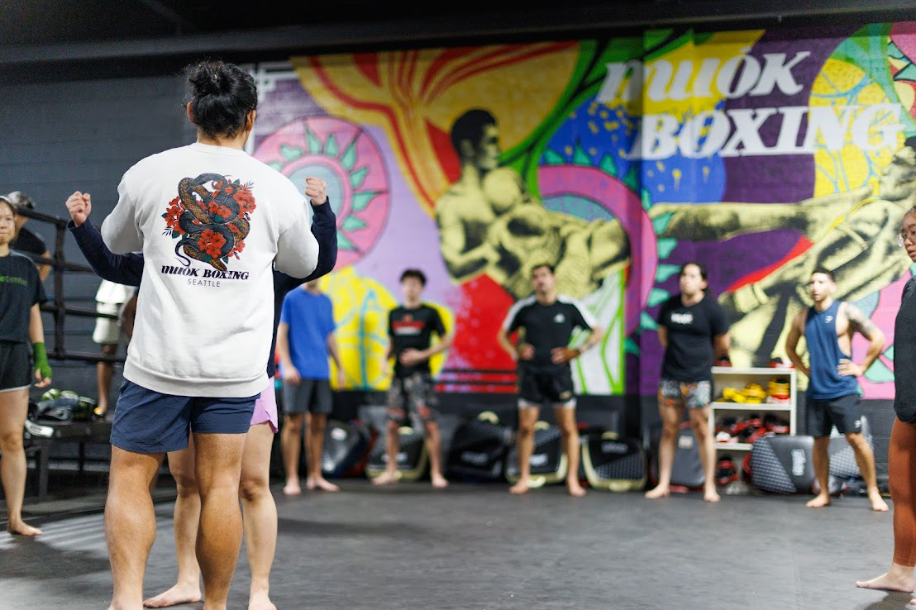
Get Better, Faster The Beginner's True Path in Muay Thai
Get Better, FasterThe Beginner's True Path in Muay Thai
Every coach at Muók hears the same question from beginners, usually within their first month: "Is there a drill I can practice at home to get better faster?"
We love this question — it means you're hooked. But the honest answer surprises almost everyone: not really. And the thing that actually will accelerate your progress costs nothing, requires no equipment, and most beginners never think to do it seriously: watch Muay Thai. A lot of it.
Like any proper fight, this one goes five rounds.
The Honest Truth About Practicing at Home
The practice that makes you better happens in the gym, during class, under the eye of a coach. That's not us protecting our jobs — it's how motor learning works.
When you repeat a movement, your body doesn't ask whether the movement is correct. It just ingrains whatever you're repeating. In class, a coach catches the dropped hand, the squared hips, the kick that's all leg and no body — before those errors get grooved in. At home, alone, there's nobody to catch anything.
So here's the uncomfortable math: a beginner who drills hundreds of solo reps at home with a subtle flaw isn't building a head start. They're building a habit — and un-learning a grooved-in habit routinely takes far longer than learning the movement correctly would have in the first place. Some coaches will tell you it takes triple the time, and honestly, that might be generous. We'd rather you walk in fresh than walk in with mileage on a broken pattern.
This doesn't mean you can't touch anything outside class — light shadowboxing to stay loose is fine, especially once a coach has checked your basics. But if your goal is getting better faster, unsupervised drilling isn't the shortcut it feels like.
The Real Problem: You Don't Know What Good Looks Like Yet
Here's what's actually holding most beginners back, and it isn't reps: you don't yet have a gold standard.
If you've never seen a roundhouse kick thrown at its highest level — the posture, the turn of the hip, the whip of it — how would you know what you're working toward? You can't aim at a target you can't picture. Every rep you throw is being compared against some internal image, and if that image is fuzzy, incomplete, or based on an action movie, your reps are calibrated against the wrong standard.
That internal image — your gold standard — is the thing beginners are missing most. And the only way to build it is to watch the art performed at its best, over and over, until the picture in your head is sharp.
This is the same principle behind our Open Training sessions: observation isn't passive. When you watch skilled movement, your brain rehearses what it sees. You absorb rhythm, timing, distance, and posture — the things that are nearly impossible to explain in words and nearly impossible to miss once you've watched enough of them. Fighters in Thailand grow up ringside for a reason.
So the best "homework" in Muay Thai looks like this: watch elite Muay Thai, get the image in your brain, then lightly mimic what you saw — shadow along, feel the shape of it. Then bring your body to class, where a coach can align your reps with the picture you've been building. Image at home, reps in the gym. That's the loop.
Pick One Fighter — and Copy Everything
Once you've been watching for a while, here's how to accelerate it: stop studying Muay Thai in general. Find one fighter you love, and copy everything he does.
Not just his kick, his punches, his combinations — everything. His stance between exchanges. His body language when he's pressing forward versus when he's reading. His signature habits: the way he pulls his shorts up after an exchange, the little acknowledging nod he gives an opponent when a strike lands clean. Copy the mannerisms that seemingly have nothing to do with fighting.
Why? Because when you copy everything, you're not collecting techniques anymore — you're channeling the fighter. You're pretending, in the best sense of the word, to be him. And something real happens when you do: you start to carry yourself like him, move like him, kick like him — and most importantly, think like him. The rhythm and the decision-making ride in on the mannerisms. Your gold standard stops being a picture you look at and becomes a character you inhabit.
There's also a practical reason wholesale copying is exactly right for beginners specifically: you don't yet have the knowledge to filter. Picking and choosing which techniques "suit your style" requires an understanding of the game you haven't built yet — at this stage, your judgment about what works is the least developed tool you have. So don't judge. Copy it all. A great fighter's complete package hangs together for a reason: his guard feeds his counters, his footwork sets up his kicks, his rhythm creates his openings. Take the whole system, not the highlights.
Then, a few years in — when you genuinely understand the game — you've earned the right to edit. Keep what fits your body. Discard what doesn't. Borrow a pattern from a second legend, a defensive habit from a third. Mix and match. That's the moment copying turns into creating: the beginning of your own style, your own interpretation of Muay Thai.
Every artist starts exactly this way — painters copying the masters stroke for stroke, musicians learning other people's songs note for note before writing their own. And when you get there — welcome. Your journey just began.
In Class: Be Curious, and Ask
The other accelerator costs nothing too: ask questions.
Ask why the technique works. Ask what you keep getting caught with. Ask about a fighter you watched — "I saw Samart do this thing with his teep, what was that?" Here's a secret: coaches love these questions. Nothing tells us a student is paying attention and genuinely cares about the art like a specific question about a technique or a fighter. It changes how we coach you, because now we know what you're seeing.
And if you're a member, this is exactly what Open Training on Tuesday and Thursday afternoons is for — the unhurried window where those conversations actually have room to happen.
One Warning: Not All Video Is Equal
Before you open YouTube, an important filter: if you want to get better at Muay Thai, watch actual Muay Thai.
Watching MMA to improve your Muay Thai is like learning Spanish by watching Italian movies — related, sure, but you'll pick up the wrong accent. MMA striking is shaped by takedowns, cages, small gloves, and different scoring; the stance, rhythm, and priorities are genuinely different arts. The same goes for generic "kickboxing workout" content and highlight reels cut for music rather than learning. Build your gold standard from the source: Thai stadium fighters, past and present, doing the real thing at full depth.
On the Bill
Muay Thai Scholar
BREAKDOWNS · BUILD YOUR GOLD STANDARDIn-depth breakdowns and highlights of the legendary Thai boxers, especially the golden-era masters of the '80s and '90s. This is where you'll find your fighter — the one worth copying wholesale. Start with any breakdown of Samart Payakaroon, the fighter our own Coach Bobby learned under.
Muay Ties
FULL FIGHTS · LEARN THE RHYTHMFull HD fights filmed at Bangkok's stadiums, uploaded constantly. Breakdowns teach you technique; full fights teach you rhythm — the pace of a real five-rounder, how exchanges unfold, how fighters adjust. Watch one Scholar breakdown, then one full fight here, and notice how much more you see.
Fifteen minutes a night is plenty. You'll be shocked how quickly things you watched start showing up in class — a coach demonstrates something, and instead of seeing it for the first time, you'll recognize it. That recognition is your gold standard forming. Everything gets faster from there.
Your first class is free, and the beginner group has its own coach. Bring your questions.
Why We Added Open Training (And Why Watching Might Be the Most Underrated Part)
Why We Added Open Training (And Why Watching Might Be the Most Underrated Part)
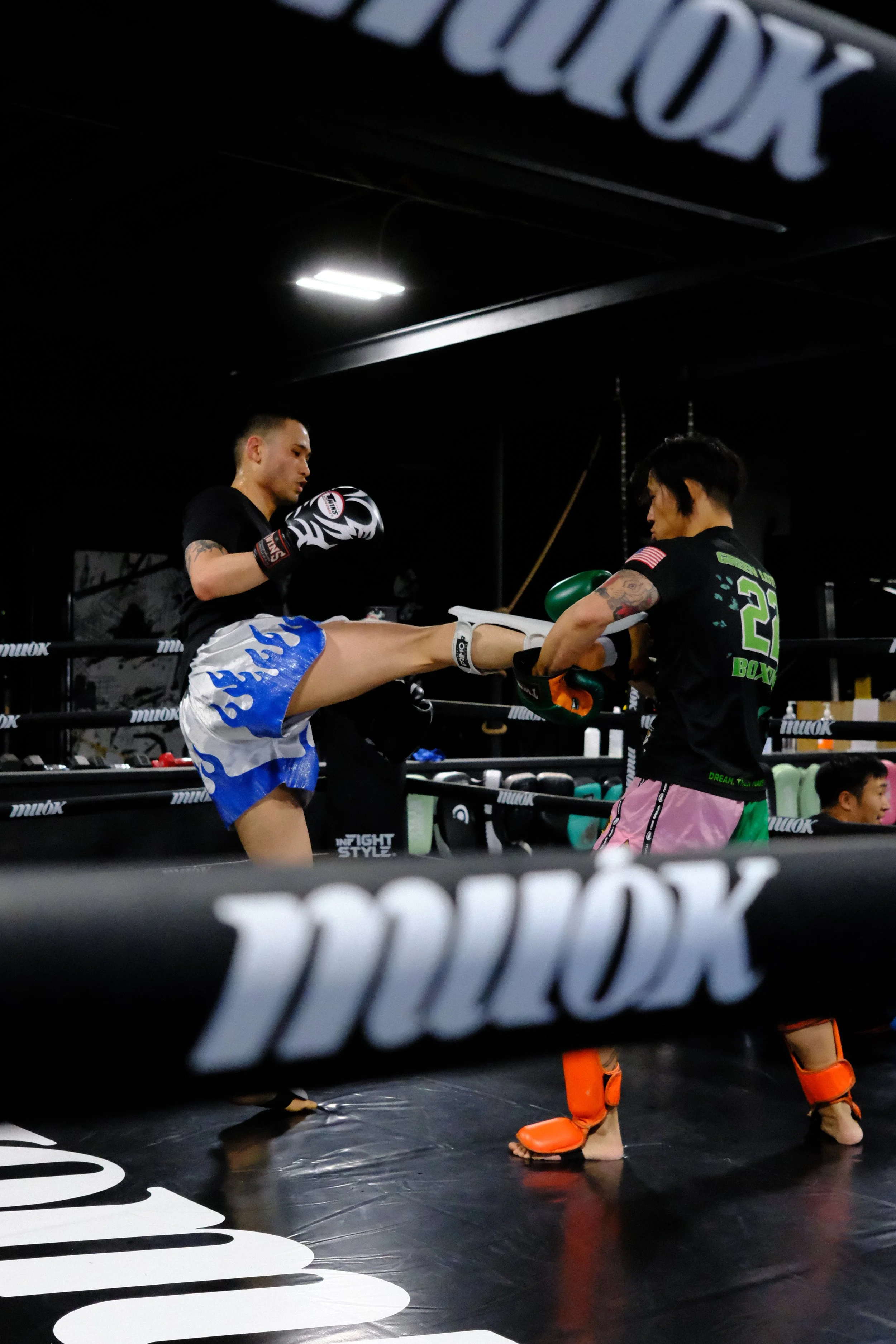
We just added something new to the schedule — and it's deliberately not a class.
Open Training runs Tuesdays and Thursdays, 3:30–5:00 PM. There's no led warm-up, no lesson plan, and minimal instruction. You arrive anytime within the window and get your work in: sparring rounds, bagwork, clinch, pads. Coaches are on the floor supervising, working with individuals, and getting their own training in. It's open to every member — the only requirement is being comfortable with a self-directed format.
If that sounds unusual for an American gym, it shouldn't. This is how Muay Thai camps in Thailand have run their afternoons forever. And there are real reasons that model produces such good fighters — reasons that have less to do with toughness and more to do with how people actually learn.
The Thing Class Time Can't Give You: Watching
A structured class is built around doing. You drill, you hit pads, you work with a partner — and that's exactly what a class should be. Repetition is how technique gets into your body.
But there's a second way humans learn movement, and it's badly underrated: observation. Motor learning research has shown for decades that watching skilled practitioners perform isn't passive — your brain rehearses what it sees, engaging many of the same neural pathways you'd use to perform the movement yourself. It's why fighters in Thailand grow up ringside before they ever grow up in the ring.
Watching does something drilling can't. Timing, setups, the way one person feels the other's balance shift, when to attack and when to wait — rhythm, distance, and decision-making are almost impossible to teach in isolation. They have to be absorbed, and absorbing takes watching.
Here's the honest gap in a normal class: you're doing so much that there's very little time to observe. Between your own rounds, your own reps, your own conditioning, you rarely get to just sit on the apron and study how the senior members put it all together. Open Training closes that gap. Come in, get your rounds — and then spend ten minutes watching two experienced people spar. Both halves count as training. In a real camp, they always have.
Learning Works Better When You're Not Exhausted
There's a second problem with trying to learn everything inside class time: by the time the interesting question occurs to you, you're usually too gassed to ask it — and too gassed to remember the answer.
That's not a character flaw; it's how the brain works. Processing new information takes attention and energy, and hard physical effort competes for both. In a 75-minute class, the priority is rightly the work itself. But it means the thinking part of your development — why that counter works, what you keep getting caught with, how to fix the hitch in your kick — gets squeezed.
Open Training flips the ratio. You dictate the pace. Work a hard round, then rest and actually think about what happened. Watch someone solve the exact problem you've been having. Walk over to a coach with the specific question you've been sitting on for two weeks — the one there's never time for mid-class — and get a real answer while your mind is fresh enough to keep it. Then go apply it, immediately, on a bag or with a partner.
No Lesson Plan Means You Have to Think — and That's a Skill
Here's the part of the camp-style format that's easiest to miss: when nobody structures the session for you, the responsibility to figure it out becomes the training.
In a class, most decisions are made before you walk in — what you'll work on, for how long, with whom, and why. That's not a flaw; it's exactly what structure is for. When you're building your foundation, having those decisions made for you frees up all your attention for learning the movements themselves. It's why our beginner program is as structured as it is, and why it should be.
But at some point, fighting stops being a movement problem and becomes a thinking problem. Solving an opponent — reading what they're doing, forming a plan, adjusting when the plan fails — is a skill of its own. And like any skill, it only develops when you're the one making the decisions. Skill-acquisition research points the same direction: practice where the learner chooses what to work on and evaluates their own performance tends to produce better long-term retention and adaptability than practice that's fully prescribed. A session that's planned for you, top to bottom, quietly does that thinking on your behalf — which is perfect early on, and limiting later.
Open Training hands the decisions back to you on purpose. Nobody tells you what today is for, so you have to ask the questions a coach normally answers: What's weak right now? What did I keep getting caught with on Tuesday? What am I building toward? Then you design the work, run it, and judge whether it worked. That's critical thinking with a heart rate — the same faculty you'll need when someone across from you refuses to cooperate with your game plan.
The Exchange Is the Point
Something else happens when you put members of every level in one room with no lesson plan: knowledge starts moving sideways.
A newer member asks a senior member how they enter the clinch, and gets a five-minute answer no curriculum could schedule. Two experienced people compare notes after a round. A coach spots something in someone's bagwork and quietly fixes a hip rotation. None of it is on a whiteboard, and all of it is training.
This is the part of camp culture we most wanted to bring into the gym. The knowledge in this room doesn't just live with the coaches — it lives across the whole community, and it transfers best in unstructured time, between rounds, when nobody's watching a clock.
And Honestly — It's Also Just Time Together
Not everything needs a performance justification. Part of what makes a gym a gym is the time between the work: hanging out, talking shop, watching your teammates get better, being around the thing you love without a timer running. Open Training is that too. Come in with no plan. Watch the room. Catch up with people before your evening class. That's not slacking off — that's what belonging to a fight gym has always looked like.
Open Training · Tue & Thu · 3:30–5:00 PM
UK Muay Thai - The Style, Explained
UK Muay Thai
Every major Western Muay Thai scene changed the art when it adopted it. Japan removed the elbows and the clinch and created kickboxing. The Netherlands built its system on that Japanese base and added Dutch boxing. The United Kingdom is the exception: it adopted the complete Thai system — all eight limbs, the clinch, five rounds, stadium scoring — and changed only one thing. It upgraded the hands.
The result is a recognizable national style: fighters who stand, check, clinch, and pace a fight like Thais, but punch like products of a boxing country. That description fits Liam Harrison, Jonathan Haggerty, Nico Carrillo, and George Jarvis — four different fighters from four different gyms — which is what makes it a style rather than a coincidence. This issue covers where the style came from, what it consists of technically, how it compares to the Dutch style, and the generation currently competing at the top of the sport.
The technical character of a regional style is usually explained by who taught it. Japan learned Muay Thai secondhand and rebuilt it for television. The Netherlands learned it from Japan — Amsterdam's Mejiro Gym was named after the Tokyo original — so the Dutch system inherited Japanese kickboxing's rules and rhythms before adding its own boxing.
Britain learned directly from Thais. In the mid-1970s, a group of Thai instructors — Master Sken, Master Toddy, Master Woody, and Master Krin — settled in the northwest of England and began teaching in Manchester, Stockport, and Bolton. Toddy's academy operated from 1975. They taught the complete art: elbows, knees, the full clinch, the wai kru, and five-round match structure. Their first generation of British champions, fighters like Ronnie Green, competed under real Thai rules and traveled to Thailand to fight. That set the pattern that still holds: the standard career path for a serious British fighter runs through Thailand, under full stadium rules. Nothing was ever removed from the British curriculum, because the people who wrote it were Thai.
Two consequences follow. First, the UK never developed a modified ruleset the way Japan and Holland did — British Muay Thai is Muay Thai. Second, because Britain is a boxing country, every generation of UK fighters has arrived at the gym with punching fundamentals already in place, or picked them up cheaply from the boxing culture around them. The style is best understood as those two facts combined: a complete Thai framework with British boxing installed inside it.
The Dutch style is the natural comparison, because both countries added boxing to Muay Thai and got different sports out of it. The difference is the foundation each built on.
George Jarvis (Lumpini Crawley, London; 29-5) is the style's clearest boxing-defense case study. He trained from age four at his father's gym, won a WBC Muay Thai world title at 21, and earned his ONE contract by knocking out Rungrawee Sitsongpeenong in November 2024. He challenged Eersel for the lightweight title in August 2025 and was knocked out in the first round — his first career KO loss — then rebuilt with a rematch win over Rungrawee in June 2026: knocked down in round one, he recovered and finished the Thai with a left hook at 1:59 of round two. His own account of that fight is a compact summary of the British method: body punches to bring the guard down, the left hook over the top, and the clinch managed rather than avoided.
Dakota Ditcheva (Manchester) documents the lineage's continuity. Her mother, Lisa Howarth, was a champion from the original Master Toddy-era Manchester scene; Ditcheva built an unbeaten Muay Thai record in that environment before moving to MMA, where she became a PFL champion. Fifty years separate her mother's teachers from her own career, in the same city, in one family.
The pipeline behind them is active. Freddie Haggerty, Jonathan's younger brother, is 2-0 in ONE with two knockouts. Jacob Smith (Bad Company) has fought for a ONE world title. A steady group of British fighters — Craig Hutchison, Gregor Thom, and others — are building records at ONE Friday Fights at Lumpinee Stadium, which is the modern version of the same rite of passage the 1980s generation followed: go to Thailand, fight under full rules, and let the results stand. Jonathan Haggerty defended his kickboxing title against Yuki Yoza at ONE SAMURAI 1 in April 2026; as this issue went to press we recommend checking the current status of that belt and Carrillo's, since both situations are recent.
The UK model is directly relevant to how we teach at Muók, because it demonstrates a specific claim: you can add Western skills to Muay Thai without removing anything Thai. The practical version of that, for a student:
Learn the Thai structure first. The British blend works because the stance, the check, and the clinch were in place before the boxing was layered on. A fighter who learns hands first and Thai structure second tends to build the Dutch problem — good punches in a stance that can't check.
Then invest in your hands seriously. Traditional Thai training under-allocates time to punching for scoring reasons that don't apply to your training goals. Treat boxing as a full discipline inside your Muay Thai: combinations, counters, and defense — not three punches that set up kicks.
Use head movement with kick awareness. Slips and rolls are usable in Muay Thai, but only paired with the discipline the British fighters show: never duck into knee range, and return to the long guard between movements.
Train the five-round clock. Pacing, reading a fight's score as it develops, and knowing when to press are trainable skills, and they're the ones three-round systems never teach. They also make sparring calmer and safer, which matters for everyone who isn't competing.
The UK scene is worth studying because it made a choice fifty years ago that keeps being validated: keep the whole art, and improve the parts your own culture is good at. That's the same principle we run this gym on. The full system — stance, checks, clinch, elbows, five-round thinking — comes first, and strong hands are built inside it, not instead of it. If you want to feel the difference between learning parts of Muay Thai and learning all of it, come take a class.
- The UK kept the complete Thai system — stance, checks, clinch, elbows, five rounds — because it learned directly from Thai instructors in Manchester from the mid-1970s.
- The addition is British boxing: hands as a primary weapon, selective head movement, and knockout intent. National signature: the left hook–low kick pairing.
- UK vs Dutch in one line: the Dutch built boxing on a kickboxing base; the UK built boxing into an intact Muay Thai base.
- The record supports the style: Haggerty KO'd Nong-O and holds ONE titles in two sports; Carrillo is the ONE featherweight Muay Thai champion; Harrison won 8 world titles over two decades.
- It isn't unbeaten: Eersel KO'd Jarvis in their August 2025 title fight — the Dutch school's current best won the direct meeting.
- The training lesson: learn the Thai structure first, then develop your hands seriously inside it.
The full system,
taught here.
Traditional Muay Thai in Georgetown, Seattle — the complete art the British scene built on, including serious work on your hands. Come try a free class.
Book a Free Class →- ONE Championship. Muay Thai Styles From Around The World: Dutch Power Meets UK Precision. 2025.
- Siam Fight Mag. The Epic of Dutch Muay Thai Champions — the Thai masters in England and the Mejiro lineage. 2021.
- Vice. When Manchester Was Mecca for Muay Thai — the Toddy/Sken-era northwest scene. 2024 reprint.
- Siam Fight Mag. Interview with Ronnie Green — the first generation of British champions.
- Wikipedia. Liam Harrison — record and career history.
- ONE Championship. How Liam Harrison and Richard Smith Built Bad Company Into a Muay Thai Powerhouse. 2025.
- Wikipedia. Jonathan Haggerty — titles and fight history.
- Wikipedia. George Jarvis — record; ONE Championship, ONE Fight Night 34 and 44 results. 2025–2026.
- ONE Championship. Nico Carrillo — athlete profile and fight results. 2023–2026.
- Sidekick Boxing. George Jarvis Recaps Rungrawee Knockout Win. 2026.
Buakaw — The White Lotus.
Buakaw —
The White Lotus.
July 7, 2004. Yoyogi National Gymnasium, Tokyo. The K-1 World MAX final — the biggest stage in striking, on national television, ten million yen to the winner. In the red corner: Masato, the reigning champion, the pre-tournament favorite, the most famous fighter in Japan. In the blue corner: a 22-year-old Thai nobody on the broadcast could pronounce, who had already fought twice that night, and whose name meant white lotus.
An extension round later, the belt left Japan. And Muay Thai — an art that had spent centuries as Thailand's national treasure and the world's rumor — suddenly had something it had never had before: a global superstar. Not a stadium legend the fans in Bangkok argued about. A face the whole world would learn, a name that would put students through the doors of every Muay Thai gym that opened in the West for the next twenty years. Including, eventually, ours.
This is his story — and per the rules of this series, it's also a story about rules: the ones he mastered, the ones they changed to stop him, and the one contract that nearly took everything.
Before the lights, the resolution drops. Sombat Banchamek was born in 1982 to a farming family of Kuy descent in Surin province — Isaan, Thailand's rural northeast, the region that grows rice, raises buffalo, and produces a wildly disproportionate share of the country's fighters. He had his first fight at eight years old, at a temple fair, the way Isaan boys do — and the prize money went home to help support his siblings. That's not a poetic flourish. That's the economics of Muay Thai in the provinces, and it's the engine under everything that follows.
At fifteen he made the move that changes a provincial fighter's life: to the Por. Pramuk gym near Bangkok, where the raw country kid was sharpened into a stadium professional. The belts came on schedule — an Omnoi Stadium featherweight title, the Thailand featherweight championship, a second Omnoi belt at lightweight — and in December 2002, the Toyota Marathon tournament at Lumpinee: multiple fights, one night, and a Japanese opponent named Satoshi Kobayashi beaten in the final. File that detail. Japan had just gotten its first look.
Isaan doesn't produce fighters because fighting is fun. It produces fighters because fighting pays.
K-1 invited the Thai unknown into its 2004 MAX tournament expecting, presumably, a respectable exit. Instead: on finals night Buakaw went through Australia's John Wayne Parr, then Japan's Takayuki Kohiruimaki, then — the fight in Tape 01 — the king himself. Three fights, one night, and the youngest MAX champion in the tournament's history, built on suffocating pressure, a wall of a long guard, chopping kicks, and a weapon Japan's ruleset had no answer for: the clinch, where Buakaw tied opponents up and threw them like laundry.
What happened next is this series' favorite kind of fact. K-1 changed the clinch rules — restricting the knee-and-tie-up game, a move widely read as a direct response to what Buakaw had just done with it. Readers of our Styles series know the shape of this story: it's the Muay Khao's pay cut, legislated in real time against one specific Thai. And here's the punchline that makes Buakaw Buakaw: he adapted, and won the whole thing again. After a 2005 final against Andy Souwer that ended in an extension-round decision Thailand still calls a robbery, he came back in 2006, stormed the bracket, met Souwer in the final again — and stopped him with punches, becoming the first two-time MAX champion in history. They rewrote the rules to beat him. He beat the rules.
The rivalry with Masato got one more chapter: a 2007 quarterfinal where Buakaw ate a knockdown in the first round, got up smiling, and spent the rest of the fight punishing Japan's hero with knees and kicks — and lost the decision anyway, on home soil, in a verdict fight fans have argued about since. The first global superstar's career is bracketed by contested scorecards in other people's buildings. It's part of why Thailand loves him the way it does: he won everything there was to win, in rooms that were never entirely his.
The ugliest chapter has no highlight reel. In 2012, after years of disputes over his treatment and earnings, Buakaw walked away from Por. Pramuk — the gym that had made him and held his contract, and whose name he had carried into every ring since he was fifteen. The fallout was public, bitter, and ended in court. When it settled, the most famous fighter Thailand had ever produced emerged with, essentially, his family name.
So he built on it. Banchamek Gym went up in his hometown in Surin — famously, in about ten days — with a second branch in Bangkok to follow. The farm kid who'd sent fight purses home at eight years old now ran the house, trained the next generation (his most decorated student, Superbon, went on to hold ONE kickboxing gold and fight Tawanchai twice — Part Three readers know the name), and fought on under the name he was born with. Every fighter in this publication's pages fights for a gym's name. Buakaw is the rare one whose name became the gym.
They owned the ring name. They never owned the man.
Here's the claim this issue exists to make, stated plainly: before Buakaw, Muay Thai had legends; after Buakaw, it had a global audience. Samart was greater in the stadium. Dieselnoi was more unbeatable. But nobody before him was famous — famous the way the world means it, recognized in airports on four continents, the single name a curious stranger could attach to the art. The K-1 broadcasts put him in tens of millions of living rooms, and a measurable wave followed: Western gyms opening, training tourism to Thailand becoming an industry, and a generation of coaches — very much including people teaching in Seattle today — whose first sight of real Muay Thai was a Thai flag on a pair of shorts at Yoyogi.
And the man inside the fame stayed stubbornly legible: an army officer, an honoree of Thai universities, a keeper of buffalo and rice fields, a national symbol who performs the wai kru — the ritual the entertainment era so often trims — like it's the whole point. In 2023 he led the largest wai kru ceremony ever recorded, a Guinness World Record for a prayer of gratitude to teachers. The broadcast made him famous. The tradition is what he did with it.
Build the long guard properly. Buakaw's signature isn't a strike — it's a defense that lets him stand in punching range unbothered, arms framed high and long, drawing opponents' offense into a funnel that ends in his clinch. It's trainable, it's transferable, and it's the single best answer to the "I hate getting punched at" problem every beginner has.
Pressure is built on defense, not courage. The Styles series said it about the Muay Mat and it's truer here: Buakaw walks forward calmly because his guard has already answered the counterfire. Get the defensive structure first; the forward pressure becomes nearly free.
Adapt like the 2006 tournament. They took his best weapon off the table and he won anyway. When a coach changes the drill, a partner solves your A-game, or an injury closes a door — that's the rule change. The response is the résumé.
Honor the art that made you. The most famous product of the modern fight-broadcast era spends his fame on the wai kru, the gym in his home province, and the next generation. Global and traditional aren't opposites. He's the proof.
Ask the coaches at any Western Muay Thai gym — ours included — how they found this art, and Buakaw's name comes up more than any other. A farm kid from Surin fought on Japanese television and twenty years later there's a traditional Muay Thai gym in Georgetown, Seattle with his sport's culture on its walls. That's what a superstar actually is: not the fame, but everything the fame builds. This broadcast is over. The signal is still traveling. Come see where it landed.
- Sombat "Buakaw" Banchamek: born 1982, Surin, Isaan — first fight at age 8 at a temple fair, prize money home to family.
- Stadium-made: Por. Pramuk gym at 15, Omnoi and Thailand titles, the 2002 Toyota Marathon at Lumpinee.
- Tokyo, 2004: three wins in one night — Parr, Kohiruimaki, Masato — youngest K-1 MAX champion ever.
- They changed the clinch rules; he won again — 2006, the first two-time MAX champion, avenging the 2005 Souwer decision.
- 2012: the bitter Por. Pramuk split — and Banchamek Gym, built in his hometown in ten days.
- The thesis: before Buakaw, Muay Thai had legends; after him, it had a global audience — and the Western gym boom that followed.
- Steal these: the long guard, pressure built on defense, adaptation as identity, and tradition as the point of the fame.
The signal landed
in Georgetown.
Traditional Muay Thai in Seattle — part of the wave the White Lotus started. Come try a free class.
Book a Free Class →- Wikipedia. Buakaw Banchamek — record, biography, and career timeline.
- MuayThai.com. Buakaw Banchamek: Biography, Fight History, Record & Legacy. 2025.
- The Art of 8. Buakaw Banchamek — Muay Thai Legend (early life, Por. Pramuk split, later career).
- YOKKAO. Buakaw Banchamek — Muay Thai Stats and Records (early titles; the K-1 clinch rule change).
- Wikipedia. K-1 World MAX 2004 World Tournament Final — the Masato fight and tournament details.
- Evolve MMA. 9 Facts About Muay Thai Superstar Buakaw Banchamek. 2021.
- Bull Sports Direct. Getting to Know Buakaw (career record, honors, and biography). 2025.
- Muay Thai Asian. The Rise and Success of Buakaw Banchamek (the Por. Pramuk dispute). 2023.
Japan's Muay Thai — The Prodigal Style.
Japan's Muay Thai —
The Prodigal Style.
Here's a fact that surprises almost everyone: the word "kickboxing" isn't a generic English term that always existed. It was coined in 1960s Tokyo, by a boxing promoter, as a brand name — for his Japanese remix of Muay Thai.
Sixty years later, that remix is one of the biggest striking cultures on earth. Japan fills arenas for it, produces global superstars from it, and — in the last two years — has sent its champions to Bangkok to test the branch against the trunk, live, at the top of the sport. If you've felt Japanese fighters suddenly everywhere in Muay Thai — Takeru headlining against Rodtang, Noiri stopping Tawanchai, Nadaka collecting stadium belts — you're not imagining it. This is the most consequential moment in the sixty-year relationship between Japan and Muay Thai.
This issue is the story of that relationship: how the fork happened, what makes the Japanese branch genuinely its own style, and why the family reunion is reshaping the whole sport.
The story starts with an exhibition: in December 1959, Thai fighters demonstrated Muay Thai in Tokyo, and Japan's martial arts world took notice. Karate men of the era were restless — their tournaments were point-fighting, and some wanted to know how karate fared in a real full-contact ring. The obvious measuring stick was Thailand.
So the challenge matches happened. In the mid-1960s, Kyokushin karate fighters traveled to fight Muay Thai fighters under Thai-style rules — a famous series Japan narrowly won, though the details (even the year) have been argued about ever since. What mattered was the man watching: Osamu Noguchi, a Tokyo boxing promoter, saw the future in the collision. He studied Muay Thai, blended it with full-contact karate and boxing, founded the first sanctioning body in 1966, and gave his creation a name he invented: kickboxing.
Note what the fork kept and what it dropped. Punches, kicks, and knees stayed. Elbows and the extended clinch — the two most distinctly Thai weapons — went (early rules even allowed throws, a karate inheritance, before safety concerns removed them). By 1970 kickboxing was on Japanese television three times a week, with cards regularly pitting Japanese kickboxers against Thai nak muay, and its first superstar — Tadashi Sawamura, "the Demon of Kickboxing" — was a household name. Japan hadn't imported Muay Thai. It had forked it: same source code, new rules, new rhythm, new culture.
Thailand built an art over centuries. Japan built a broadcast product in a decade — out of the same eight limbs, minus two.
Sixty years of separate evolution under different rules produced a genuinely distinct fighting style — as recognizable to a trained eye as the Dutch style or the Thai stadium game. Side by side:
Here's the chapter that makes this issue more than a history lesson. Readers of The Two Muay Thais know that entertainment-era Muay Thai — three rounds, damage scoring, fast clinch breaks, knockout bonuses — feels engineered for the broadcast. What that article didn't tell you is where that engineering came from.
Trace it back and the trail runs through Japan. The K-1 promotion — born in Tokyo in the 1990s, the direct descendant of Noguchi's fork — spent two decades proving to a global audience that three-round, no-elbow, damage-scored striking could fill stadiums and dominate television. When the modern entertainment promotions built their Muay Thai rulesets, they were building on the template K-1 had validated. The Japanese branch didn't just grow beside the Thai trunk. Its DNA got spliced back in. Every scoring debate in our Styles series — the puncher's raise, the knee fighter's pay cut — traces, in part, to a decision made in 1960s Tokyo about what would play on TV.
And K-1's golden era produced the rivalry that previews our next issue: Japan's biggest star against an unknown Thai farm kid who would become the sport's first global superstar. That fight is Tape 02.
Japan forked Muay Thai in 1966. The pull request landed forty years later.
One note before the tapes: the bridge generation deserves its line. Kenji Kurosaki — one of the original karate challengers — founded Tokyo's Mejiro Gym and trained the branch's first great champions. Among his 1970s foreign students were the Dutchmen who took the system home to Amsterdam, where Jan Plas named his gym Mejiro Gym in tribute. Dutch kickboxing — the lineage behind Part One's Ramon Dekkers — is Japan's grandchild. The fork has more descendants than most fans realize.
This is a traditional gym's publication, so here's the honest chapter. The Japanese branch is a genuine, sophisticated fighting culture — and it is also, by design, an incomplete Muay Thai. The fork removed the elbow and the clinch, which readers of our Styles series will recognize as amputating two entire archetypes: the Muay Sok's whole identity and the Muay Khao's home address. A kickboxer meeting full Thai rules discovers a fight happening in rooms their sport never built; a nak muay meeting kickboxing rules discovers — as Takeru's left-hook nightmare and revenge both showed — that the sprint format and the boxing-first pocket are skills of their own, not a dumbed-down subset.
The branch and the trunk are honest about different things. Japanese kickboxing is honest about pace, hands, and the three-round question: can you win right now? Thai Muay Thai is honest about completeness: all eight limbs, every range, and the five-round question: can you win a story? The current era — Takeru and Rodtang trading knockouts across rulesets, Nadaka winning stadium gold, Noiri holding kickboxing gold over a Thai great — isn't a verdict for either side. It's the two honesties finally testing each other at full strength, which is the best thing to happen to striking in decades.
We teach the complete art at Muók — the trunk, all eight limbs. But sixty years of parallel evolution produced things worth stealing, and the branch's best exports travel well.
Let boxing be a first language, not a garnish. The Japanese branch proves what happens when hands are trained as a complete system inside a kicking sport. Thai stadium scoring let punches stay underdeveloped for decades; your training doesn't have to.
Borrow the sprint. Three-round urgency is a skill. Training rounds where you must win this round — no arc to lean on, no later round to bank on — builds output and decision speed that five-round pacing never demands.
Steal the in-and-out. The karate-inherited blitz — explosive entry, strike, angle out — is the branch's signature movement pattern, and it's a legitimate answer to fighters who want to plant and trade. Part Four's femur chapter called pressure a question; the blitz is another way of asking it.
Respect the whole family tree. The deepest lesson isn't technical. Muay Thai is strong enough to survive its forks and be enriched by them — the branch gave the art global television, the Dutch school, and now a generation of Japanese champions returning home to the trunk. An art that can do that isn't diluted by its diaspora. It's proven by it.
Students ask us sometimes whether kickboxing and Muay Thai are the same thing. Now you have the real answer: kickboxing is Muay Thai's most successful child — born in Tokyo, raised on television, and lately come home to test itself against its parent. We teach the parent art, complete, the way the stadiums shaped it. But when a Takeru or a Tenshin fights, watch closely — you're watching sixty years of a very good question: what happens to the eight limbs when you change the rules? Our whole publication exists because that question never stops being interesting.
- "Kickboxing" was coined in 1960s Tokyo — promoter Osamu Noguchi's name for his fork of Muay Thai: keep punches, kicks, knees; drop elbows and the clinch.
- The branch is a real style: karate blitz footwork, boxing-first hands, three-round sprint pacing, damage scoring.
- The feedback loop: K-1 validated the broadcast formula that modern entertainment Muay Thai rules descend from — the fork's DNA got spliced back into the trunk.
- The lineage: Fujiwara (first foreign stadium champion, 1978) → Buakaw vs Masato (the fork's biggest stage) → Tenshin (44–0) → Takeru (the Rodtang saga) → Nadaka (Thai stadium gold on Thai terms).
- The Dutch connection: Amsterdam's Mejiro Gym is named for Tokyo's — Dutch kickboxing, and Dekkers' lineage, is Japan's grandchild.
- The honest accounting: the branch is incomplete Muay Thai by design — and complete mastery of its own three-round, hands-first question.
- Next issue: the farm kid from Surin who won Tape 02 and became the first global Muay Thai superstar. Buakaw gets his own cover.
Learn the trunk.
Understand the branches.
Traditional Muay Thai in Georgetown, Seattle — the complete art the forks descend from, taught whole. Come try a free class.
Book a Free Class →- Wikipedia. Osamu Noguchi — coining of "kickboxing" and founding of the first sanctioning body.
- Sidekick Boxing. The History of Kickboxing: From Japan and Muay Thai to Global Sport. 2025.
- Siam Fight Mag. Toshio Fujiwara — career, Mejiro Gym, and the Dutch connection. 2021.
- Wikipedia. Toshio Fujiwara — record and the 1978 Rajadamnern title fight.
- Siam Fight Mag. Chronology of Foreign Champions at Rajadamnern Stadium. 2024.
- Wikipedia. K-1 World MAX 2004 World Tournament Final — Buakaw vs Masato.
- Wikipedia. Tenshin Nasukawa vs. Takeru — THE MATCH 2022.
- World Boxing Council. Inoue vs Nasukawa II — WBC bantamweight title rematch announcement. 2026.
- ONE Championship. ONE 172 results (March 2025) and ONE SAMURAI 1 results (April 2026).
- ONE Championship. Nadaka Yoshinari — athlete profile and features.
- Muay Thai Citizen. Best Foreign Muay Thai Fighters — Fujiwara and Kozo Takeda. 2021.