
Muay Tae — The Golden Leg.
Muay Tae —
The Golden Leg.

Close your eyes and picture Muay Thai. You didn't picture a jab, and you didn't picture a clinch. You pictured a roundhouse kick — shin turning over, hips all the way through, the sound like a bat hitting a heavy bag.
That's not an accident. The roundhouse is the signature weapon of the whole art — the hardest-hitting strike in any standup sport, the top of the stadium's scoring ladder, and the technique that made Muay Thai famous everywhere it traveled. Muay Tae (มวยเตะ) — literally, the kick fighter — is the archetype that took the art's signature and made it an entire identity.
After the puncher's gamble and the knee fighter's grind, this is the series' aesthetic centerpiece: the style purists and casual fans agree on, because it's beautiful and terrifying at the same time.
Every style in this series has a temperament underneath the technique. The Muay Mat's is audacity; the Muay Khao's is will. The Muay Tae's is something closer to devotion.
Because here's the truth about the roundhouse: it's one of the hardest techniques in martial arts to genuinely master. The step, the hip rotation, the whip of the arm, the turn of the standing foot, kicking through rather than at — dozens of details that only fuse into one motion after thousands upon thousands of repetitions. The Muay Tae's training life reflects it: hundreds of kicks on the bag and pads, every day, for years, hardening the shins and grooving the motion until it fires without thought. Tawanchai — we'll meet him in the tapes — is said to have drilled his left kick a million times. Nobody who's watched it land doubts the number.
The payoff for that devotion is a weapon that works at every level of the body — chopping legs, crushing ribs, ending fights at the head — and works from a range where the opponent's punches can't answer. One perfect tool, endlessly sharpened, is a complete game.
Everyone kicks. The Muay Tae is the one who never stopped practicing it.
Like the puncher's loop and the knee fighter's grind, the kicker's game is a system — and it starts with a different weapon than you'd expect.
This series has quietly been building an economics lesson, and Part Three completes it. The puncher, we said, is underpaid by stadium scoring and made rich by the entertainment era. The knee fighter is the inverse — the stadium's wealthiest style, taxed into scarcity by modern clinch breaks. So where does the kicker sit?
Both columns. Under stadium rules, kicks to the body are at the very top of the scoring ladder — the premium currency, registering even when partially blocked, as we covered in The Two Muay Thais. And under entertainment rules? The roundhouse is a damage weapon and a highlight machine — leg kicks that end fights, head kicks that end evenings. Nothing about a clinch break or a three-round clock hurts a fighter whose game lives at range.
The puncher gets paid by the broadcast. The knee fighter gets paid by the stadium. The kicker gets paid everywhere. It's why the golden era's kickers were stadium royalty, why Buakaw Banchamek — the K-1 era's proto-Muay Tae — could carry the art onto foreign rulesets and become the most famous Thai fighter on the planet, and why the Thais dominating the modern global era, Superlek and Tawanchai, are both kickers. The roundhouse is the one weapon whose value survives every change in the sport's economy. If you're wondering why the kick is the first thing every Muay Thai gym teaches and the thing Thailand never stopped drilling — that's why.
Rules change. Promotions change. The kick keeps its value.
Before the tapes, the origin myth. Apidej Sit-Hirun — "The Golden Leg," the man in our headline — was the 1960s kicker whose roundhouse was said to echo around arenas, who famously broke both of an opponent's arms in a single 1963 bout, who collected seven championships across Muay Thai and boxing, and who remains the only fighter ever named Fighter of the Century, an honor bestowed by King Rama IX himself. His prime predates usable footage, so he lives here the way Chamuakpet did in Part Two: as the legend the tapes descend from. Everyone below is, in some sense, chasing his leg.
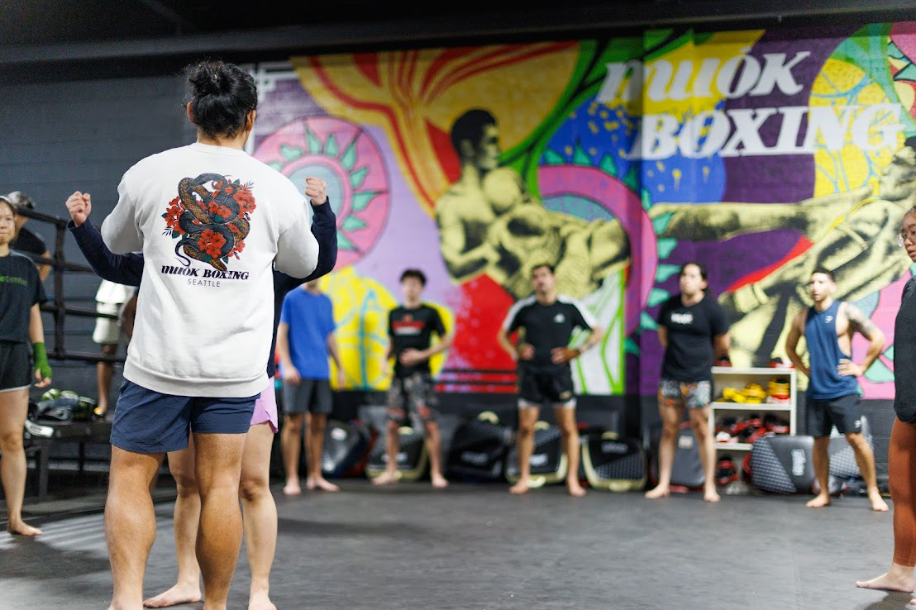
The belt Tawanchai relinquished now sits with Nico "King of the North" Carrillo — the Scottish knockout artist who won the interim title in February 2026 and was elevated to undisputed ONE Featherweight Muay Thai World Champion this July. Savor the series symmetry: the crown of the sport's greatest active kicker now belongs to a puncher in the classic Muay Mat mold — the scoring triangle from Chapter 03, playing out in real time at the top of the sport. And this April, before the elevation made it official, Nico spent a day on our mats in Georgetown, teaching a seminar to Muók members — that's him in the hero photo. When the champion's lineage runs through your gym, you frame the picture. When Tawanchai comes back for the belt, we'll be watching that fight with a rooting interest on both sides of the style divide.
Every archetype pays somewhere. The kicker's invoice is written in physics: a kick commits your whole body, on one leg, into shared space.
The kicker's game is the most directly stealable in this series, because the weapon is already the center of your curriculum. Four things.
Throw the teep like a jab. Most hobbyists treat the teep as an occasional technique. The Muay Tae treats it as punctuation — constant, casual, range-setting. Double your teep volume in sparring and watch every other weapon you own get easier to land.
Buy power with volume, not effort. The kickers on these tapes didn't muscle their way to power — they repped their way there. Hundreds of relaxed, technical kicks on the bag beat dozens of maximum-effort ones. Grease the groove; the power arrives on its own.
Relax to hit harder. The counterintuitive one. Tension in the shoulders and hips slows the whip and telegraphs the launch. The loosest kicker in the room is almost always the hardest one. If your kicks feel laborious, the fix is usually less effort, better sequence.
Kick through the target. Aim your shin a foot past where it lands and let the hips carry it there. Kicks thrown at a target decelerate before impact; kicks thrown through it are the ones that make the whole room look over.
The roundhouse is the first technique we teach you and the last one you'll ever finish learning — coaches with twenty years in are still refining theirs. That's not discouraging; it's the point. The kick is Muay Thai's signature because it rewards devotion longer than any other weapon in the art. Ten thousand kicks from now, yours will say something about you. Come throw the first hundred.
- Muay Tae = the kick fighter: the art's signature weapon, sharpened into an entire identity.
- The system: teep sets the range, rhythm hides the launch, kick through the target, volume compounds.
- The scoring triangle, completed: the puncher gets paid by the broadcast, the knee fighter by the stadium — the kicker gets paid everywhere.
- The lineage: Apidej → Sakmongkol → Yodsanklai → Singdam → Superlek → Tawanchai. A weapon handed down like an heirloom.
- The plot twist of 2026: the great kicker's belt now belongs to Nico Carrillo — a puncher. The triangle in real time.
- The costs: caught kicks get swept, launches get countered over the top, and the clinch deletes the range.
- Steal these: teep like a jab, volume over effort, relaxation over tension, through the target — never at it.
Ten thousand kicks.
Start with one.
Traditional Muay Thai in Georgetown, Seattle — where the art's signature weapon is taught from your first class, properly. Come try a free one.
Book a Free Class →- Evolve MMA. The Top 5 Muay Tae of Muay Thai. 2022.
- MuayThai.com. Muay Tae: The Kick Specialist. 2022.
- Muay Thai Citizen. Muay Thai Kicks — The Long Range Weapons (Apidej Sit-Hirun). 2021.
- Wikipedia. Sakmongkol Sithchuchok — record, titles, and the Dekkers and Jongsanan fights.
- Wikipedia. Yodsanklai Fairtex — record and titles.
- Wikipedia. Singdam Kiatmuu9 — record, titles, and Fighter of the Year.
- ONE Championship. Superlek Kiatmoo9 — athlete profile.
- ONE Championship. Tawanchai PK Saenchai — athlete profile.
- ONE Championship / Bangkok Post. Tawanchai vacates the featherweight Muay Thai title; Nico Carrillo elevated to undisputed champion. July 2026.
- Primo Fightwear. A Guide to the Different Styles of Muay Thai in the Modern Era. 2023.
Muay Khao — The Relentless Knee.
Muay Khao —
The Relentless Knee.
Ask any stadium fighter which style they least want to see across the ring, and you'll hear the same answer with remarkable consistency. Not the puncher. Not the kicker. The knee fighter.
In Part One we covered Muay Mat — the puncher, the style built on a bet that the knockout outranks the scorecard. This issue is its temperamental opposite: Muay Khao (มวยเข่า) — literally, the knee fighter. Where the Muay Mat gambles on a single ending, the Muay Khao promises a process. They walk you down, absorb your best long-range work, attach to you in the clinch, and feed you knees until your will files for bankruptcy.
It is the most feared style in the sport, the most physically demanding to train, and — as we'll get to — the one style whose fortunes tell you the most about where Muay Thai's rulesets are heading.
Every archetype in this series is organized around a weapon, but Muay Khao is really organized around a disposition. The knee is the payoff; the style is the willingness to pay for it.
Here's the price. A knee fighter's entire game lives at the closest possible range — which means every fight begins with an uphill march through everything Muay Thai keeps at long range: teeps to the hips, kicks to the body, punches on the way in. The Muay Khao accepts all of it as the toll. Then, once attached, the style demands a gas tank that can out-work another trained athlete in the most grueling position in the sport, round after round, without the option of coasting — because the moment a knee fighter stops working in the clinch, the referee breaks it, and the toll must be paid again.
That's why every coach will tell you the same thing: Muay Khao is the conditioning style. Knee fighters are famous across Thailand as the hardest trainers in any gym — not because they're built differently, but because the style simply doesn't run on anything less.
The clinch isn't a pause in the fight. For the knee fighter, it's where the fight finally starts.
Like the puncher's loop in Part One, the knee fighter's game is a system — a cycle that compounds. It just runs at a different range and on a longer clock.
Remember the paradox from Part One? Punches score low under stadium rules, so the puncher's game is a bet against the scorecard. Muay Khao is the exact inversion — and putting the two side by side explains more about modern Muay Thai than any other comparison.
Under traditional scoring, knees to the body are premium currency — they register as effect even when partially defended, they visibly drain the opponent, and clinch dominance with sweeps and off-balancing sits near the top of what judges reward. A knee fighter in control of the tie-up is winning in the most legible way stadium judging recognizes: they look like the stronger, fresher, more dominant athlete, and their opponent looks like they're being dismantled. The Muay Khao doesn't bet against the points game. The Muay Khao is the points game, played at maximum stakes.
Now flip to entertainment rules, and everything reverses. Three rounds is a short clock for a style built on compounding. Damage-based judging rates the grind below the highlight. And most decisively: modern promotions break the clinch fast — the position the khao spent a decade mastering gets separated by the referee seconds after it starts. The same ruleset shift that handed the puncher a golden era quietly taxed the knee fighter into scarcity. One style got a raise; the other got a pay cut. Same sport, same weapons — different definition of winning.
The stadium pays for control. The broadcast pays for damage. The knee fighter deals in control.
Watch these in order and you'll see the same system pass through very different bodies — a 6'2" giant, a 5'6" grinder, a southpaw aggressor — which is itself the lesson: Muay Khao is a method, not a physique.
One more name belongs in this chapter, in a different capacity. Sylvie von Duuglas-Ittu is an American who moved to Thailand, fights as a Muay Khao, and has logged more recorded fights than any Western fighter in history — hundreds of them, still counting. But her larger significance isn't measured in belts. Her Muay Thai Library is the most important preservation project the sport has: hundreds of hours of filmed sessions with the aging legends of the Golden Age — Dieselnoi, Langsuan, Chamuakpet, Yodwicha, and dozens more — documenting knowledge that would otherwise leave with them. Much of what the world still knows about how this style is actually taught exists because she filmed it. A bridge between the stadium generation and everyone who came after — that's a pioneer, and this article stands partly on her work.
Same deal as Part One: every archetype is a trade, and the knee fighter's invoice has three lines.
You don't have to become a knee fighter to train like one occasionally profits you. Four things from the khao's game, for everyone.
Stop treating the clinch as an interruption. In Thailand, clinch work is daily curriculum — like bag work, like skipping. In the West it's the most neglected phase of the art. If you only steal one thing from this style, steal the attitude: the clinch is Muay Thai, not a break from it.
Posture is the entire game. Tall spine, hips close, inside position. The person with better posture in the tie-up controls the exchange almost regardless of strength — which is exactly why clinch skill is the great equalizer for smaller students. Strength matters less in there than anywhere else in the sport, provided your frame is right.
Learn the body knee properly. It's the highest-value strike most hobbyists barely train — a premium scoring weapon, a genuine energy drain on your partner in sparring, and the safest heavy strike to develop because it's thrown from control rather than at range.
Build the engine on purpose. The khao's cardio isn't a gift; it's a curriculum. Treat conditioning as a skill you train deliberately — because every other skill you own shrinks to fit whatever gas tank is carrying it.
Clinch night is where we watch students change. The first month, everyone hates it — it's claustrophobic, exhausting, humbling. Then posture clicks, and the smallest person in class starts turning people twice their size, and something shifts in how they carry themselves everywhere else. The knee fighter's style is the deepest argument in Muay Thai that will, conditioning, and position beat talent. That argument is trainable. Come test it.
- Muay Khao = the knee fighter: forward pressure, clinch control, and knees that compound.
- The grind is a system: survive the range, enter on their commitment, win the lock, collect interest.
- It's the conditioning style. The gas tank isn't a bonus — it's the weapon everything else rides on.
- The scoring inversion: knees and clinch are the stadium's premium currency — and the entertainment era's clinch breaks tax exactly that. The puncher got a raise; the knee fighter got a pay cut.
- The lineage: Dieselnoi → Langsuan → Petchboonchu → Yodwicha → Sagetdao. A method, not a physique.
- The costs: the entry toll, the aging engine, and rules that can legislate the clinch away.
- Steal these: clinch as curriculum, posture over strength, the body knee, and conditioning trained as a skill.
Get comfortable
being close.
Traditional Muay Thai in Georgetown, Seattle — including the clinch, taught as core curriculum, the way the stadium art intends. Come try a free class.
Book a Free Class →- Evolve MMA. The Ultimate Guide to the Muay Khao Style for Muay Thai. 2025.
- YOKKAO. Muay Khao Explained: Meaning, Fighters and Techniques. 2020.
- Evolve MMA. Top 5 Muay Khao in Muay Thai History. 2022.
- Wikipedia. Dieselnoi Chor Thanasukarn — record, titles, and retirement.
- Wikipedia. Langsuan Panyuthaphum — record and stadium titles.
- Wikipedia. Chamuekpet Hapalang — titles and "Computer Knee" era.
- Wikipedia. Petchboonchu FA Group — record and stadium titles.
- Wikipedia. Yodwicha Por.Boonsit — record, titles, and notable wins.
- Wikipedia. Sagetdao Petpayathai — record, titles, and notable wins.
- The Fight Site. Dieselnoi vs. Samart: Storm of the Sky Piercing Knee. 2023.
- Sylvie von Duuglas-Ittu. The Muay Thai Library — documentary project table of contents. Patreon.
Muay Mat — The Heavy Hands.
Muay Mat —
The Heavy Hands.
Spend enough time around Muay Thai and you'll hear coaches talk about fighters the way scouts talk about ballplayers — not by record, but by kind. He's a femur. She's a khao. That one's a mat, watch your lead leg.
These aren't nicknames. They're the classic stylistic archetypes of the stadium art — a taxonomy Thailand has used for generations to describe how a fighter solves the problem of another human being trying to hit them. Most fighters start as a blend. The great ones become a definite something.
This series walks through them one at a time. And we're starting with the loudest: Muay Mat (มวยหมัด) — literally, the punch fighter. Heavy hands, brutal low kicks, forward pressure, and a standing offer to trade with anyone.
Before zooming in, here's the whole map. Each archetype is named for the weapon or temperament that organizes everything else in the fighter's game.
Why start the series here? Because Muay Mat is the style Western audiences read instantly. If you grew up watching boxing, the puncher's logic is already installed in you. It's also — as we covered in The Two Muay Thais — the style the modern entertainment era was practically built to showcase. Understanding it explains a lot about where the sport is right now.
The lazy description of Muay Mat is "a boxer who also kicks legs." The real style is more elegant than that, because the punches and the low kick aren't two separate weapons. They're one system, and each half exists to make the other land.
The punches buy the low kick. The low kick sells the punches. Neither works half as well alone.
The other half of the blueprint is temperament. Muay Mat fighters accept trades other stylists refuse — they'll take a shot to give two, and they treat pressure itself as a weapon, draining opponents psychologically before anything lands. That acceptance has a price we'll get to. But it also demands things people underestimate: an iron chin, a deep gas tank, and the composure to walk forward calmly while someone is trying to take your head off. Aggression without composure is just panic pointed forward.
Here's the puzzle at the heart of this style. If you read our guide to stadium scoring, you know traditional judges pay a premium for kicks and knees, and rate punches near the bottom of the currency table. So how did punchers become stadium champions — repeatedly, across every era?
Because the Muay Mat deals in the two things that outrank the currency table entirely.
First, effect. Stadium judging is effect-based: a strike that visibly moves, buckles, or hurts an opponent scores regardless of what limb delivered it. A punch that snaps a head back and changes how a man fights for the rest of the round is worth more than three pretty kicks that bounce off a block. The Muay Mat's entire game is manufacturing visible effect.
Second, the knockout — the one result no scorecard can overrule. The traditional Muay Mat strategy is openly a bet: concede the points game, and end the fight before the points matter. It's a style with a built-in deadline, which is exactly what makes it electric to watch.
This is also why Muay Mat fighters transition so naturally to kickboxing, boxing, and entertainment-rules Muay Thai. Damage-based scoring pays full price for the thing they were already selling at a discount. When ONE Championship built a ruleset around knockdowns and aggression, it effectively built a ruleset around the Muay Mat — which is a big part of why the style dominates the modern highlight reel.
Styles are best understood by watching, not reading. Here are six fighters who defined Muay Mat, in rough chronological order — each with tape. Watch them in sequence and you can see the style pass down through fifty years.
Every archetype is a trade, and honesty about the downside is part of understanding a style. The Muay Mat pays in three currencies.
Pressure is a question. The teep is an answer.
You don't have to be a Muay Mat to take things from the style — that's the whole point of this series. From the puncher's game, we'd point every Muók student at four things.
Punch the body. The most neglected target in hobbyist Muay Thai. Body punching is what makes the guard move — and a moving guard is what makes everything else land, low kicks included.
Pair your hands with your low kick — always. Don't throw naked leg kicks; they get checked and countered. Sell them behind punches, the way every fighter on the tapes above does. The combination is the technique.
Commit. Muay Mat fighters throw every strike like they mean it. Tentative, tap-scoring shots build tentative habits. Even at controlled sparring intensity, the intent and mechanics of committed striking are trainable — and they're what make technique honest.
Walk forward calmly. The deepest Muay Mat skill isn't power — it's composure under fire. Pressure that comes from panic gets picked apart. Pressure that comes from calm is the scariest thing in the ring. That composure is trained, not inherited, and it's the same quality that keeps sparring safe.
As a traditional gym, we teach the complete stadium art — which means every student here builds all five archetypes' fundamentals before gravitating toward their own. But we'll say this for the Muay Mat style: it's the great honesty test. Power, pressure, and composure expose every flaw in your base, your guard, and your conditioning — and fix them. Some of you reading this are punchers and don't know it yet. Come find out.
- Muay Mat = the puncher archetype: heavy hands, low kicks, pressure, knockouts.
- The hands and the low kick are one weapon. Punches raise the guard; the kick chops the base; repeat.
- The style is a bet: concede the stadium points game, win by effect and the knockout — the results no scorecard overrules.
- Modern damage-based scoring pays full price for what the stadium rated at a discount — which is why the style rules the entertainment era.
- The lineage: Sagat → Dekkers → Anuwat → Pornsanae → Harrison → Rodtang. Watch the tapes in order.
- The costs: absorbed damage, scorecard deficits, and a game the technician's teep is built to tax.
- Steal these: body punches, kicks sold behind hands, full commitment, calm forward pressure.
Find out what
kind of fighter you are.
Traditional Muay Thai in Georgetown, Seattle — all five styles live in the complete art, and the complete art is what we teach. Come try a free class.
Book a Free Class →- YOKKAO. Muay Mat Explained — Fighters & Meaning. Muay Thai Styles series. 2020.
- Rajadamnern Stadium (official). Muay Mat Explained: Techniques, Training Tips, Fighters. 2025.
- MuayThai.com. Muay Mat — The Power Puncher. 2022.
- Lowkick MMA. Muay Thai Styles — The Different Fighting Styles Explained. 2023.
- Wikipedia. Anuwat Kaewsamrit — career record and stadium titles.
- Wikipedia. Pornsanae Sitmonchai — career record and stadium titles.
- World Muaythai Council. Anuwat Kaewsamrit: The Iron Hands of Siam. 2020.
- ONE Championship. Liam "Hitman" Harrison — athlete profile.
- EventHubs. Street Fighter's Sagat is based on a real Muay Thai champion. 2018.
Sleep — The Cheapest Upgrade You're Not Using
Sleep — The Cheapest
Upgrade You're Not Using.
Every member who's serious about Muay Thai eventually optimizes something. Better gloves. More classes. Cleaner food. Supplements. Recovery gadgets.
Almost nobody optimizes sleep. And sleep is the one that's free, backed by the most evidence, and quietly determining whether the work you put in on the mats actually turns into skill.
Here's what the research says happens to a fighter's body and brain overnight — and what happens when you don't give it enough time to do the job.
Sleep isn't one thing. Your brain cycles through distinct stages roughly every 90 minutes, and each is doing a different job for a Muay Thai athlete.
You don't get better during training. You get better after it — while you're asleep. Training is just the request.
In 2011, Cheri Mah's team at Stanford ran a simple experiment on the men's varsity basketball team. Eleven athletes kept their normal sleep for a few weeks, then were asked to get a minimum of 10 hours in bed per night for the next five to seven. They didn't change training. They didn't change diet. They just slept more.
Put that in the ring. Slower reactions mean the kick you'd have checked, you don't. Degraded coordination means your landing mechanics get sloppy on a pivot. Reduced tissue tolerance means the shins that handled your training volume last month suddenly aren't.
A lot of what gets blamed on "bad luck" or "overtraining" is a sleep problem wearing a costume.
Every few months a member comes to us frustrated they've plateaued — technique feels stuck, they gas in round two, they keep tweaking something. We ask about volume. We ask about food. Then we ask how much they're sleeping — and it's five and a half hours on a good night. Fix that before you buy another supplement or add another class. It's free, and it's the biggest lever you've got.
None of this needs a $300 ring or a sleep coach. It needs treating the two hours before bed like part of your training — not the leftover time at the end of your day.
Nobody sleeps 8 hours every night. You have a job, maybe kids, maybe a 6am. The goal isn't perfection — it's raising your average. Going from a consistent 6 hours to a consistent 7.5 will do more for your Muay Thai than any supplement on the shelf. Aim for the trend, not a perfect record.
If you're doing the basics right — consistent schedule, dark cool room, caffeine controlled — and you're still exhausted, waking constantly, or in enough pain that you can't get comfortable, that's worth looking at properly. Persistent pain disrupts sleep, and disrupted sleep amplifies pain. It's a loop, and it doesn't break on its own.
That's one reason Root Physical Therapy is on-site — same building, same hallway. Our clinicians are Doctors of Physical Therapy (two coach Muay Thai here), and they treat sleep as a real recovery variable, not an afterthought. If pain is what's keeping you up, that's a thing they can actually fix. Washington is direct-access: no referral, most major insurance accepted. Just walk down the hall.
- Deep sleep rebuilds the body. Growth hormone, muscle repair, bone remodeling — front half of the night.
- REM files away your technique. Back half — the part you lose when you go to bed late.
- Under 8 hours = 1.7× the injury risk. In a contact sport, that's not a rounding error.
- Sleep more, react faster. Athletes who extended sleep got measurably quicker and more accurate.
- Cut caffeine by early afternoon — especially if you train at night.
- Alcohol destroys REM — the stage where your skill work actually sticks.
- Sauna after sparring helps you come down — and it's included with your membership.
Train hard.
Sleep harder.
New to Muók? Come try a free class — and see the training floor, the sauna, and the on-site PT clinic for yourself.
Book a Free Class →- Mah CD, Mah KE, Kezirian EJ, Dement WC. The effects of sleep extension on the athletic performance of collegiate basketball players. SLEEP. 2011;34(7):943–950.
- Milewski MD, et al. Chronic lack of sleep is associated with increased sports injuries in adolescent athletes. Journal of Pediatric Orthopaedics. 2014;34(2):129–133.
- Nedeltcheva AV, et al. Insufficient sleep undermines dietary efforts to reduce adiposity. Annals of Internal Medicine. 2010;153(7):435–441.
- Watson AM. Sleep and athletic performance. Current Sports Medicine Reports. 2017;16(6):413–418.
- Walker MP, Stickgold R. Sleep-dependent learning and memory consolidation. Neuron. 2004;44(1):121–133.
Traditional vs. Entertainment Muay Thai: Rules, Scoring, and What Actually Wins
The Two
Muay Thais.

Muay Thai is having its biggest global moment in history — and most of the world is meeting it through 4-ounce gloves, three-round wars, and knockout bonuses. It's electric. It's also not the version fought in Rajadamnern and Lumpinee for the past hundred years.
The two versions now run side by side, and they go by name: traditional (stadium) Muay Thai and entertainment (modern) Muay Thai. Same eight limbs. Different gloves, different formats — and, most importantly, different definitions of winning. Once you understand how each is scored, you understand why they produce such different fights.
Start with the physical differences, because everything else flows downstream from them.

Traditional scoring confuses newcomers because it doesn't count what most combat sports count. It's not volume. A fighter can land twice as many strikes and clearly lose the round. What judges watch for is effect — and a very Thai idea of dominance.
Volume is noise. Effect is signal.
Now flip everything. ONE Championship built its ruleset deliberately — as an answer to the fact that stadium scoring is genuinely hard for a new fan to read. Their system prioritizes what anyone can see: damage.
- Effect & off-balancing over volume
- Kicks & knees valued above punches
- Clinch control and sweeps
- Composure — looking like the winner
- The fight as a five-round story
- Knockdowns above all
- All strikes score equally — damage decides
- Aggression & forward pressure
- Volume of clean strikes after damage
- Every round its own fight — plus KO bonuses
Here's the wrinkle that makes this more than a clean two-way split: even Rajadamnern — the oldest stadium in the world — is modernizing. Its broadcast promotion, the Rajadamnern World Series (RWS), keeps the traditional hardware but reworks the format for a global audience.
You'll sometimes hear that sweeps have been "banned." Not quite. Certain sweep variants have always been fouls in Muay Thai — long before any modern promotion. Karate-style instep sweeps, hip throws, and judo-style trips where your leg stays planted as they fall: all illegal under traditional rules. What's legal — and what scores, RWS included — is kicking the supporting leg out with your shin or the top of the foot, or off-balancing from the clinch with proper technique. The line is precise, which is exactly why it has to be taught properly. When a sweep gets waved off in a fight, it usually crossed that long-standing line — the technique wasn't outlawed.
None of this is a "real vs fake" argument. The athletes competing under entertainment rules — Rodtang, Superlek, Tawanchai — are elite, stadium-forged fighters, and the format has brought Muay Thai a global audience the stadiums never reached. Thailand itself is split on the tradeoffs. Both versions are Muay Thai — optimized for different things: one for a century of martial depth, the other for the modern fight fan's screen.
So where does Muók land in all this? Simple: we're a traditional Muay Thai gym, and that's a deliberate choice.
The stadium art is the complete art. Train it and you inherit the entire system — the teep and the sweep, the clinch in all its depth, the balance and posture that scoring has demanded of fighters for a hundred years, the five-round patience, and the culture that holds it together. Train that, and you can adapt to any ruleset later. Train only for three-round damage, and you've skipped the foundation.
We teach the full weapon set — including the parts entertainment scoring devalues. The clinch isn't an afterthought at Muók; it's core curriculum. Sweeps, off-balancing, knee positioning — the skills that win stadium rounds are the same skills that make you genuinely hard to deal with anywhere. Same with the teep: in the stadium game it's a scoring statement and a range weapon, and we drill it that way.
We train balance and composure as skills, not accidents. Stadium scoring rewards the fighter who stays in posture while everything happens around them — and that's trainable, not a personality trait. It's why our technique work is obsessive about base, weight transfer, and returning to position. That same composure is what keeps hobbyists safe in sparring.
We keep the culture. The wai kru ram muay — the pre-fight ritual honoring your teachers and your gym — is compulsory in every stadium in Thailand, and it's part of what we pass on here. Muay Thai isn't a delivery system for knockouts; it's a martial tradition with a lineage. Respecting that lineage is part of training at Muók.
We build fighters who understand the story of a fight. Five-round thinking — reading an opponent, pacing, peaking at the right moment — teaches ring IQ that a three-round sprint never demands. Even if you never compete, training with that mindset makes you a smarter, calmer martial artist.
Love the ONE highlights — we do too. But understand what you're watching: a version of the sport tuned for the screen. On our mats, you're learning the version tuned for depth — where balance beats aggression, where a clean sweep says more than a wild exchange, and where the art is bigger than the highlight. Learn that first, and everything else is available to you.
- Traditional/stadium: 8–10 oz gloves, 5 rounds, effect-based scoring, weighted rounds.
- Entertainment/modern: 4 oz gloves, 3 rounds, damage-based scoring, every round equal.
- Stadium scoring rewards effect over volume — one clean body kick beats five light punches.
- Rounds 3–4 decide a stadium fight. It's a story, not three sprints.
- Small gloves change everything: punches equalize, defense tightens, finishes multiply.
- RWS is the middle path: 3 rounds, per-round winners, volume/accuracy/power scoring — full gloves and legal sweeps kept.
- Sweeps aren't banned — instep sweeps and hip throws were always fouls; kick-based sweeps still score everywhere.
- Muók trains the traditional art — the complete system, culture included. Foundation first; adapt later.
Train the Real Thing.
Traditional Muay Thai in Georgetown, Seattle — the full art, from your first teep to the clinch. Come try a free class and feel the difference.
Book a Free Class →- Evolve MMA. An Updated Guide to the Muay Thai Scoring Systems of Today. 2024.
- Muay Thailand. Muay Thai Rules — Traditional vs Modern Rulesets. 2025.
- Muay Ying. Muay Thai Scoring Explained: Traditional vs. Entertainment Standards. 2025.
- Harrison L. Interview, The City Life Project, via Sportskeeda — on fighting under traditional vs 4-oz rulesets.
- Superbon. Interview, South China Morning Post, via Sportskeeda — on small-glove defense.
- Gym Bangarang (Kru Tommy, stadium judge). Muay Thai Rules and Scoring: A Fighter's Guide. 2025.
- Rajadamnern Stadium (official). A Beginner's Guide to the Muay Thai Point Scoring System — RWS judging criteria. 2026.
- Bangtao Muay Thai. Muay Thai 2.0: How Rajadamnern's New Promotion Is Changing the Game. 2025.
- Muay Thai Purist. Tournament Rules — legal vs illegal sweeps, trips, and throws.