Traditional vs. Entertainment Muay Thai: Rules, Scoring, and What Actually Wins
The Two
Muay Thais.

Muay Thai is having its biggest global moment in history — and most of the world is meeting it through 4-ounce gloves, three-round wars, and knockout bonuses. It's electric. It's also not the version fought in Rajadamnern and Lumpinee for the past hundred years.
The two versions now run side by side, and they go by name: traditional (stadium) Muay Thai and entertainment (modern) Muay Thai. Same eight limbs. Different gloves, different formats — and, most importantly, different definitions of winning. Once you understand how each is scored, you understand why they produce such different fights.
Start with the physical differences, because everything else flows downstream from them.

Traditional scoring confuses newcomers because it doesn't count what most combat sports count. It's not volume. A fighter can land twice as many strikes and clearly lose the round. What judges watch for is effect — and a very Thai idea of dominance.
Volume is noise. Effect is signal.
Now flip everything. ONE Championship built its ruleset deliberately — as an answer to the fact that stadium scoring is genuinely hard for a new fan to read. Their system prioritizes what anyone can see: damage.
- Effect & off-balancing over volume
- Kicks & knees valued above punches
- Clinch control and sweeps
- Composure — looking like the winner
- The fight as a five-round story
- Knockdowns above all
- All strikes score equally — damage decides
- Aggression & forward pressure
- Volume of clean strikes after damage
- Every round its own fight — plus KO bonuses
Here's the wrinkle that makes this more than a clean two-way split: even Rajadamnern — the oldest stadium in the world — is modernizing. Its broadcast promotion, the Rajadamnern World Series (RWS), keeps the traditional hardware but reworks the format for a global audience.
You'll sometimes hear that sweeps have been "banned." Not quite. Certain sweep variants have always been fouls in Muay Thai — long before any modern promotion. Karate-style instep sweeps, hip throws, and judo-style trips where your leg stays planted as they fall: all illegal under traditional rules. What's legal — and what scores, RWS included — is kicking the supporting leg out with your shin or the top of the foot, or off-balancing from the clinch with proper technique. The line is precise, which is exactly why it has to be taught properly. When a sweep gets waved off in a fight, it usually crossed that long-standing line — the technique wasn't outlawed.
None of this is a "real vs fake" argument. The athletes competing under entertainment rules — Rodtang, Superlek, Tawanchai — are elite, stadium-forged fighters, and the format has brought Muay Thai a global audience the stadiums never reached. Thailand itself is split on the tradeoffs. Both versions are Muay Thai — optimized for different things: one for a century of martial depth, the other for the modern fight fan's screen.
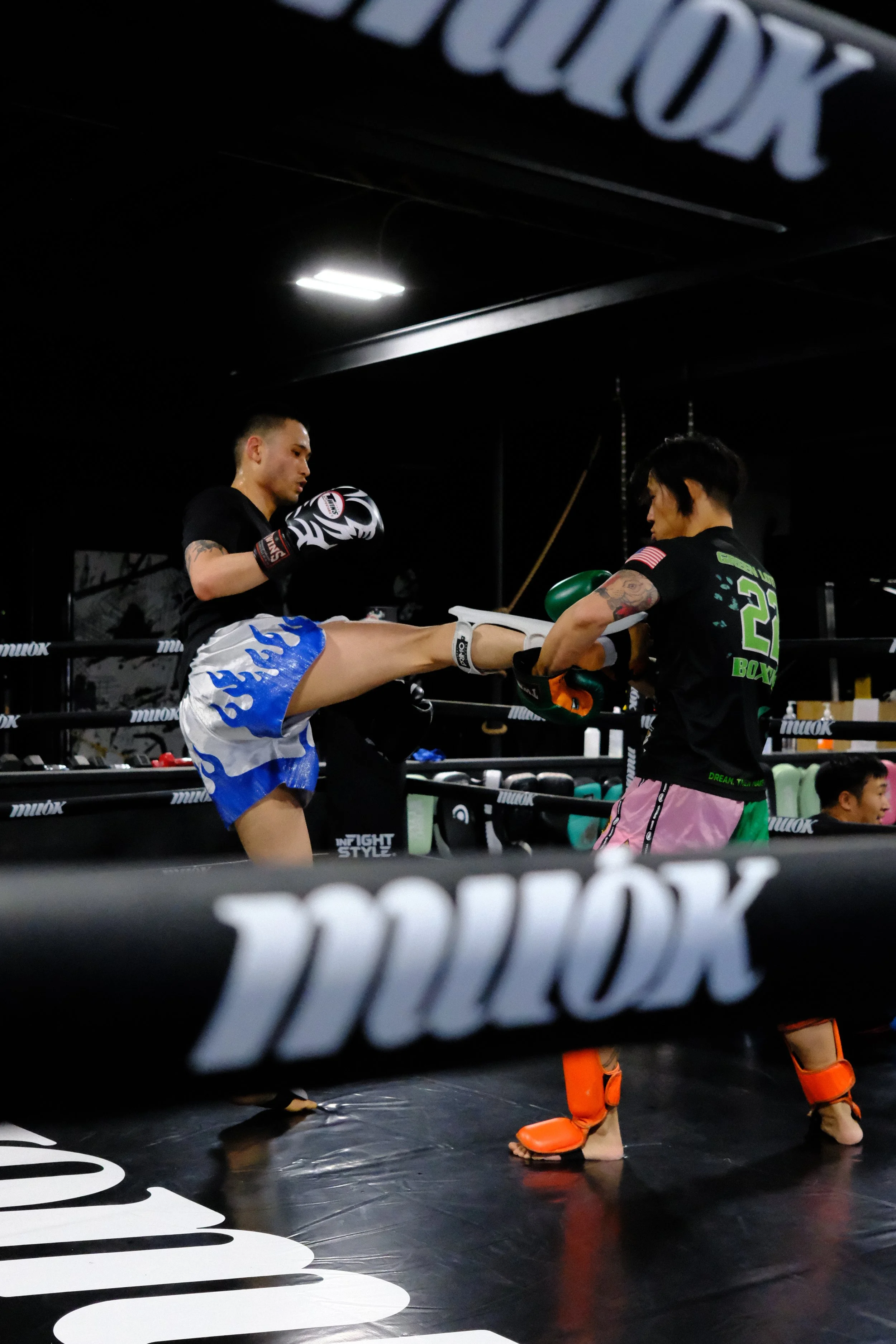
So where does Muók land in all this? Simple: we're a traditional Muay Thai gym, and that's a deliberate choice.
The stadium art is the complete art. Train it and you inherit the entire system — the teep and the sweep, the clinch in all its depth, the balance and posture that scoring has demanded of fighters for a hundred years, the five-round patience, and the culture that holds it together. Train that, and you can adapt to any ruleset later. Train only for three-round damage, and you've skipped the foundation.
We teach the full weapon set — including the parts entertainment scoring devalues. The clinch isn't an afterthought at Muók; it's core curriculum. Sweeps, off-balancing, knee positioning — the skills that win stadium rounds are the same skills that make you genuinely hard to deal with anywhere. Same with the teep: in the stadium game it's a scoring statement and a range weapon, and we drill it that way.
We train balance and composure as skills, not accidents. Stadium scoring rewards the fighter who stays in posture while everything happens around them — and that's trainable, not a personality trait. It's why our technique work is obsessive about base, weight transfer, and returning to position. That same composure is what keeps hobbyists safe in sparring.
We keep the culture. The wai kru ram muay — the pre-fight ritual honoring your teachers and your gym — is compulsory in every stadium in Thailand, and it's part of what we pass on here. Muay Thai isn't a delivery system for knockouts; it's a martial tradition with a lineage. Respecting that lineage is part of training at Muók.
We build fighters who understand the story of a fight. Five-round thinking — reading an opponent, pacing, peaking at the right moment — teaches ring IQ that a three-round sprint never demands. Even if you never compete, training with that mindset makes you a smarter, calmer martial artist.
Love the ONE highlights — we do too. But understand what you're watching: a version of the sport tuned for the screen. On our mats, you're learning the version tuned for depth — where balance beats aggression, where a clean sweep says more than a wild exchange, and where the art is bigger than the highlight. Learn that first, and everything else is available to you.
- Traditional/stadium: 8–10 oz gloves, 5 rounds, effect-based scoring, weighted rounds.
- Entertainment/modern: 4 oz gloves, 3 rounds, damage-based scoring, every round equal.
- Stadium scoring rewards effect over volume — one clean body kick beats five light punches.
- Rounds 3–4 decide a stadium fight. It's a story, not three sprints.
- Small gloves change everything: punches equalize, defense tightens, finishes multiply.
- RWS is the middle path: 3 rounds, per-round winners, volume/accuracy/power scoring — full gloves and legal sweeps kept.
- Sweeps aren't banned — instep sweeps and hip throws were always fouls; kick-based sweeps still score everywhere.
- Muók trains the traditional art — the complete system, culture included. Foundation first; adapt later.
Train the Real Thing.
Traditional Muay Thai in Georgetown, Seattle — the full art, from your first teep to the clinch. Come try a free class and feel the difference.
Book a Free Class →- Evolve MMA. An Updated Guide to the Muay Thai Scoring Systems of Today. 2024.
- Muay Thailand. Muay Thai Rules — Traditional vs Modern Rulesets. 2025.
- Muay Ying. Muay Thai Scoring Explained: Traditional vs. Entertainment Standards. 2025.
- Harrison L. Interview, The City Life Project, via Sportskeeda — on fighting under traditional vs 4-oz rulesets.
- Superbon. Interview, South China Morning Post, via Sportskeeda — on small-glove defense.
- Gym Bangarang (Kru Tommy, stadium judge). Muay Thai Rules and Scoring: A Fighter's Guide. 2025.
- Rajadamnern Stadium (official). A Beginner's Guide to the Muay Thai Point Scoring System — RWS judging criteria. 2026.
- Bangtao Muay Thai. Muay Thai 2.0: How Rajadamnern's New Promotion Is Changing the Game. 2025.
- Muay Thai Purist. Tournament Rules — legal vs illegal sweeps, trips, and throws.