Sleep — The Cheapest Upgrade You're Not Using
Sleep — The Cheapest
Upgrade You're Not Using.
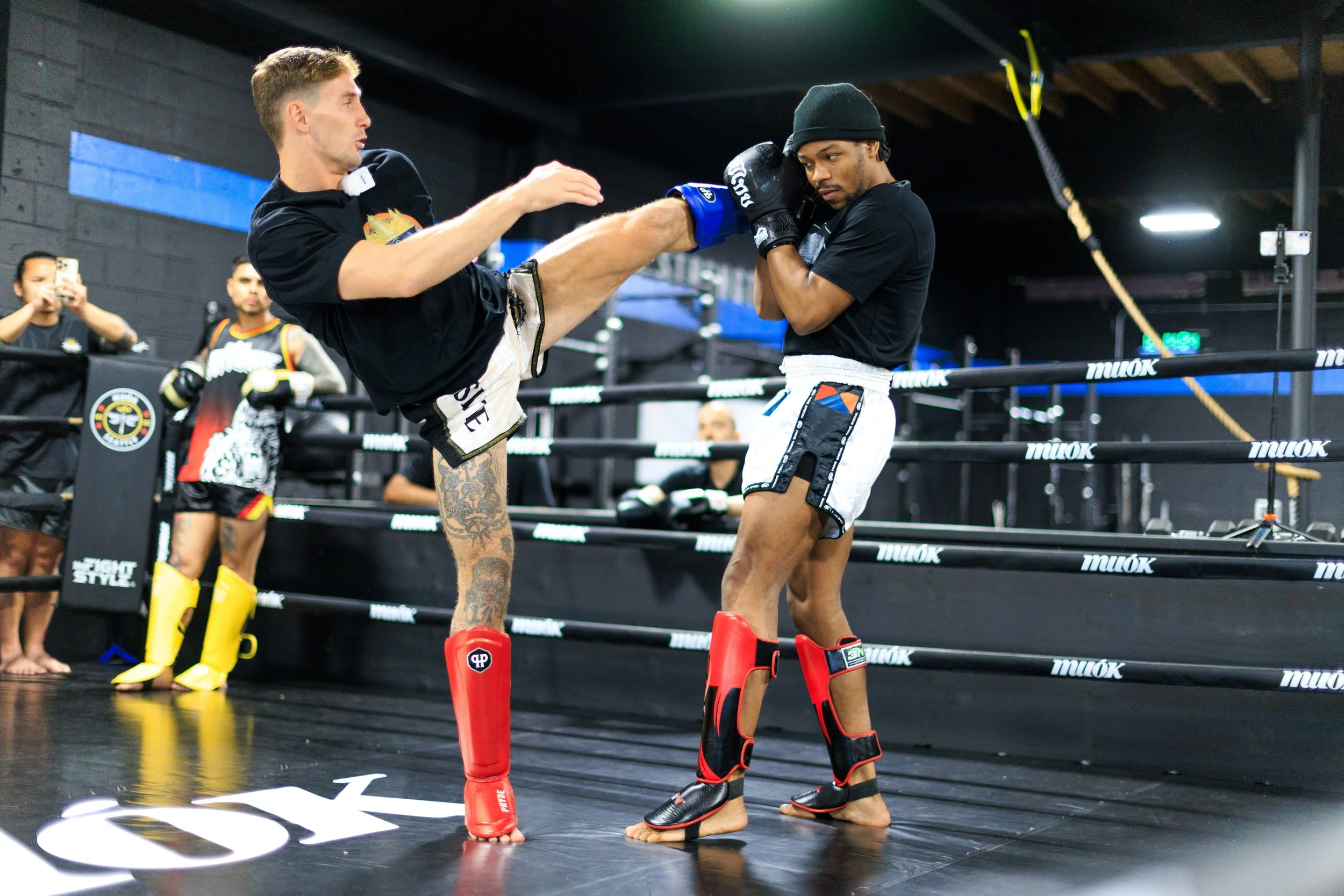
Every member who's serious about Muay Thai eventually optimizes something. Better gloves. More classes. Cleaner food. Supplements. Recovery gadgets.
Almost nobody optimizes sleep. And sleep is the one that's free, backed by the most evidence, and quietly determining whether the work you put in on the mats actually turns into skill.
Here's what the research says happens to a fighter's body and brain overnight — and what happens when you don't give it enough time to do the job.
Sleep isn't one thing. Your brain cycles through distinct stages roughly every 90 minutes, and each is doing a different job for a Muay Thai athlete.
You don't get better during training. You get better after it — while you're asleep. Training is just the request.
In 2011, Cheri Mah's team at Stanford ran a simple experiment on the men's varsity basketball team. Eleven athletes kept their normal sleep for a few weeks, then were asked to get a minimum of 10 hours in bed per night for the next five to seven. They didn't change training. They didn't change diet. They just slept more.
Put that in the ring. Slower reactions mean the kick you'd have checked, you don't. Degraded coordination means your landing mechanics get sloppy on a pivot. Reduced tissue tolerance means the shins that handled your training volume last month suddenly aren't.
A lot of what gets blamed on "bad luck" or "overtraining" is a sleep problem wearing a costume.
Every few months a member comes to us frustrated they've plateaued — technique feels stuck, they gas in round two, they keep tweaking something. We ask about volume. We ask about food. Then we ask how much they're sleeping — and it's five and a half hours on a good night. Fix that before you buy another supplement or add another class. It's free, and it's the biggest lever you've got.
None of this needs a $300 ring or a sleep coach. It needs treating the two hours before bed like part of your training — not the leftover time at the end of your day.
Nobody sleeps 8 hours every night. You have a job, maybe kids, maybe a 6am. The goal isn't perfection — it's raising your average. Going from a consistent 6 hours to a consistent 7.5 will do more for your Muay Thai than any supplement on the shelf. Aim for the trend, not a perfect record.
If you're doing the basics right — consistent schedule, dark cool room, caffeine controlled — and you're still exhausted, waking constantly, or in enough pain that you can't get comfortable, that's worth looking at properly. Persistent pain disrupts sleep, and disrupted sleep amplifies pain. It's a loop, and it doesn't break on its own.
That's one reason Root Physical Therapy is on-site — same building, same hallway. Our clinicians are Doctors of Physical Therapy (two coach Muay Thai here), and they treat sleep as a real recovery variable, not an afterthought. If pain is what's keeping you up, that's a thing they can actually fix. Washington is direct-access: no referral, most major insurance accepted. Just walk down the hall.
- Deep sleep rebuilds the body. Growth hormone, muscle repair, bone remodeling — front half of the night.
- REM files away your technique. Back half — the part you lose when you go to bed late.
- Under 8 hours = 1.7× the injury risk. In a contact sport, that's not a rounding error.
- Sleep more, react faster. Athletes who extended sleep got measurably quicker and more accurate.
- Cut caffeine by early afternoon — especially if you train at night.
- Alcohol destroys REM — the stage where your skill work actually sticks.
- Sauna after sparring helps you come down — and it's included with your membership.
Train hard.
Sleep harder.
New to Muók? Come try a free class — and see the training floor, the sauna, and the on-site PT clinic for yourself.
Book a Free Class →- Mah CD, Mah KE, Kezirian EJ, Dement WC. The effects of sleep extension on the athletic performance of collegiate basketball players. SLEEP. 2011;34(7):943–950.
- Milewski MD, et al. Chronic lack of sleep is associated with increased sports injuries in adolescent athletes. Journal of Pediatric Orthopaedics. 2014;34(2):129–133.
- Nedeltcheva AV, et al. Insufficient sleep undermines dietary efforts to reduce adiposity. Annals of Internal Medicine. 2010;153(7):435–441.
- Watson AM. Sleep and athletic performance. Current Sports Medicine Reports. 2017;16(6):413–418.
- Walker MP, Stickgold R. Sleep-dependent learning and memory consolidation. Neuron. 2004;44(1):121–133.