
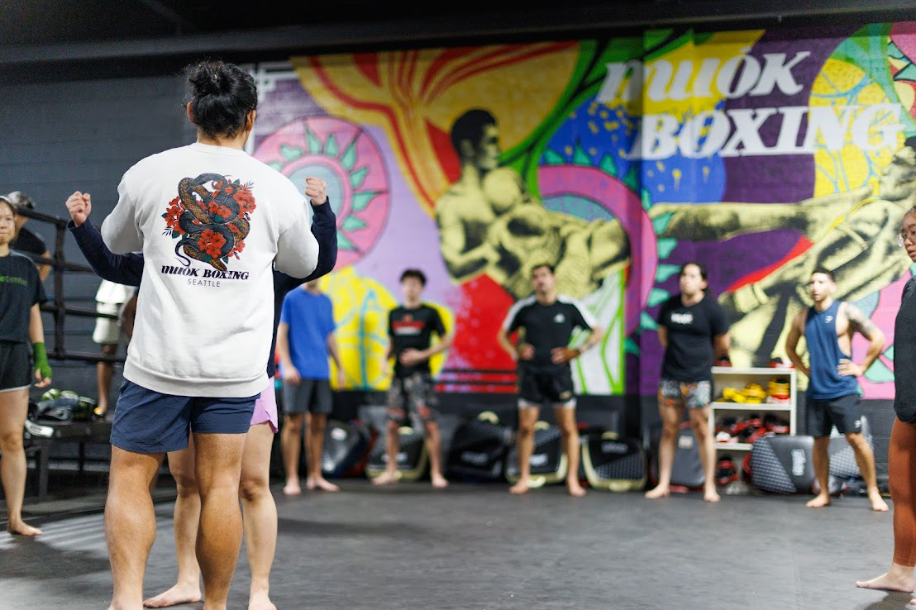
Kickboxing Gym in Seattle — What to Look For

If you've searched for a kickboxing gym in Seattle, you've probably noticed that the results cover a wide range of things — boutique fitness studios, martial arts schools, boxing gyms with kickboxing classes, and dedicated Muay Thai gyms. They all use similar language. They're not all offering the same thing.
This guide is going to help you understand what you're actually looking at — so you can choose the right gym for what you actually want.
Two Very Different Things Called "Kickboxing"
The word kickboxing gets applied to two fundamentally different types of training, and the difference matters more than most people realize before they start.
Neither is wrong — but they serve different goals. If you want a group fitness class that's more interesting than a treadmill, Type A works great. If you want to actually develop a skill, learn to defend yourself, and keep improving for years — you need Type B.
"The test is simple: after six months of training, will you have a real skill — or just a fitness habit? The gym you choose determines the answer."
What Is Muay Thai — And How Does It Relate to Kickboxing?
Muay Thai is often called the most complete kickboxing system in the world — and for good reason. Where Western kickboxing uses punches and kicks, Muay Thai adds elbows, knees, and clinch work, giving practitioners tools at every range. It's the reason Muay Thai has become the dominant striking base for MMA fighters globally — it works in every realistic context, not just within a narrow ruleset.
If you're searching for a kickboxing gym in Seattle, training Muay Thai gives you everything kickboxing offers — and significantly more. The kicks are the same. The punches are the same. But you also develop close-range weapons that kickboxing simply doesn't teach. For people who want real striking ability, Muay Thai is the more complete investment.
What to Look for in a Seattle Kickboxing Gym
Technical coaching — not just intensity
A good kickboxing or Muay Thai gym teaches you why techniques work — the hip mechanics behind a roundhouse kick, the guard position that protects you while you punch, the footwork that creates and closes distance. If a gym can't explain the mechanics behind what they're teaching, you're paying for a workout, not an education.
Structured progression
Beginners need a clear path — classes designed for their level, a curriculum that builds logically, and coaching that meets them where they are. If a gym throws everyone into the same class regardless of experience, beginners either get overwhelmed or coast without real challenge.
Controlled partner work
How a gym handles partner drilling and sparring tells you everything about its culture. Quality gyms are deliberate and controlled — partners work together to develop skill, not to prove anything. Walk away from any gym where the culture feels aggressive or where newer members don't feel safe.
Month-to-month membership
A gym that believes in what it offers won't need to lock you into a long-term contract. Month-to-month with no enrollment fees is the structure that tells you the gym earns your continued membership rather than trapping it.
A free trial
No reputable gym should ask you to commit before you've trained there. A free trial class is the only honest way to evaluate whether a gym is right for you. If a gym won't offer one — that tells you something.
Common Questions About Kickboxing in Seattle
-
Is kickboxing good for fitness?Yes — but technical kickboxing and Muay Thai produce better fitness outcomes than fitness kickboxing classes, because the movements are full-body, explosive, and constantly varied. You develop cardio, coordination, strength, and flexibility simultaneously rather than just working up a sweat.
-
Do I need experience to start?No. The best gyms are specifically designed for beginners — structured programs that build from the ground up. You don't need any martial arts background to walk in and start training effectively.
-
Is kickboxing or Muay Thai better for self-defense?Muay Thai is widely considered more practical for self-defense because it covers more ranges — including the close range where most real confrontations end up. The clinch, knees, and elbows give Muay Thai practitioners tools that pure kickboxing doesn't develop.
-
What equipment do I need?Nothing for your first class — a good gym provides everything for a trial. After a few weeks you'll want hand wraps and boxing gloves (16oz). Shin guards come later when you begin partner drilling. Don't buy equipment before your first class.
-
How many classes per week do I need?Three sessions per week is the ideal starting point — enough stimulus to improve consistently while allowing recovery between sessions. Consistency over time matters far more than volume in the short term.
Kickboxing and Muay Thai at Muók Boxing — Georgetown, Seattle
At Muók Boxing we teach authentic Muay Thai — the most complete kickboxing system available. Our coaches have trained extensively at renowned Thai camps including PK Saenchai, Manasak, and Sitjaopho, and bring that depth to every class we run.
Our classes are structured around two levels — beginner and experienced — so every member trains at the appropriate pace with dedicated coaching at their level. We run 17 classes per week across morning, midday, and evening time slots, with open gym available 7am–8pm daily.
- Real Muay Thai technique — punches, kicks, elbows, knees, clinch. Nothing watered down.
- Beginner-structured classes — you don't need experience to walk in and start improving immediately.
- Coaching staff with DPT backgrounds — injury prevention and movement quality built into every session.
- 9,000+ sq ft Georgetown facility — purpose-built for serious training, not a cramped fitness studio.
- Month-to-month membership — no enrollment fees, no contracts, no cancellation penalties.
- 200+ five-star Google reviews — the most reviewed Muay Thai gym in Seattle.
- Free trial class — experience it before committing to anything
- Beginner and experienced levels — 17 classes per week
- Authentic Muay Thai — the most complete striking art available
- Coaches trained at elite Thai camps
- 6332 6th Ave S, Georgetown, Seattle WA 98108
Muay Thai for beginners Seattle

If you've been thinking about trying Muay Thai in Seattle, you've probably run into one of two problems: either there's not enough information to know where to start, or there's so much conflicting advice that none of it actually helps. This guide cuts through both of those. We're going to tell you exactly what Muay Thai for beginners looks like — what to expect, what you need, how to pick the right gym, and what the first few months will actually feel like.
No fluff. Just the practical stuff that gets you from curious to actually training.
What Is Muay Thai — And Why Do Beginners Love It?
Muay Thai is a striking martial art from Thailand, sometimes called the Art of Eight Limbs because it uses fists, elbows, knees, and shins — eight points of contact compared to the two in boxing or four in kickboxing. It's one of the most complete stand-up combat systems in the world, and it also happens to be one of the best full-body workouts you can do.
Here's why beginners specifically tend to thrive in Muay Thai: the learning curve is steep enough to be engaging but structured enough to be manageable. Every class teaches something new. There's always another technique to refine, another combination to develop, another layer to the art. You don't plateau the way you do with conventional gym training — there's always more.
"Most people who try Muay Thai don't start because they want to fight. They start because they're bored, burned out, or looking for something that challenges them in ways the gym never did."
That said — Muay Thai is also genuinely difficult. The first few weeks are humbling. Your coordination won't be there yet, your cardio will get tested, and your shins will be sore. This is completely normal and completely temporary. The members who stick with it past the first month almost universally describe it as one of the best decisions they've made.
What to Look for in a Muay Thai Gym in Seattle
Seattle has more Muay Thai options than most people realize, and not all of them are equal. Choosing the right gym for your first experience matters — the wrong environment can make a great sport feel unwelcoming.
Structured Beginner Classes
A good gym doesn't throw beginners into advanced open mat sessions. Look for dedicated beginner programming — classes that build fundamentals in a logical sequence and are explicitly designed for people with no prior experience. If a gym can't tell you exactly how they teach beginners, that's a flag.
Technically Focused Coaching
There's a real difference between a gym that teaches you to hit hard and one that teaches you to move correctly. Look for coaches who explain the mechanics — why hip rotation matters, how guard position affects balance, what makes a teep effective. Technical coaching produces practitioners who improve for years. Pure intensity coaching burns people out.
An Ego-Free Culture
Some Muay Thai gyms carry a culture of aggression that can feel unwelcoming to newcomers. The best gyms for beginners prioritize controlled partner work, mutual respect, and genuine support for members at every level. Visit before you commit — pay attention to how experienced members treat new people.
Month-to-Month Membership
A gym confident in what it offers won't need to lock you into a long-term contract. Look for month-to-month memberships with no enrollment fees and no cancellation penalties. That structure tells you the gym believes you'll stay because you want to — not because you're locked in.
A Free Trial Class
Any reputable gym will offer a free trial. If they don't — that tells you something. Always train once before committing. The trial lets you experience the coaching quality, the gym culture, and the facility before spending any money.
What You Need for Your First Class
One of the most common beginner mistakes is buying equipment before ever attending a class. Here's what you actually need at each stage:
-
01For your trial class — nothingA good gym provides everything for a trial class. Wear athletic clothing, bring a water bottle, and show up. That's it. Don't buy gloves or wraps until you know you're going to stick with it.
-
02After your first few weeks — the essentialsHand wraps (180" cotton), boxing gloves (16oz for bag and pad work — don't buy cheap ones), and a mouthguard. These three items cover everything you need for the first several months.
-
03When you're ready for sparringShin guards and a cup (for men). Traditional Muay Thai shorts become worthwhile once you're training regularly — the wider cut allows full hip range of motion that standard athletic shorts restrict.
What the First Three Months Actually Look Like
Common Beginner Mistakes to Avoid
Going hard too early
Muay Thai rewards patience. A punch thrown correctly at 50% effort is worth ten times more than one thrown hard with bad form. The power comes naturally once the mechanics are built. Don't rush the foundation.
Holding too much tension
Beginners almost universally hold too much tension in their shoulders, jaw, and hands. Relaxation is a skill — staying loose between strikes makes you faster, more efficient, and less fatigued. When a coach tells you to breathe and relax, that's one of the most important technical corrections they can give.
Comparing yourself to experienced members
The person moving fluidly next to you may have trained for three years. Focus entirely on your own progress. Your only meaningful benchmark is where you were last month.
Buying too much gear too soon
Don't spend money on equipment until you've attended enough classes to know you're going to continue. Start with the minimum, upgrade as you go.
Frequently Asked Questions
-
Do I need to be fit before starting Muay Thai?No. Muay Thai will get you fit — you don't need to arrive fit. The training itself is the conditioning program. Show up at whatever fitness level you're at and let the classes do the work.
-
Is Muay Thai safe for beginners?At a well-structured gym with experienced coaches, yes. Beginner classes are designed to build skills safely, with controlled partner drilling rather than full-contact sparring. You control the pace of your own progression.
-
Do I have to spar?No. Sparring is always optional and should only begin when you and your coaches feel you're ready — typically several months into training at a minimum. Most beginners train for many months before sparring, and some never spar at all. Both approaches are completely valid.
-
How often should I train as a beginner?Three sessions per week is an ideal baseline. It gives your body enough stimulus to adapt and improve while allowing recovery between sessions. More is fine once your body has adjusted — but three consistent sessions beats five inconsistent ones every time.
-
Will I get hurt?You'll be sore — especially your shins in the early weeks as they condition to striking. Serious injuries at a well-run beginner class are rare. The biggest risk factors are overtraining early, poor technique, and ego-driven sparring — all of which a good coach will help you avoid.
- 17 structured classes per week across beginner and experienced levels
- Coaching staff including multiple Doctors of Physical Therapy
- 9,000+ sq ft facility in Georgetown with open gym 7am–8pm
- Month-to-month membership — no enrollment fees, no contracts
- 200+ five-star Google reviews from real members
Muay Thai vs MMA
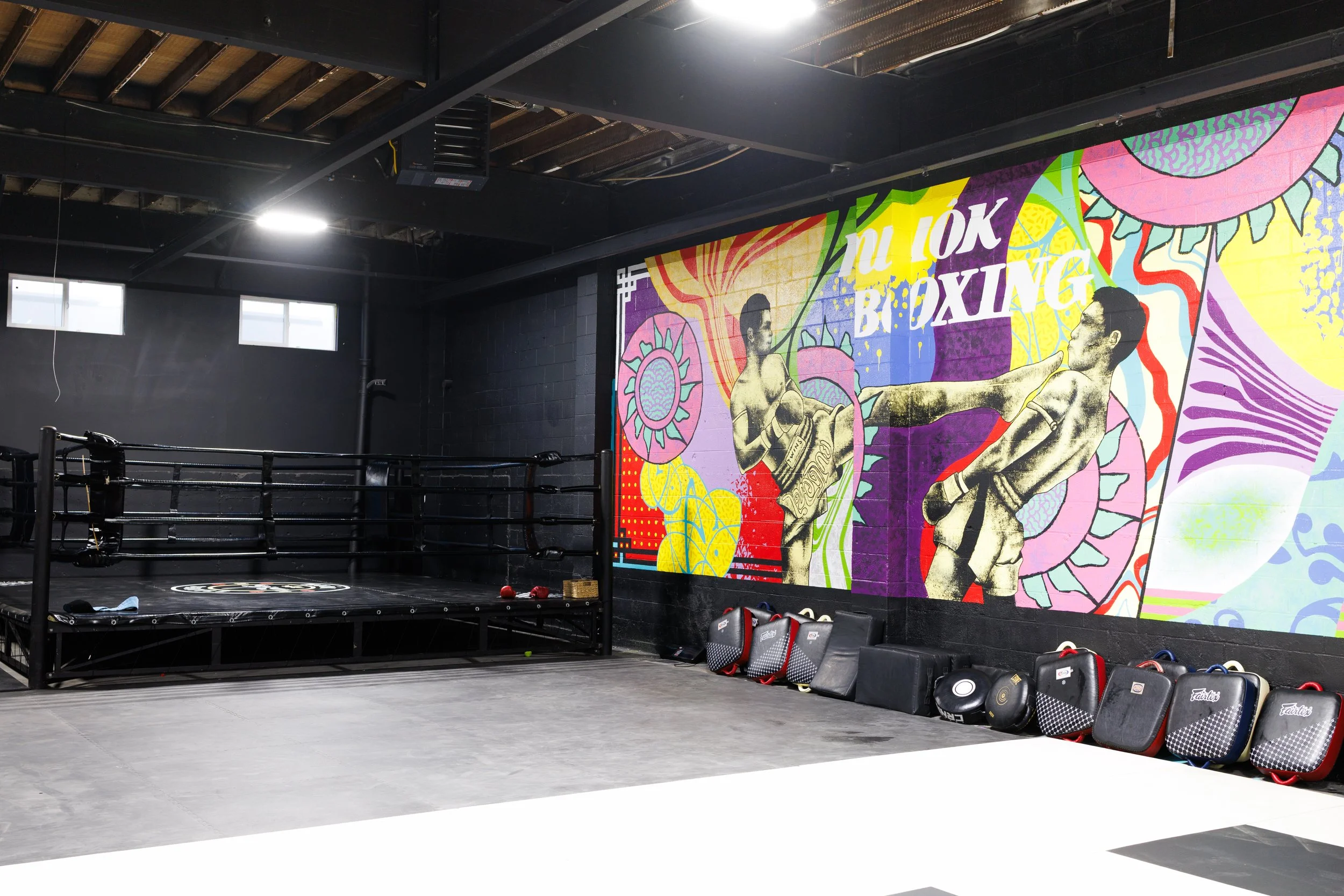
It's one of the most common questions we get from people who are new to martial arts: should I do Muay Thai or MMA? They're related — Muay Thai is actually one of the core components of MMA — but they're different disciplines with different commitments, different learning curves, and different things to offer.
We teach Muay Thai at Muók Boxing, so we have a perspective. But we also think the honest answer matters more than the promotional one. Here's how we'd actually think through this decision.
What Each One Actually Is
- Striking art using punches, kicks, elbows, knees, and the clinch
- Deep technical language developed over centuries in Thailand
- Stand-up only — no ground fighting or grappling
- One discipline mastered deeply over time
- Strong competitive scene in Seattle and nationally
- Combines striking, wrestling, and ground fighting (BJJ/grappling)
- Requires competency across multiple disciplines
- Fight can go to the ground — must be comfortable there
- Broader skill set, longer road to proficiency
- UFC-inspired — amateur competition is less accessible for beginners
The simplest way to think about it: MMA is a combination of martial arts, and Muay Thai is one of the most important pieces of that combination. Many serious MMA fighters spend years drilling Muay Thai specifically because the striking game it develops is so transferable.
The Case for Starting with Muay Thai
If you're new to martial arts, we'd almost always recommend starting with Muay Thai — and not just because we teach it. Here's the honest reason.
MMA requires you to learn multiple disciplines simultaneously. You need to be comfortable striking, comfortable on the ground, comfortable in the transition between the two. For beginners, that's a lot to process at once. Progress can feel slow because you're always in beginner mode across several areas.
Muay Thai lets you go deep in one discipline. You build a strong striking foundation — footwork, timing, distance management, the clinch — that transfers directly to MMA if that's where you eventually want to go. Many fighters who excel in MMA got there by mastering their Muay Thai first.
"Muay Thai is not a detour from MMA — it's one of the most direct paths into it. A fighter with strong Muay Thai is dangerous from day one."
What you build with Muay Thai
The striking range in Muay Thai is unmatched in any other martial art. You learn to use all four limbs as weapons — hands for boxing combinations, legs for kicks and teeps, knees for close range, elbows for the clinch. The clinch work alone takes years to develop properly and is one of the most underappreciated skills in combat sports.
Beyond the techniques, Muay Thai builds timing, rhythm, and body awareness that make everything else in martial arts easier to learn. When you eventually add wrestling or jiu-jitsu, you'll be a much better student because your body already knows how to move.
When MMA Might Be the Right Choice
MMA is the right call if you have a specific goal: competing in MMA, being a well-rounded martial artist across all ranges, or you're already competent in one area and want to fill gaps. It's also a great choice if the idea of grappling and ground fighting genuinely excites you — because you'll be spending a lot of time there.
The honest trade-off is depth for breadth. MMA gyms teach you enough of each discipline to function in a fight — but you rarely develop the same depth in any one area that a specialist gym does. If you want to be truly dangerous with your hands and feet, a Muay Thai-focused gym will get you there faster.
Who Should Choose What
How We Train Muay Thai at Muók Boxing
If Muay Thai is the direction you're leaning, here's what training at Muók Boxing in Georgetown actually looks like.
We teach authentic, technically grounded Muay Thai — all eight limbs including the clinch, with an emphasis on real technique rather than cardio-based movement. Our coaches are Doctors of Physical Therapy who've trained at world-renowned camps in Thailand and competed internationally. We structure classes for all levels with dedicated beginner and advanced groups in the same session, each with their own instructor.
We offer 17 classes per week, open gym from 7am to 8pm on weekdays, a full strength and conditioning zone through Root Strength, and an on-site physical therapy clinic. Whether you want to train casually, get seriously fit, or eventually compete — the structure is there to support it.
And if you eventually want to add MMA to your toolkit after building your Muay Thai foundation — you'll be in a much stronger position to do it.
What to Look For in a Muay Thai Gym in Seattle

Choosing a Muay Thai gym is one of those decisions that feels simple on the surface and turns out to matter a lot. The gym you pick shapes the habits you build, the technique you develop, and whether you actually stick with it long enough to get good.
Seattle has a genuine Muay Thai community. There are solid options around the city — but there's also a lot of variation in what gyms teach, how they teach it, and what the experience of training there actually looks like day to day.
We're coaches at Muók Boxing in Georgetown, so we have a perspective. But we also think the most useful thing we can do is help you understand what to actually look for — because the first six months of Muay Thai set the foundation for everything that comes after, and the habits you build early are hard to undo.
Real Muay Thai vs. Cardio Kickboxing
The first thing to understand is that not every gym using the words "Muay Thai" is actually teaching Muay Thai. There's a wide spectrum — from authentic technical training rooted in the art's traditions, to fitness classes that borrow the branding without the depth.
Neither is wrong. But they're different products, and you should know which one you're signing up for.
What authentic Muay Thai includes
Real Muay Thai is the art of eight limbs — punches, kicks, elbows, knees, and the clinch. A technically grounded gym teaches all of it. Teeps for range control. The clinch for close-range fighting. Timing and distance management, not just power. Defensive footwork and head movement. Padwork that builds real skill, not just conditioning.
If a gym's classes feel like a high-intensity workout where Muay Thai is the theme, that's cardio kickboxing. Nothing wrong with it as fitness — but if you want to actually learn Muay Thai, you'll outgrow it quickly and need to start over somewhere else.
"The habits you build in your first six months of Muay Thai are hard to undo. The gym you choose determines those habits."
What Actually Makes a Great Muay Thai Gym
Here's what we'd tell anyone evaluating a gym — including ours.
Always Try Before You Commit
No review, no Instagram feed, and no blog post — including this one — can tell you whether a gym is right for you. The feel of a place is something you can only assess in person. The energy when you walk in. How coaches talk to newer members. Whether people are genuinely focused or just going through the motions.
Any gym worth training at will offer a trial class. Take it. Show up with your eyes open and use the checklist above. You'll know pretty quickly whether it's a place you want to spend a lot of time.
Why We Built Muók Boxing the Way We Did
We've spent a lot of time thinking about what a great Muay Thai gym looks like — because we were trying to build one. Here's where we landed.
Coaching: Our staff includes multiple Doctors of Physical Therapy with over a decade of Muay Thai experience. Coaches have trained at world-renowned camps in Thailand — PK Saenchai, Manasak, Sitjaopho — and competed internationally. We teach real Muay Thai: all eight limbs, the clinch, the timing. Not a fitness class with Muay Thai branding.
Program structure: 17 classes per week for all levels. Beginners and advanced members train in the same session but with dedicated instructors and separate lesson plans for each group. Open gym runs 7am to 8pm on weekdays so you can train on your own schedule between classes.
The facility: A 9,000+ sq ft purpose-built warehouse in Georgetown. Dedicated Muay Thai training areas, a full strength and conditioning zone through our partnership with Root Strength, an on-site physical therapy clinic that accepts insurance, a large sauna, showers, and locker rooms. Everything in one place — by design.
The community: Ego-free, welcoming, and genuinely invested in each other. Members remember each other's names. Experienced practitioners help beginners. The culture is set by the people who show up every day — and we're proud of who those people are.
We started in a 168 sq ft garage during the pandemic — one group, one mat, masks and an open door in the Seattle winter. We grew because the training was real and the community showed up. The Georgetown facility is the next chapter of the same story.
If you're in Seattle and Muay Thai has been on your list — come try a class. No experience required, all equipment provided. Just show up 15 minutes early so we have time to walk you through what to expect.
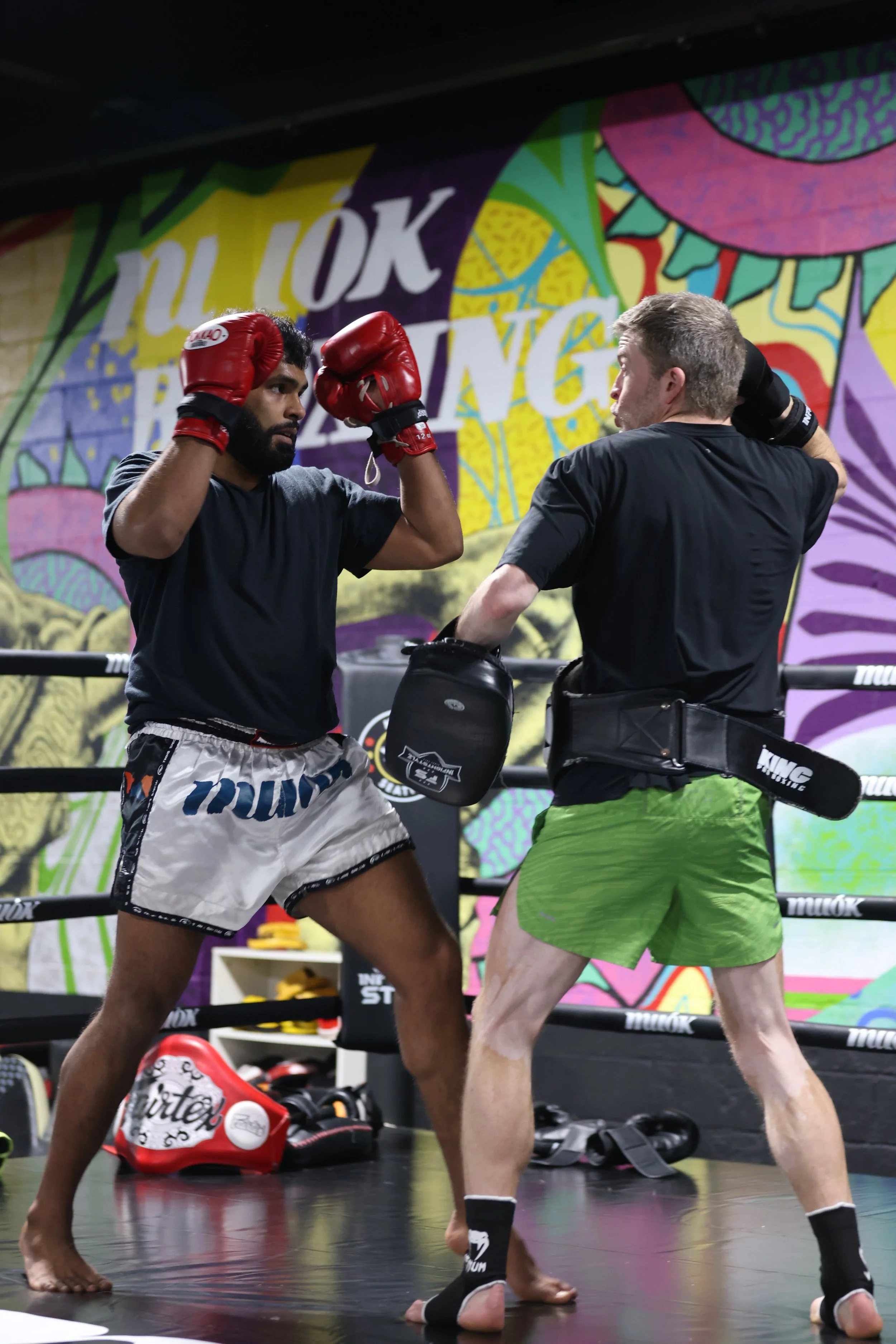
How We Do Padwork at Muók Boxing
Watch the video above. What you're seeing isn't just a workout. It's a conversation — between a coach who knows how to draw the best out of a student, and a student who has put in enough work to start finding their rhythm. That back-and-forth, that sense of connection and flow, is what padwork at Muók Boxing is built around.
Most gyms treat padwork as a fitness drill. You show up, hit the pads hard, sweat a lot, go home. At Muók, we see it differently. Padwork is where technique becomes instinct. It's the bridge between learning a movement in isolation and being able to execute it under pressure, with timing, with flow.
Our Approach to Padwork
At Muók Boxing, padwork is structured, intentional, and coached with the same attention to detail we bring to every other part of training. Here's what that looks like in practice.
"Padwork done right is one of the most technical, beautiful things in Muay Thai. It's where the art reveals itself — in the timing, the rhythm, the connection between coach and student."
What We Use
Muók Boxing uses a full range of striking equipment in padwork sessions — each piece serves a specific purpose in developing different aspects of Muay Thai technique.
What Flow Actually Feels Like
Most beginners experience their first real flow moment somewhere around month two or three of consistent training. It usually happens mid-round — a combination lands cleanly, the next technique flows naturally from it, and for a few seconds everything feels effortless. Then it's gone. But now you know it's possible.
That moment is what we're building toward in every padwork session. The accumulation of correct repetitions, the development of timing, the growing trust between student and coach — all of it compounds toward that state where technique stops being something you think about and becomes something you simply do.
"Flow isn't the absence of effort — it's effort that has been practiced so many times it no longer feels like effort. It's technique that has become instinct."
Padwork for All Levels
One of the things we're most proud of at Muók Boxing is that our padwork sessions genuinely work for everyone — from people attending their very first class to experienced competitors preparing for a fight.
For beginners, padwork is about building the movement patterns that everything else in Muay Thai is built on. Stance, guard, the mechanics of a jab, the hip rotation of a kick. The pace is deliberate, the combinations are simple, and the focus is entirely on correct form.
For experienced practitioners, padwork is where those patterns are tested under pressure — longer combinations, faster calls, more complex angles, higher expectations. The goal shifts from learning the movement to owning it.
What stays the same at every level is the standard of coaching, the attention to detail, and the commitment to building technique that lasts — not just fitness that fades.
- Dedicated padwork sessions throughout the weekly schedule
- Coaches including multiple Doctors of Physical Therapy
- Full range of striking equipment — Thai pads, mitts, bags, and more
- 17 classes per week · 9,000+ sq ft facility in Georgetown
- Month-to-month memberships — no contracts, no enrollment fees