Muay Thai vs Kickboxing: What's the Difference?
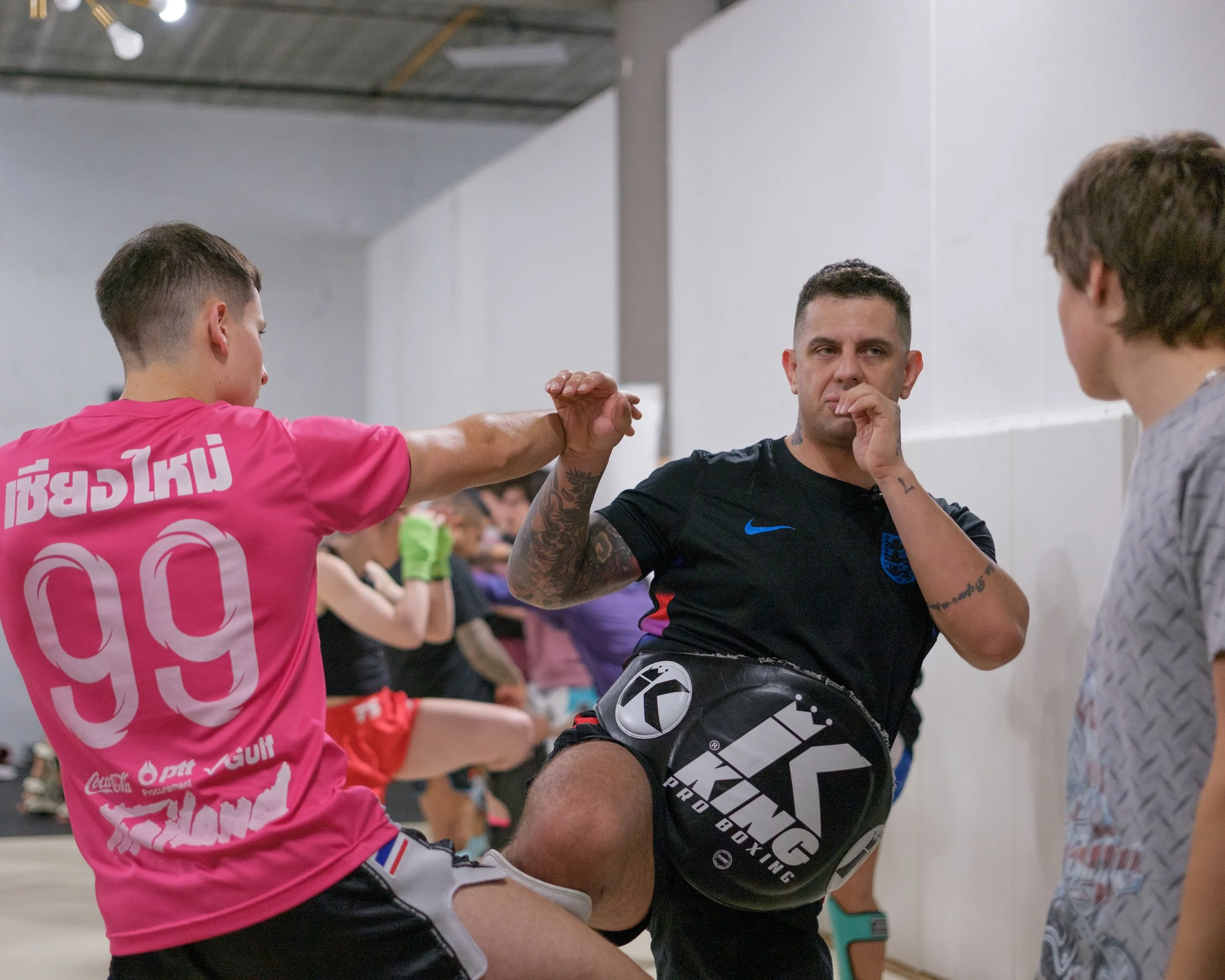
If you've been looking into combat sports or martial arts classes in Seattle, you've probably come across both Muay Thai and kickboxing. From the outside, they look almost identical — people in gloves, throwing punches and kicks. So what's actually different, and does it matter which one you choose?
It matters quite a bit. While they share some surface similarities, Muay Thai and kickboxing are fundamentally different disciplines — in their techniques, their history, their culture, and what they'll teach you. This guide breaks it all down so you can make an informed decision.
The Short Answer
Kickboxing is a striking sport that uses punches and kicks. Muay Thai is a striking art that uses punches, kicks, elbows, knees, and the clinch — giving you eight points of contact instead of four. Muay Thai is older, more comprehensive, and widely considered the more complete stand-up striking system of the two.
But there's much more to it than that.
A Brief History of Each
Muay Thai
Muay Thai has roots in Thailand dating back several centuries, developed as both a combat system and a cultural tradition. It was refined by Thai soldiers and practitioners over generations, and remains Thailand's national sport today. Fights are held in a deeply ritualized context — fighters perform a pre-fight dance called the Wai Kru to pay respect to their trainers and the art itself.
This history matters because Muay Thai wasn't designed as a sport first — it was designed to be effective in real combat. Every technique has a practical purpose, which is why it's become the dominant striking base in modern mixed martial arts.
Kickboxing
Kickboxing as a formal sport emerged in the 1970s, primarily in Japan and the United States, as a hybrid of Western boxing and various kicking arts like karate. It was designed from the start as a competition sport, with rules that made it accessible and exciting for audiences. Different kickboxing rulesets exist — American, Japanese, Dutch-style — each with slightly different rules around kicks, sweeps, and clinch work.
This doesn't make kickboxing less valuable — Dutch kickboxing in particular is known for producing elite strikers. But it does mean kickboxing is a purpose-built sport, whereas Muay Thai is a martial art that also happens to be a sport.
The Technical Differences
Weapons: 4 vs 8
This is the biggest practical difference. Kickboxing uses fists and feet — four points of contact. Muay Thai uses fists, feet, elbows, and knees — eight points of contact. That means in Muay Thai you have twice as many ways to attack and defend.
Elbows and knees aren't just bonus weapons — they change the entire geometry of a fight. Elbows are devastating at close range, where punching loses power. Knees dominate the mid-range clinch, an area kickboxing largely ignores.
The Clinch
One of the most significant distinctions is clinch work. In most kickboxing rulesets, when two fighters grab each other, the referee immediately separates them. In Muay Thai, the clinch is a core technical domain — fighters spend considerable time learning to control, off-balance, and strike from the clinch position.
This makes Muay Thai dramatically more complete as a self-defense tool. Real-world confrontations often end up at close range. A Muay Thai practitioner is trained to operate effectively there. A kickboxer often isn't.
Stance and Movement
Muay Thai fighters typically use a more upright stance with a higher guard than boxers or kickboxers. Movement tends to be more measured and deliberate — Muay Thai values balance and composure over constant footwork. Kicks are thrown with the shin (not the foot), which is harder, more durable, and more powerful when conditioned correctly.
Kickboxing, particularly Dutch-style, places more emphasis on boxing combinations and lateral movement. The style tends to be more aggressive in punch output, with kicks used to complement the boxing rather than as primary weapons.
Side-by-Side Comparison of Muay Thai vs Kickboxing
Which Is Better for Fitness?
Both are excellent full-body workouts that build cardiovascular endurance, coordination, core strength, and mental toughness. If pure fitness is your goal, either discipline will deliver results most traditional gym programs can't match.
That said, Muay Thai's broader technical range means more muscle groups are engaged more often. The clinch work alone develops grip, upper back, and shoulder endurance that kickboxing doesn't train. For total-body conditioning, Muay Thai has a slight edge.
Which Is Better for Self-Defense?
Muay Thai. It's not particularly close. The inclusion of elbows, knees, and clinch work means a Muay Thai practitioner is equipped to handle situations at every range — long, mid, and close. Kickboxing leaves significant gaps at close range where most real altercations end up.
This is also why Muay Thai has become the universal striking foundation in MMA. Coaches at the elite level consistently choose Muay Thai as the base striking art because of how well it transfers to real fighting scenarios.
Which Is Better for Beginners?
Both are beginner-friendly at a good gym. Kickboxing has a slightly lower initial learning curve because there are fewer techniques to absorb early on. Some people find that easier to start with.
However, at a technically-focused Muay Thai gym, beginners are introduced to the full system progressively — you don't need to learn everything at once. Structured beginner classes build the foundation step by step, and most people find that within a few weeks, the additional techniques start to feel natural rather than overwhelming.
At Muok Boxing, our beginner classes are specifically structured for people with zero experience. Coaches with backgrounds in physical therapy guide you through proper mechanics from your first class, making the learning curve manageable regardless of your starting point.
So Which Should You Choose?
If you're deciding between the two, here's a simple framework:
Choose Muay Thai if you want the most complete striking system, are interested in MMA, value self-defense effectiveness, or want to train something with deep cultural roots and tradition.
Choose kickboxing if your primary goal is sport competition in a kickboxing-specific ruleset, or if you're coming from a boxing background and want to add kicks without the full Muay Thai curriculum.
For the vast majority of people — beginners, fitness-focused members, and self-defense seekers alike — Muay Thai is the stronger long-term investment. The broader skillset opens more doors, and the training is just as accessible at a well-structured gym.
Train Muay Thai in Seattle at Muok Boxing
Muok Boxing is Georgetown, Seattle's authentic Muay Thai gym. Our coaching staff — which includes multiple Doctors of Physical Therapy — teaches the full Muay Thai system with an emphasis on technical precision, safety, and long-term athletic development.
We offer 17 classes per week across beginner and experienced levels, open gym from 7am–8pm, and a 9,000+ sq ft facility built specifically for serious training. Whether you've never thrown a punch in your life or you're coming from a kickboxing background looking to add depth to your game, there's a place for you here.