The Most Common Injuries in Muay Thai — and what to do about them
The Most Common Injuries
in Muay Thai — and what to do about them.
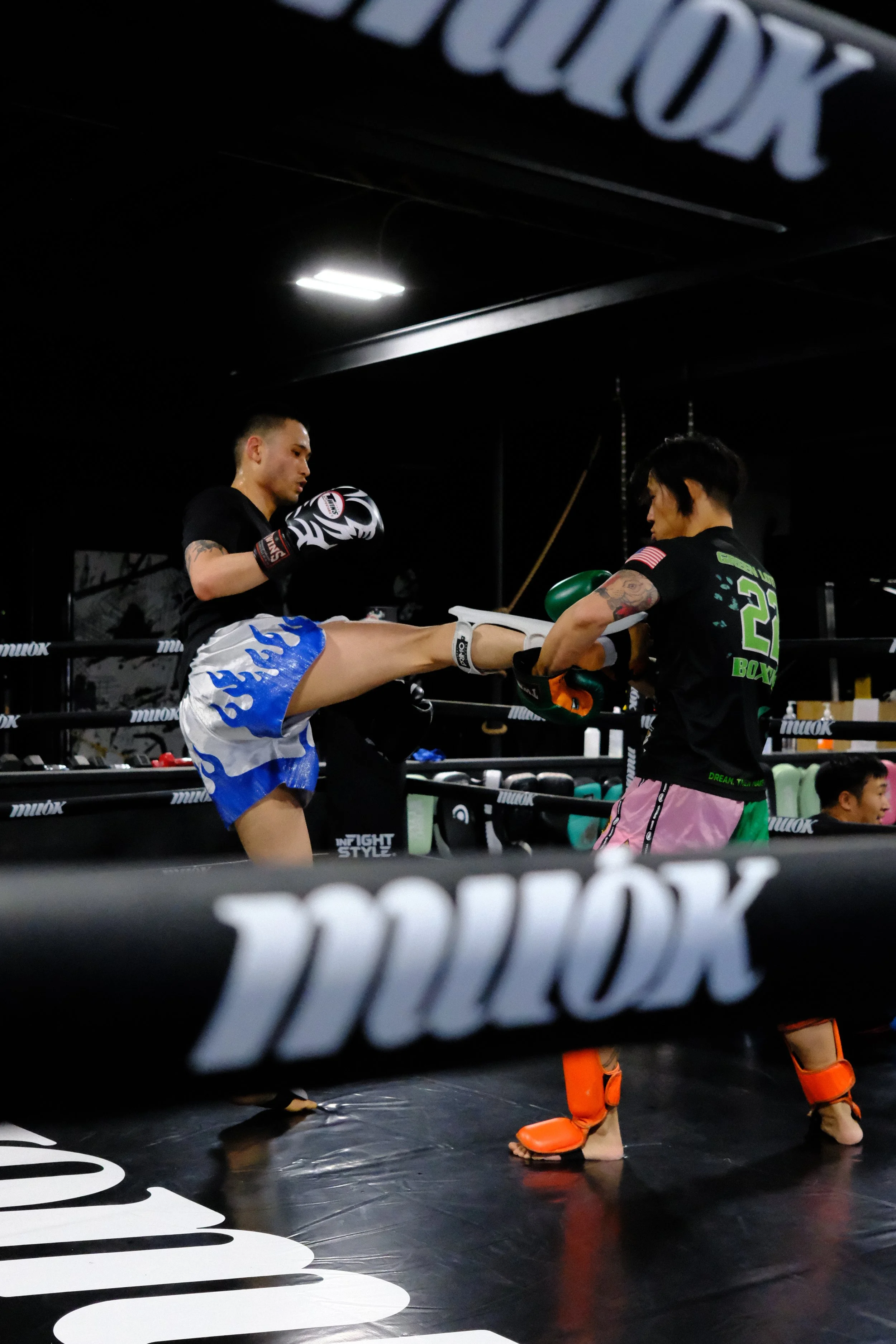
Tell someone you train Muay Thai and watch their face. They're picturing broken noses and shattered shins — a sport that uses your body up. The actual injury research paints a much less dramatic picture: mostly bruises, sprains, and strains, mostly in the legs, and mostly happening to people in their first year, before their body and their technique have caught up with their enthusiasm.
That last part matters, because it means the injury story in Muay Thai isn't really about bad luck. It's about load, technique, and honesty — three things a good gym can actually do something about.
So here's the field guide: the six regions that actually complain, what's usually going on, and the honest call for each — when to train through it, when to modify, and when to walk down the hall to the clinic.
Read those three numbers together and a story emerges. Muay Thai injuries cluster in the legs, cluster in beginners, and are overwhelmingly soft tissue rather than structural. In other words: the typical Muay Thai injury isn't a dramatic fight-night moment. It's a training injury — a shin that got overloaded, an ankle that rolled on a sloppy pivot, an adductor asked to kick at a range it doesn't own yet.
Almost nothing on this list is bad luck. It's load arriving faster than adaptation.
Deep bruising, tender spots, and the diffuse ache that gets filed under "shin splints." Here's the thing nobody tells beginners: shin conditioning is bone remodeling, and remodeling runs on its own schedule — weeks and months, not sessions. Every hard round of kicks is a request for adaptation. Pile requests on faster than the bone can answer and you get pain. We wrote a full guide to shin pain for exactly this reason.
Rolled ankles from pivots and missed kicks, bruised insteps from landing on an elbow or a knee instead of the pad, and jammed toes from teeps that arrive a beat early. The ankle sprain deserves special mention because almost everyone manages it wrong — the old advice was rest it for weeks; the current evidence says protected early movement heals it faster and better.
Adductor and hip-flexor strains — the classic "I felt it on a high kick" injury. The pattern is almost always the same: kicking at heights and angles your hips don't currently own. Flexibility arrives slower than ambition, and the muscle that pays the difference is usually the groin. (This is also why we bang on about hip mobility so much.)
Bruised knuckles, sore wrists, the occasional sprained thumb. The honest diagnosis for most hand and wrist pain in a Muay Thai gym is equipment and alignment, not combat: wraps done in ninety seconds, gloves a size wrong, and hooks landing on the heavy bag with a bent wrist. Your hand has twenty-seven bones and none of them enjoy improvisation.
Bruised ribs from body kicks, strained intercostals from clinch work. Here's an odd detail from the research: trunk injuries are disproportionately a beginner problem. It makes sense once you've coached — new people haven't yet learned to absorb a body shot with their guard, their breath, and their base, so the ribs take it raw. Absorbing impact is a skill, and it's one of the quieter things you're learning in your first six months.
We're not going to fold the head into a cute card format, because it doesn't belong there. Here's the straight version: in competing amateurs and professionals, head injuries are the second most common category. In training, head contact is a dial, and the gym decides where it's set.
At Muók it's set conservatively. Hard sparring is earned, not default; intensity is coached, not left to whoever's feeling spicy that day; and a suspected concussion ends your session — no negotiation, no "I'm fine, coach." Symptoms after head contact — headache, fog, nausea, light sensitivity, feeling off — mean you're done for the day and following an actual return protocol. We wrote up the full concussion guide so nobody has to guess what that looks like.
You can train around a sore shin. You do not train around a brain.
The single most useful idea to steal from the physical therapy world is the distinction between hurt and harm. Pain is information, but it's noisy information — soreness after a hard session is your body adapting, not breaking. The skill is telling the difference, and it's more learnable than people think. Here's the three-lane version our coaches and the Root PT clinicians agree on:
- General muscle soreness after hard sessions
- Bruises that bloom, yellow, and fade
- Stiffness that eases as you warm up
- Shin tenderness that's broad, dull, and improving
- Pain that changes how you move or strike
- Anything unchanged after two weeks
- Pain trending sharper, not duller
- Visible swelling around a joint
- The same spot complaining every session
- A joint that gives way or feels unstable
- Can't bear weight, or pain with every breath
- Numbness or tingling anywhere
- Sharp, pinpoint bone pain
- Pain that wakes you at night
- Any suspected concussion
A blog post can teach you the lanes; it can't examine your ankle. If you're genuinely unsure which lane you're in, that uncertainty is itself the answer: ask. Ask a coach mid-class, or book twenty minutes with the clinicians at Root PT — same building, no referral needed in Washington, most major insurance accepted. The expensive injuries are almost never the ones people ask about early. They're the ones people sat on for three months.
Back to that five-times number, because it's the most useful one in this whole article. Why do beginners get injured at several times the rate of experienced amateurs — in a sport where the experienced people are the ones getting kicked harder?
Three reasons, and none of them is toughness. First, tissue lags. Your cardio adapts in weeks; your tendons, bones, and connective tissue adapt in months. Early on there's a gap between what you're willing to do and what your structures are ready for, and injuries live in that gap. Second, technique errors load the wrong things. A rolled ankle on a pivot isn't bad luck — it's a pivot that needed fixing. Bad wraps, bent wrists, kicks thrown past your flexibility: each one is a small mechanical error collecting interest. Third, beginners don't say anything. New members assume pain is the price of admission and quietly push through things a coach could have adjusted in one conversation. (There's a fourth, unglamorous factor too: recovery. If you're training hard on six hours of sleep, you're stacking the deck against your own tissue — we wrote about that as well.)
All three are fixable, and fixing them is most of what a good gym quietly does: a curriculum that builds load gradually, coaches who correct mechanics before they become injuries, sparring that's controlled by culture rather than left to ego — and, in our case, a PT clinic in the same building, with two Doctors of Physical Therapy who also coach on these mats and know exactly what a switch kick asks of a hip.
The members who stay healthy for years aren't the ones who never feel anything — they're the ones who tell us early. "Coach, my shin's been weird for two weeks" is a thirty-second conversation and a tweak to your week. The same sentence after three months is a rehab plan. Nobody here will ever think less of you for flagging something. We think less of the silence.
- The legs take most of it. Lower-extremity injuries lead at every level of the sport.
- Your first year is the risky year — beginners get injured at several times the rate of experienced amateurs. Load, technique, and honesty close the gap.
- Four out of five injuries are soft tissue. Bruises, sprains, strains — not fractures, not concussions.
- Shin conditioning is bone remodeling. It runs on its own schedule; volume errors, not bad luck, are what hurt it.
- Pinpoint bone pain, instability, numbness, night pain, breathing pain — get assessed. Everything else is usually a dose problem.
- Concussions end your session. Every time, no negotiation.
- Say something early. Two weeks of "it's been weird" is a conversation; three months is a rehab plan.
This article is general education from coaches and clinicians, not a diagnosis. If something on this list sounds like you — especially anything in the "get assessed" lane — have it evaluated properly.
Train smart.
Ask early.
New to Muay Thai? Come try a free class and see how technique-first training feels. Already dealing with something from this list? The clinic's in our building — skip the three months of wondering.
- Gartland S, Malik MHA, Lovell ME. Injury and injury rates in Muay Thai kick boxing. British Journal of Sports Medicine. 2001;35(5):308–313.
- Gartland S, Malik MH, Lovell M. A prospective study of injuries sustained during competitive Muay Thai kickboxing. Clinical Journal of Sport Medicine. 2005;15(1):34–36.
- Strotmeyer S, Coben JH, Fabio A, Songer T, Brooks M. Epidemiology of Muay Thai fight-related injuries. Injury Epidemiology. 2016;3:30.
- Hallaçeli H, et al. Epidemiological analysis of athlete injuries in Muay Thai in-ring matches. Injury Epidemiology. 2025;12:28.
- Milewski MD, et al. Chronic lack of sleep is associated with increased sports injuries in adolescent athletes. Journal of Pediatric Orthopaedics. 2014;34(2):129–133.