Muay Thai for Beginners — what your first month actually looks like
Muay Thai for Beginners —
what your first month actually looks like.
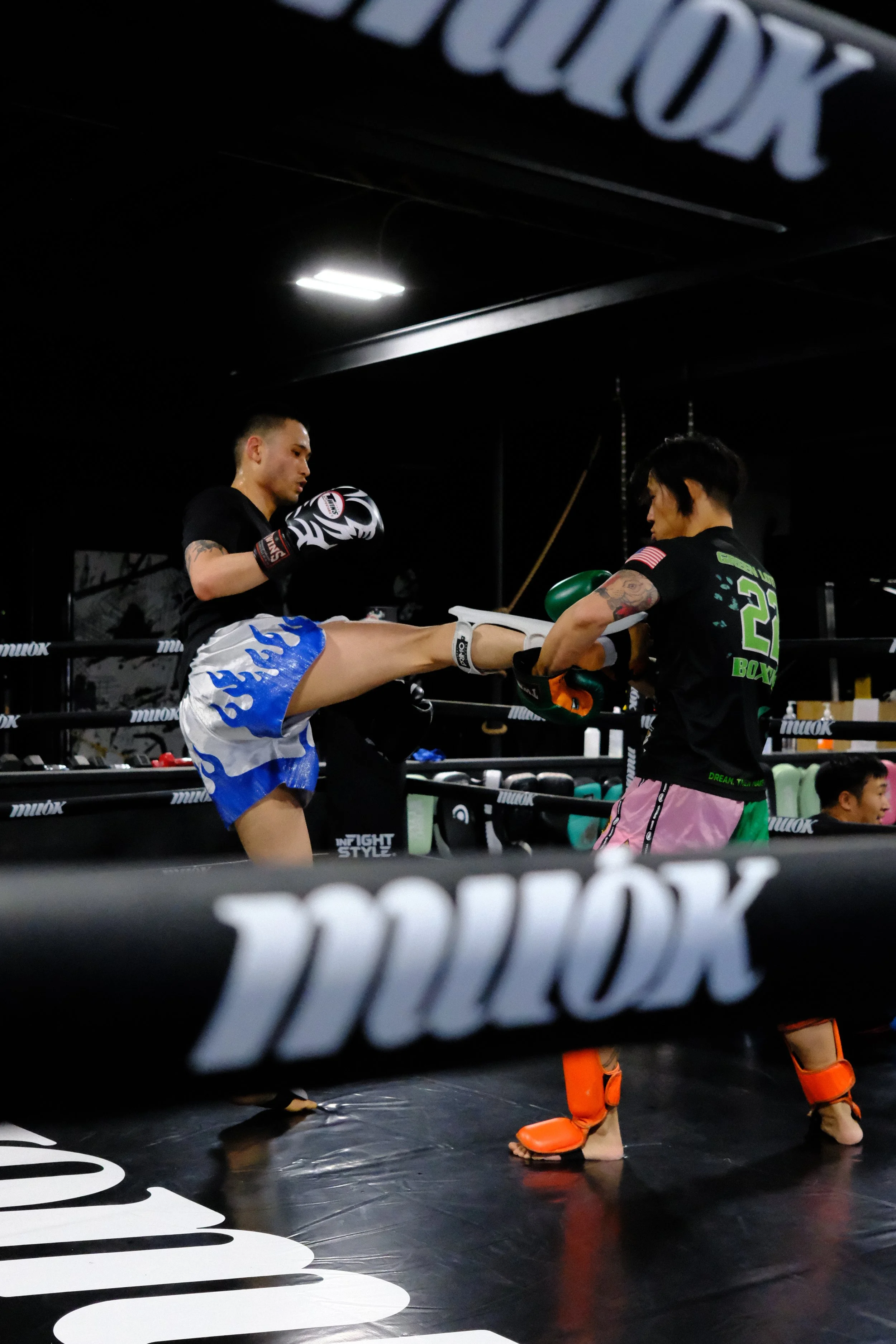
Here's the sentence we hear most often from people calling about a trial class: "I want to start, but I need to get in shape first." It sounds sensible. It is also, respectfully, backwards — and it keeps more people off the mats than any injury, any schedule conflict, any fear of getting hit.
You do not get in shape to start Muay Thai. You start Muay Thai, and getting in shape is what happens while you're busy learning to kick. Every conditioned person you'd see in our gym arrived less conditioned. The class is the machine that does the converting; showing up already converted defeats the point of the machine.
With that settled, here's everything else: what your first class actually involves, what you need to buy (less than you think), and what the first month of progress genuinely feels like.
Most first-class anxiety is just the unknown. So here's the whole thing, demystified:
Awkward is not a sign you're behind. Awkward is the entry fee, and everyone pays it.
Beginner gear anxiety is a solved problem, and the solution is: don't buy anything before your first class. Here's the honest shopping list, sequenced by when you'll actually need it:
- Athletic clothes you already own — shorts or leggings, t-shirt
- Water bottle. Non-negotiable; you will drain it
- Loaner gloves — most gyms, ours included, have them for trials
- That's it. Genuinely.
- Your own gloves — 14–16 oz for training; ask a coach before buying, sizing matters
- Hand wraps — $10–15, protect twenty-seven small bones you'd miss
- Muay Thai shorts — when you want them; the wide cut exists for kicks, not fashion
- Shin guards — only when you start partner drills with contact, months away
Progress in month one is real but it's not linear, and it doesn't look like the movies. Here's the shape of it:
Two classes a week is the honest minimum for progress; three is the sweet spot. Once a week keeps you moving but everything stays perpetually new, which is discouraging. If your schedule only allows one, come anyway — but if you can find the second session, the whole first-month arc above accelerates and the frustrating phase shortens. Consistency beats intensity here by a mile.
"Will I get hit?" Not in beginner training. Sparring is a separate, opt-in thing that arrives months down the line, if you want it, at intensities a coach controls. Plenty of longtime members never spar and are entirely welcome. (More on how we think about risk in "Is Muay Thai Dangerous?")
"Am I too old / too unfit / too uncoordinated?" Our members run from students to people in their fifties, and the "too unfit" concern is the one this whole article opened by dismantling. Coordination is trained, not innate — nobody arrives with a Muay Thai-shaped nervous system. If the age question is the one keeping you up, we wrote a whole piece on it.
"Will everyone be watching me?" No, and this one's worth internalizing: everyone in that room is managing their own fatigue, their own technique, their own round. The beginner's spotlight is imaginary. The actual social experience of a Muay Thai gym is people quietly rooting for the new person, because every single one of them was the new person.
"What if I have an old injury?" Tell the coach before class — it changes nothing about your welcome and everything about how we scale things for you. We're unusually well set up for this: our building also houses Root Physical Therapy, and two of their Doctors of Physical Therapy coach Muay Thai here. Starting a combat sport with a cranky shoulder is a very solvable problem when the clinic is down the hall.
The gap between the people who train Muay Thai and the people who want to is not fitness, age, or talent. It's one booked class. Every member you'd be intimidated by walked in exactly once, knowing exactly nothing, feeling exactly what you're feeling. The first class is the whole barrier. After that, it's just training.
- Don't get in shape first. The class is what gets you in shape — that's its job.
- First class: warm-up, technique, pad work, conditioning. No sparring, no getting hit, no surprises.
- Buy nothing yet. Loaner gloves exist. Real list: gloves, wraps, shorts — under $100, spread over a month.
- Week two soreness is the quitting trap. It's adaptation, it fades, and knowing it's coming defuses it.
- Two classes a week minimum, three ideal. Consistency beats intensity.
- Nobody is watching you. They're all too tired.
- Old injuries aren't disqualifiers — tell a coach, and remember there's a PT clinic in our building.
The first class
is the whole barrier.
Come try a free class at Muók — traditional Muay Thai in Georgetown, Seattle, taught from zero. Loaner gloves provided. Awkwardness expected and welcomed.