HOW TO IMPROVE YOUR CLINCH GAME
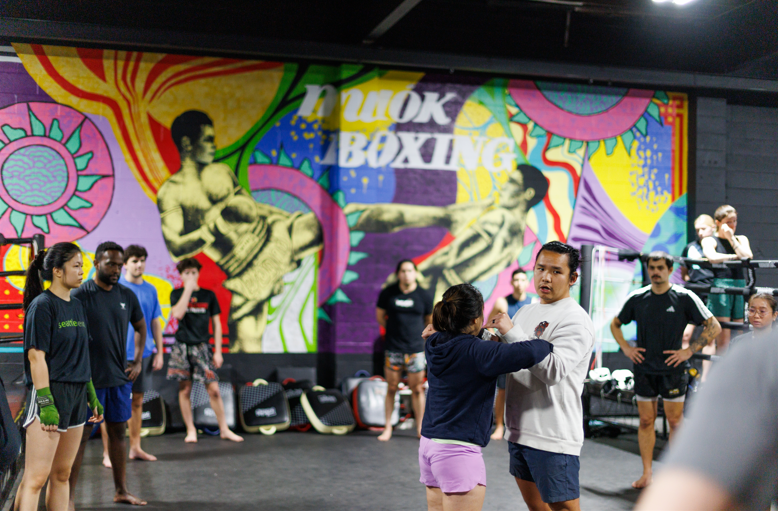
If you've been training Muay Thai for any amount of time, you've probably noticed something: the clinch separates people who've trained the art seriously from those who haven't.
A kickboxer can look sharp on the outside — good combinations, decent footwork, solid defense. But the moment the fight moves into close range, everything changes. If you haven't trained the clinch, you're suddenly lost. Arms tangled, hips weak, no idea where your knees should be going.
The clinch is where Muay Thai diverges completely from every other striking art. It's also where some of the most technical, beautiful, and effective work in the entire sport happens. And for most practitioners outside of Thailand, it's the most underdeveloped part of their game.
Why Most Practitioners Neglect the Clinch
In most Western gyms, clinch work gets maybe five to ten minutes at the end of class — if it gets trained at all. Pad work, bag work, and sparring tend to dominate. The clinch is treated as something to survive, not something to develop.
This is backwards.
"In Thailand, fighters spend enormous amounts of time in the clinch. Lumpinee bouts regularly feature extended clinch exchanges lasting thirty seconds or more. Judges score it. Coaches teach it in detail. It's considered a core technical domain — not an inconvenience."
The result is that Thai fighters are almost universally superior in the clinch to their Western counterparts — not because of physical gifts, but because of deliberate, repeated practice over years. If you want to be technically complete in Muay Thai, the clinch has to be part of your regular training diet.
The Foundation: Posture and Head Position
Everything in the clinch starts with posture. Before you think about grips, sweeps, or knees, you need to understand what a strong clinch position feels like.
Your hips are your engine
In the clinch, power comes from the hips — not the arms. Fighters who try to muscle through clinch exchanges using upper body strength exhaust quickly and are easy to off-balance. Fighters who stay hip-connected to their opponent, maintain a low center of gravity, and use hip rotation to generate movement and power are the ones who control exchanges.
Your head position determines your control
Where your head goes, your body follows — and so does your opponent's. In the clinch, your head should be slightly forward and low, making contact with your opponent's shoulder or upper chest. This position controls the range, makes it harder for your opponent to create space for elbows, and allows you to feel their weight shifts in real time.
Knees bent, weight forward
A stiff, upright posture in the clinch is easy to manipulate. Bent knees lower your center of gravity, make you harder to sweep, and allow you to react dynamically to whatever your opponent is doing.
Understanding the Grips
The clinch isn't one position — it's a constantly shifting exchange of grips, each with different offensive and defensive implications.
Double collar tie (the neck lock)
Both hands grip the back of the opponent's neck, elbows in tight, forehead to shoulder. From here, you control the direction of their head, which controls their entire body. To make it effective, your elbows need to be pressing together — not flaring out. Flared elbows create space and allow your opponent to push out. Tight elbows create a frame that compresses the opponent's head and sets up knee strikes.
The single collar tie
One hand on the neck, one hand free. This is a transitional position — less controlling than the double, but more dynamic. The free hand can post on the hip, throw a short elbow, or reach for a sweep. Learning to fight for the double — and to deny it to your opponent — from the single is an essential skill.
The crossface
One forearm across your opponent's face, the other arm working their neck or shoulder. The crossface creates leverage to turn your opponent's head, which disrupts their posture and creates openings. It's particularly useful when your opponent has a strong base and you can't off-balance them directly.
The Knee Game: More Than Straight Knees
Most beginners think of clinch knees as straight strikes coming up the middle. That's one tool, but a limited one.
Straight knee to the body
The most fundamental clinch strike. Pull your opponent's head down while driving your knee into their midsection. The pull and the strike happen simultaneously — the opponent's movement into your knee magnifies the impact. Common mistake: letting go of the neck as you throw. Keep the grip tight through the strike to maintain control.
Diagonal knee
Instead of coming straight up the center, the diagonal knee travels at an angle — targeting the floating ribs, hip, or outer thigh. This is harder to check and harder to anticipate than the straight knee. The diagonal requires good hip rotation to generate power. Practice it slowly before adding speed.
Knee feints
The feint is one of the most underused tools in the clinch. By initiating the hip and pulling motion of a knee without following through, you create a reaction in your opponent. That reaction is information you can use — and it sets up the real knee to land clean.
"The best clinch fighters aren't the ones who feel comfortable because nothing is happening. They're the ones who've been in every uncomfortable situation enough times that none of it surprises them anymore."
Off-Balancing: Taking the Base
Push-pull combinations
The most basic off-balancing tool. Push your opponent away, then immediately pull them back as they resist. The moment they push back is when they're most vulnerable. The timing has to happen at the peak of their resistance — the pull has to become instinctive through drilling.
Rotating the opponent
Using your collar tie to rotate your opponent's head creates angles. When you rotate someone ninety degrees, their hips are no longer square to you, their guard is disrupted, and a well-timed knee can land on an unguarded target. Practice rotating in both directions — most people have a dominant side.
How to Actually Drill It
Isolated grip fighting
Start from neutral and simply compete for grips — no knees, no sweeps. Just the hand fighting. This builds sensitivity, timing, and the habit of constantly working for position. Five minutes of focused grip fighting reveals exactly where your clinch game is weakest.
Slow clinch sparring
The clinch slows down when you go slow, which means you can feel things you'd miss at full speed. Emphasize posture, head position, hip connection, and the mechanics of off-balancing. Slow clinch sparring is where concepts become embodied understanding.
Knee counting drills
Practice throwing a set number of knees — say, three — while staying in the clinch without resetting. This forces you to maintain your grip and position through multiple strikes. Most beginners reset after one knee; elite clinch fighters throw in long, controlled sequences.
The Mental Game
The clinch is uncomfortable. It's physically close, it's tiring, and when you're in there with someone stronger or more experienced, it can feel suffocating. A lot of practitioners — consciously or not — avoid the clinch because of this discomfort.
The problem is that avoidance reinforces the discomfort. Every time you disengage instead of working through it, you're training your nervous system to associate the clinch with danger and escape rather than opportunity.
The solution is deliberate exposure. Spend more time in the clinch than feels comfortable. Let yourself be in bad positions and work out of them. Over time, the discomfort fades — and what's left is clarity.
- 17 classes per week including dedicated clinch sessions
- Coaches with Thailand training and competition experience
- 9,000+ sq ft facility in Georgetown, open gym 7am–8pm
- Month-to-month memberships — no contracts, no enrollment fees