Muay Thai vs Kickboxing — what's actually different, and which one you want.
Muay Thai vs Kickboxing —
what's actually different, and which one you want.
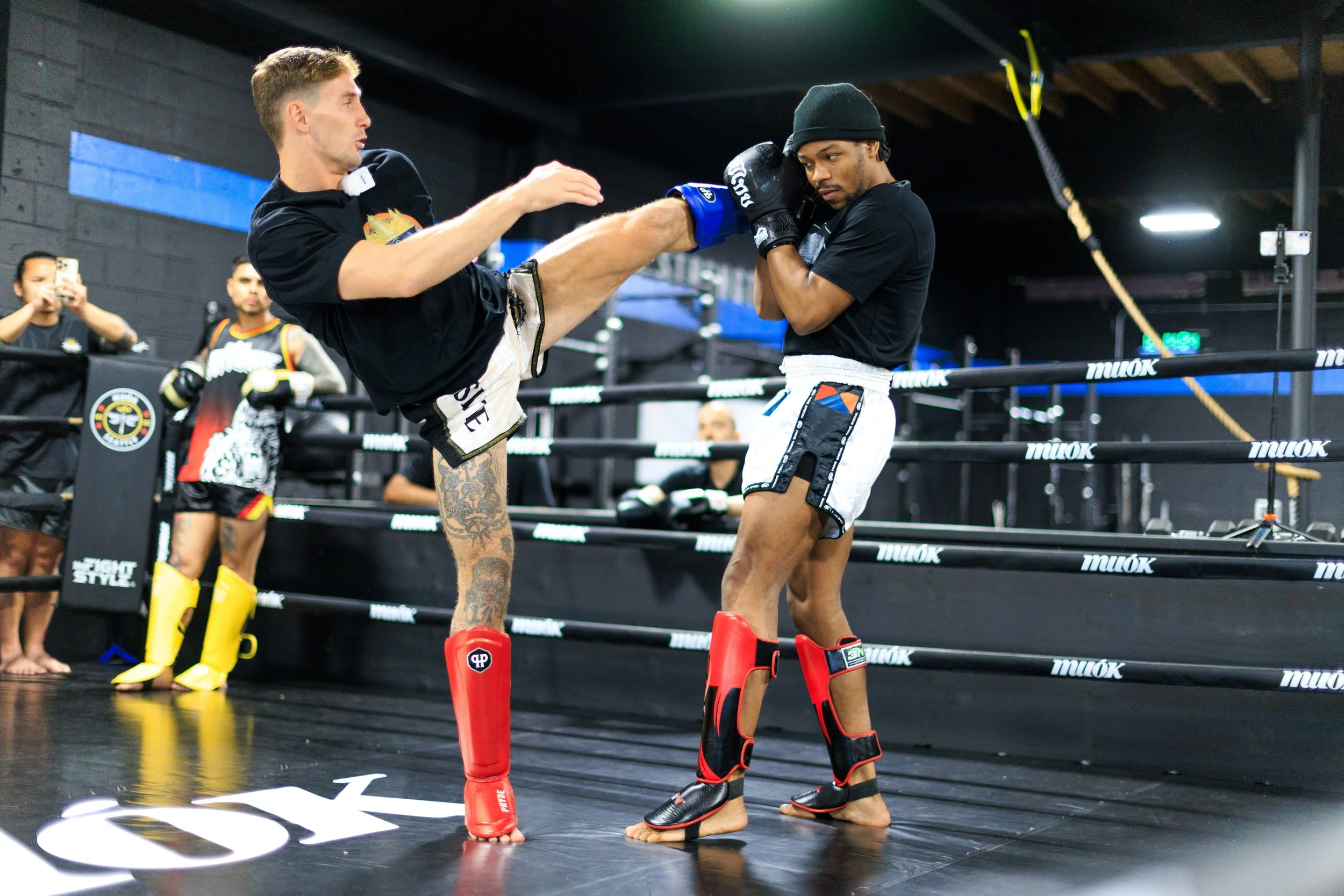
Start with the family tree, because it explains everything. Kickboxing isn't Muay Thai's rival — it's Muay Thai's descendant. In the 1960s, Japanese promoters took Muay Thai, removed the parts that were hard to score and hard to watch as a fast-paced spectacle — chiefly the clinch and the elbows — and blended what remained with karate. American kickboxing followed in the 70s and trimmed further, for years not even allowing kicks below the waist.
So when people ask "what's the difference," the compact answer is: kickboxing is a simplification of Muay Thai, built for a different kind of contest. That's not an insult — simplification created a fast, technical, hugely watchable sport. But it means the honest comparison isn't between two equal siblings. It's between an art and its edit.
Muay Thai is called the art of eight limbs: two fists, two elbows, two knees, two shins. Kickboxing, depending on the ruleset, fights with four to six — punches and kicks, sometimes knees, almost never elbows, and no sustained clinch.
Now notice what the removed pieces have in common. The clinch, the elbows, the sweeps — they're the close-range game. Kickboxing keeps everything that happens at punching and kicking distance and deletes nearly everything that happens when two bodies collide. Which is precisely the range where real altercations, and the most interesting technical problems, tend to live.
Kickboxing keeps the long range and deletes the collision. Muay Thai is what happens when nobody deletes anything.
Put a Muay Thai fight and a kickboxing fight side by side and three differences jump out fast:
The teep. Muay Thai's push kick is a constant — a jab for the leg, managing distance, disrupting rhythm, scoring by off-balancing. Kickboxing uses front kicks, but not as the ever-present range-management tool the teep is. Watch a Thai fight for one round and count the teeps; it recalibrates how you see the whole sport.
The stance and rhythm. Thai fighters stand tall and square, weight back, lead leg light — built to check kicks and fire knees. Kickboxers are typically more bladed and bouncier, borrowing footwork from boxing and karate, built for angles and combinations. Neither is wrong; they're answers to different rulesets.
What happens on a caught kick. In Muay Thai, catching a kick opens a small buffet — sweep the standing leg, run your opponent across the ring, return fire while they hop. In most kickboxing, the catch is a brief interruption before a reset. Same moment, completely different consequences — and it changes how bravely people kick.
One more distinction matters when you're choosing a gym, because in the US the word "kickboxing" is doing triple duty. There's kickboxing the combat sport (everything above). There's cardio kickboxing — a fitness format that borrows the movements for a group workout, with no partner work, no technical curriculum, and no intention of teaching you to actually fight. And there's Muay Thai. All three get marketed under overlapping names, which is how people end up six months into a "kickboxing" program that never taught them to hold their hands up under pressure.
None of these is a scam — a cardio kickboxing class is a perfectly good workout. But know which product you're buying. We wrote a separate guide to decoding this in Seattle specifically: "Kickboxing Classes in Seattle — and the one question to ask before you book."
Kickboxing's hands are often better. Because the ruleset leans on punch combinations, and because the Dutch style in particular fused Muay Thai with Western boxing, high-level kickboxers frequently out-box high-level Thai fighters in pure hand exchanges. The pace is relentless, the footwork is sophisticated, and some of the greatest strikers alive built their base in K-1 rings. If a great kickboxing gym is what's near you, you will learn real, pressure-tested striking there. This isn't a "real vs fake" divide — it's a complete art versus a brilliantly optimized subset.
Here's our honest framework, and note that it mostly isn't about which art is "better":
Choose based on the gym, not the label. A great kickboxing gym beats a mediocre Muay Thai gym every single time. Coaching quality, culture, and safety standards matter more than the style on the sign.
But given two good gyms — start with the complete art. This is the same argument we made in "The Two Muay Thais": train the full system and every subset is available to you later. A Muay Thai student can walk into a kickboxing ruleset and simply not use elbows. A kickboxer entering the clinch for the first time is starting a new sport at zero. Foundations should be built on the widest base available.
And there's the culture. Muay Thai comes with a lineage — the wai kru, the respect for teachers, a tradition that's centuries deep. Some people just want a workout, and that's fine. But if part of what draws you to martial arts is belonging to something older than a franchise, that's a real difference between the two, and only one of them has it.
We teach Muay Thai because we'd rather hand you the whole toolbox and let you choose your tools than pre-choose them for you. But the honest version of this article's conclusion is one sentence: the best striking art is the one taught well, near you, at a gym you'll still be walking into two years from now. If that's us, come find out.
- Kickboxing descends from Muay Thai — 1960s Japan, edited with karate, elbows and clinch removed.
- Eight limbs vs four-to-six. Muay Thai adds elbows, knees, sweeps, and a full clinch game.
- What's missing from kickboxing is the close range — exactly where collisions actually happen.
- Kickboxing's strengths are real: often superior boxing, relentless pace, sophisticated footwork.
- "Kickboxing" in the US also means cardio kickboxing — a fitness class, not a martial art. Know which you're buying.
- Pick the gym first, the style second. Given two good gyms, start with the complete art.
Learn all eight limbs.
Traditional Muay Thai in Georgetown, Seattle — elbows, knees, clinch, and culture included from the ground up. Come feel the difference in a free class.
- On the origins of Japanese kickboxing from Muay Thai and karate in the 1960s: widely documented in histories of K-1 and Japanese kickboxing promotion.
- Muók Boxing. The Two Muay Thais — traditional vs entertainment rulesets. 2026. (Companion piece on rules and scoring within Muay Thai itself.)